|
Preliminary Examination
History, Art & Culture
Mains Examination
GS Paper-I: Study of the major aspects of art, literature, and architecture from ancient to modern times within Indian culture.
|
Why in the News ?
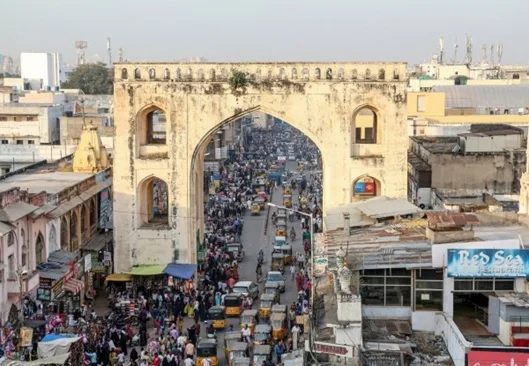
The Telangana government has announced the restoration of Hyderabad's historic Char Kaman. The government has granted administrative approval for the project and will soon issue a tender and appoint an expert consultant. The aim is to preserve the original architecture of these historic gates while protecting their structure.
What is Char Kaman ?
- Char Kaman is a group of four grand ornamental gateways surrounding Hyderabad's famous Charminar. They were built during the Qutb Shahi period as entrances to the old city of Hyderabad.
- A large square and garden, called Char Kaman, was built at the entrance to the Qutb Shahi palace complex, located north of the Charminar. A beautiful water fountain called Gulzar Houz (Char-Su-Ka-Houz) was located in its center.
The Four Gates of Char Kaman
- The four gates are located on the four sides of Gulzar Hauz:
- North: Machli Kaman
- South: Charminar Kaman
- East: Kali Kaman
- West: Sher-e-Batil ki Kaman
- Three stories were built on either side of each Kaman, which served as quarters for the royal soldiers and security personnel.
History of Char Kaman
- Charminar was built by Muhammad Quli Qutb Shah, the fifth ruler of the Qutb Shahi dynasty, between 1589–1591.
- According to historians, Char Kaman was built around 1594, a few years after the construction of Charminar.
- Its purpose was to grand the entrance to the royal palace complex and to create a large public square for administrative activities.
The original names of the four arches
At the time of construction, these gates had different names than they do today.
|
Direction
|
Original Name
|
Meaning / Significance
|
|
West Arch
|
Daulat Khana-e-Ali
|
Gateway to the Royal Residence
|
|
East Arch
|
Naqqar Khana
|
Gateway of the Royal Drums (where ceremonial drums were played)
|
|
Central Enclosure
|
Jilau Khana
|
Royal Vestibule (Forecourt of the Royal Palace)
|
How did they get their current names?
- Over time, the names of these gates changed, and today they are known by the following names:
- Machhli Kaman (North): A giant fish made of bamboo and paper was hung here on the occasion of the Lunar New Year.
- Charminar Kaman (South): This name is derived from its location facing the Charminar.
- Kali Kaman (East): It is also known as Shambhu Prasad's Kaman.
- Sher-e-Batil Kaman (West): It is believed to mean "Gate of the Lionhearted" or "Gate that Destroys Evil."
Historical Significance of the Char Kaman
- During the Qutb Shahi period, the Char Kaman was not only a gateway but also a major center of administrative activity.
- Royal officials and nobles visited here daily.
- Officials would leave their attendants in the royal courtyard located between the four gates and would go alone to meet the king.
- This area was the main entrance to the royal palace complex.
What will the restoration plan include?
- Under the government's proposed project:
- Historic structures will be repaired.
- Damaged areas will be conserved.
- Original architecture and heritage features will be preserved.
- Efforts will be made to repair damage caused by pollution and urbanization.
Significance of Char Kaman
- An excellent example of Qutb Shahi architecture.
- A historical landmark of the Charminar complex.
- An important part of Hyderabad's cultural heritage.
- An excellent example of medieval urban planning and architecture in India.
- A monument of immense importance from the perspective of tourism and heritage conservation.
Conclusion
The Char Kaman are not just four gateways, but a precious relic of Hyderabad's glorious history, Qutub Shahi architecture, and urban planning. The Telangana government's restoration plan will significantly help preserve these historical monuments and safeguard their legacy for future generations.
Preliminary Exam Questions
Question: Consider the following statements regarding the historic Char Kaman in Hyderabad:
- Char Kaman was built during the reign of Muhammad Quli Qutb Shah, ruler of the Qutb Shahi dynasty.
- Char Kaman is a group of four decorative gateways surrounding the Charminar.
- Gulzar Houz (Char-Su-Ka-Houz), located between the four Kaman, is a historic water fountain.
- Char Kaman was built during the Nizam rule.
Which of the above statements are correct?
-
1, 2, and 3 only
-
2 and 4 only
-
1 and 4 only
-
1, 2, 3, and 4
Mains Question
"Char Kaman is an important example of Hyderabad's Qutb Shahi architecture and medieval urban planning." In the context of this statement, discuss the historical significance of Char Kaman, its architectural features, and the need for its conservation. (250 words)
|
FAQs (Frequently Asked Questions)
1. What is Char Kaman?
Answer: Char Kaman is a group of four historic ornamental gateways located around the Charminar in Hyderabad, built during the Qutb Shahi period.
2. Who built Char Kaman?
Answer: Char Kaman was built around 1594 AD during the reign of Muhammad Quli Qutb Shah, the fifth ruler of the Qutb Shahi dynasty.
3. What are the four gates of Char Kaman?
Answer: The four gates of Char Kaman are:
- Machli Kaman
- Charminar Kaman
- Kali Kaman
- Sher-e-Batil Kaman
4. What is the historical significance of Char Kaman?
Answer: Char Kaman represents Qutb Shahi architecture, medieval urban planning, and the main entrances to the royal palace complex of Hyderabad. It was also an important center of administrative and cultural activities.
5. What is the purpose of the restoration of the Char Kaman?
Answer: The purpose of the restoration is to preserve the heritage of these historic gates by structurally repairing them, preserving their original architecture, and repairing the damage caused by urbanization and pollution.
|







 Contact Us
  New Batch : 9555124124/ 7428085757
  Tech Support : 9555124124/ 7428085757