Prelims: Small Modular Reactors (SMRs), Bhabha Atomic Research Centre (BARC), Department of Atomic Energy, Andaman and Nicobar Islands, Great Nicobar Project, Galathea Bay, Strait of Malacca
Mains: GS Paper 2: Government Policies and Strategic Infrastructure GS Paper 3 Energy Security, Nuclear Technology, Infrastructure and Environment
Keywords: Small Modular Reactors, BARC, Department of Atomic Energy, Andaman and Nicobar Islands, Great Nicobar Island, Galathea Bay, Strait of Malacca, INS Baaz, Nuclear Energy, Energy Security, Indo-Pacific |
Why in News?
- The Bhabha Atomic Research Centre (BARC) has undertaken an assessment of potential sites in the Andaman and Nicobar Islands for the deployment of Small Modular Reactors (SMRs).
- The five-day assessment is being conducted from 4 to 8 September 2026.
- Potential sites across all three districts of the Union Territory are being examined.
- The move comes amid expectations of rising electricity demand due to major infrastructure development in the islands.
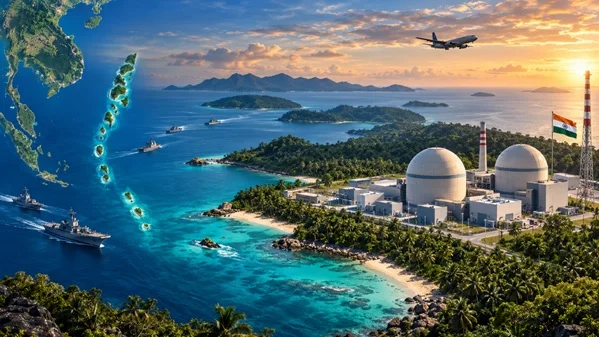
Background
- The Andaman and Nicobar Islands currently depend heavily on diesel generator sets for electricity generation.
- Diesel fuel has to be transported from mainland India, increasing transportation costs and supply dependence.
- Earlier proposals involving offshore LNG regasification and geothermal energy have not become operationally viable.
- Growing infrastructure development, particularly in Great Nicobar, is expected to increase the need for reliable electricity.
- Small Modular Reactors are therefore being explored as a possible long-term energy option for the islands.
What are Small Modular Reactors?
- Small Modular Reactors are advanced nuclear reactors with a smaller power capacity than conventional large nuclear reactors.
- They are designed around modular construction, allowing major components to be manufactured separately and assembled at the proposed location.
- Their smaller size makes them potentially suitable for remote and geographically isolated regions.
- SMRs can provide continuous electricity and are being considered by several countries as part of future low-carbon energy systems.
Key Features of Small Modular Reactors
- Smaller Size: SMRs have a lower generation capacity and generally require less land than large conventional nuclear power plants.
- Modular Construction: Major reactor components can potentially be manufactured in factories and transported to the site for installation.
- Flexible Deployment: They can be considered for remote regions, islands and areas where very large nuclear power plants may not be suitable.
- Reliable Electricity: Nuclear reactors can provide continuous electricity without depending on weather conditions.
- Low-Carbon Energy: Nuclear power produces very low operational carbon emissions and can support clean-energy goals.
Energy Profile of Andaman and Nicobar Islands
- The islands are geographically separated from India's mainland electricity grid.
- Electricity generation depends significantly on diesel-based systems.
- Fuel transportation from mainland India creates logistical and economic challenges.
- Renewable energy is being expanded, but reliable round-the-clock electricity remains important for major infrastructure.
- The proposed SMRs are being examined in the context of future electricity requirements.
Great Nicobar Project
The proposed nuclear power initiative is significant because of the development planned under the Great Nicobar Island Project.
Major components include:
- International Container Transhipment Terminal at Galathea Bay
- Greenfield international airport
- Township development
- Associated power infrastructure
- Connectivity and supporting infrastructure
These projects are expected to substantially increase electricity demand on Great Nicobar Island.
Strategic Importance of Andaman and Nicobar Islands
- The Andaman and Nicobar Islands occupy an important position in the eastern Indian Ocean.
- They are located close to major international shipping routes connecting the Indian Ocean with Southeast Asia.
- Their proximity to the Strait of Malacca increases their maritime importance.
- The islands support India's wider security and connectivity interests in the Indo-Pacific region.
- Development of reliable infrastructure in the islands is therefore important from both civilian and strategic perspectives.
Strait of Malacca
- The Strait of Malacca lies between the Malay Peninsula and the Indonesian island of Sumatra.
- It is one of the world's most important maritime chokepoints.
- It provides a major shipping route between the Indian Ocean and the South China Sea.
- A significant amount of international trade and energy transportation passes through the region.
- The Andaman and Nicobar Islands are strategically located near the western approaches to this important maritime route.
INS Baaz
- INS Baaz is a naval air station located at Campbell Bay on Great Nicobar Island.
- It was commissioned in 2012.
- It is India's southernmost naval air station.
- Its location is important for monitoring maritime activity around the Six Degree Channel and approaches towards the Strait of Malacca.
Significance
- Energy Security: SMRs could help reduce the islands' dependence on diesel fuel transported from mainland India.
- Reliable Power Supply: They could provide continuous electricity for critical civilian infrastructure and growing urban requirements.
- Infrastructure Development: Reliable electricity would support the port, airport, township and other infrastructure planned under the Great Nicobar Project.
- Strategic Importance: Improved energy infrastructure can strengthen India's presence and capabilities in the strategically important island territory.
- Clean Energy: Nuclear energy can provide low-carbon electricity and complement renewable energy sources.
- Technological Development: Deployment of SMRs could help India gain operational experience with emerging nuclear reactor technologies.
Way Forward
- Conduct comprehensive seismic and environmental assessments before finalising any reactor site.
- Establish strong nuclear safety and disaster-management mechanisms.
- Ensure that infrastructure development does not cause irreversible ecological damage.
Conclusion
- The exploration of Small Modular Reactors in the Andaman and Nicobar Islands reflects India's effort to find reliable long-term energy solutions for remote regions. Growing electricity requirements associated with the Great Nicobar Project have increased the need for dependable power infrastructure.
- However, the ecological sensitivity and seismic vulnerability of the islands make safety and environmental assessment particularly important. Any future deployment of SMRs will therefore require a careful balance between energy requirements, strategic infrastructure, environmental protection and nuclear safety.
Prelims MCQs
Q1. Small Modular Reactors (SMRs) are best described as:
(a) Nuclear reactors designed exclusively for submarines
(b) Smaller nuclear reactors designed with modular construction
(c) Fusion reactors used for electricity generation
(d) Nuclear reactors without radioactive fuel
Mains Question
Discuss the significance of Small Modular Reactors for meeting the energy requirements of remote and strategically important regions such as the Andaman and Nicobar Islands. Also examine the environmental and safety challenges associated with their deployment.
|
FAQs
What are Small Modular Reactors?
Small Modular Reactors are relatively small nuclear reactors designed around modular construction and flexible deployment.
Why are SMRs being considered for Andaman and Nicobar Islands?
They are being explored to meet growing electricity demand and reduce dependence on diesel-based power generation.
Which organisation is assessing potential SMR sites?
The Bhabha Atomic Research Centre under the Department of Atomic Energy is assessing potential sites.
Why is Great Nicobar Island important?
It is strategically located near important international shipping routes and is the site of major proposed port, airport and infrastructure projects.
What is the importance of the Strait of Malacca?
It is a major maritime chokepoint connecting the Indian Ocean with the South China Sea and is important for global trade and energy transportation.
|







 Contact Us
  New Batch : 9555124124/ 7428085757
  Tech Support : 9555124124/ 7428085757