Keywords
UNSC, SHANTI, Global South, Multilateralism, Veto Power, UNGA, Peacekeeping, Maritime Security, G4, L.69 Group, OIC, Rules-Based Order, Global Governance, Strategic Autonomy, UNSC Reform.
Prelims
UNSC, UNGA, P5, Non-Permanent Members, Veto Power, Asia-Pacific Group, OIC, UNSC Elections.
Mains
GS-II : UNSC Reforms, Global Governance, India's Permanent Membership, Global South, Multilateralism, India's Foreign Policy.
|
Why in News ?
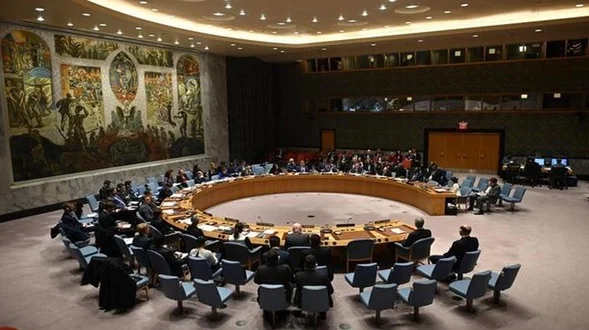
External Affairs Minister Dr. S. Jaishankar officially launched India's campaign for election as a Non-Permanent Member of the United Nations Security Council (UNSC) for the 2028–29 term at the UN Headquarters in New York on 13 July 2026. The election will be held in June 2027, where India and Tajikistan will compete for the sole Asia-Pacific Group seat.
Key Highlights
- India has officially launched its campaign for the 2028–29 UNSC non-permanent seat.
- Elections will be conducted by the United Nations General Assembly (UNGA) in June 2027.
- India is contesting against Tajikistan for the Asia-Pacific Group seat.
- The campaign is based on the vision of SHANTI (Securing Holistic Advancement through Norms, Trust and Integrity).
- India has pledged to work towards :
- Peace and international security
- Reform of global governance institutions
- Greater representation for the Global South
- Maritime security
- Responsible technology governance
- Effective UN peacekeeping
- The campaign comes amid major geopolitical crises, including the Russia–Ukraine war, the Gaza conflict and heightened tensions in West Asia.
India's Vision: SHANTI
India's campaign is based on the concept of SHANTI, which stands for :
|
Letter
|
Meaning
|
|
S
|
Securing
|
|
H
|
Holistic
|
|
A
|
Advancement
|
|
N
|
Norms
|
|
T
|
Trust
|
|
I
|
Integrity
|
What is the United Nations Security Council (UNSC) ?
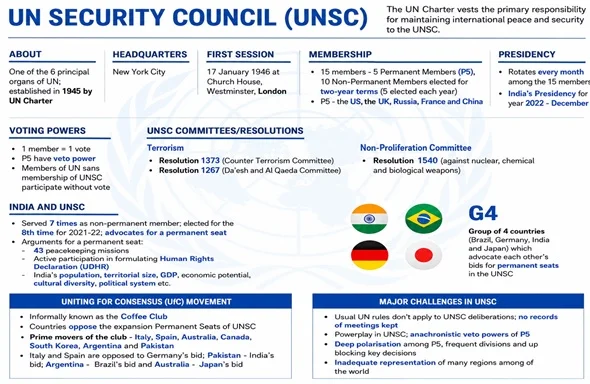
- The United Nations Security Council (UNSC) is one of the six principal organs of the United Nations, established under the UN Charter in 1945. It bears the primary responsibility for maintaining international peace and security.
- The resolutions of the UN General Assembly, Security Council resolutions adopted under the UN Charter are legally binding on all UN member states.
- The Council performs several critical functions, including preventing armed conflicts, authorising peacekeeping operations, imposing economic sanctions, recommending the appointment of the UN Secretary-General, approving the admission of new UN members and, when necessary, authorising the use of military force to restore international peace.
Composition of the UNSC
The Security Council consists of 15 members :
|
Category
|
Number
|
|
Permanent Members (P5)
|
5
|
|
Non-Permanent Members
|
10
|
|
Total Members
|
15
|
Permanent Members (P5)
The five permanent members are :
- United States
- Russia
- China
- United Kingdom
- France
These countries possess the veto power, allowing any one of them to block a substantive Security Council resolution regardless of the level of international support.
Non-Permanent Members
The remaining 10 members are elected by the UN General Assembly for a two-year term through a secret ballot. A candidate must secure a two-thirds majority of members present and voting. Non-permanent members do not possess veto power.
Regional Distribution of Non-Permanent Seats
|
Region
|
Seats
|
|
Africa
|
3
|
|
Asia-Pacific
|
2
|
|
Latin America & Caribbean
|
2
|
|
Western Europe & Others
|
2
|
|
Eastern Europe
|
1
|
India's Journey in the UNSC
India has previously served as a Non-Permanent Member of the UNSC eight times—in 1950–51, 1967–68, 1972–73, 1977–78, 1984–85, 1991–92, 2011–12 and 2021–22. If elected, 2028–29 will become India's ninth tenure in the Security Council.
During its previous terms, India consistently focused on counter-terrorism, maritime security, UN peacekeeping reforms, women-led peacebuilding, development-oriented security and reform of multilateral institutions. India has also remained one of the largest troop contributors to UN Peacekeeping Operations.
India's Vision for the 2028–29 Term
India's campaign is centred on the concept of SHANTI – Securing Holistic Advancement through Norms, Trust and Integrity.
Through this vision, India seeks to promote :
- A peaceful and rules-based international order.
- Greater participation of developing countries in global decision-making.
- Strengthened multilateral institutions capable of addressing contemporary challenges.
- Responsible governance of emerging technologies such as Artificial Intelligence.
- Secure oceans and uninterrupted maritime trade routes.
- Stronger international cooperation against terrorism.
India has emphasised that multilateral institutions must evolve to reflect 21st-century geopolitical realities rather than the power structure of 1945.
Key Priorities for India's UNSC Campaign
India's candidature is not limited to winning a seat but also reflects its aspiration to shape global governance.
- First, India aims to strengthen the voice of the Global South by advocating issues such as food security, energy security, climate justice, development financing and equitable access to technology.
- Second, India will continue to push for comprehensive reforms of the United Nations Security Council, arguing that emerging powers and underrepresented regions deserve greater participation in international decision-making.
- Third, India seeks to improve the effectiveness of UN Peacekeeping Operations through better training, technology, protection of peacekeepers and greater participation of women.
- Fourth, India intends to promote maritime security, freedom of navigation and secure sea lanes, recognising that global trade and energy supplies depend heavily on safe maritime routes.
- Finally, India aims to promote responsible use of emerging technologies by encouraging international cooperation on Artificial Intelligence, cyber security and digital governance.
Key Issues and Challenges for India's Bid
- Strong Electoral Competition : India enjoys widespread international goodwill, but the election will be closely contested rather than uncontested.
- Challenge from Tajikistan : India is competing with Tajikistan for the only Asia-Pacific Group seat in the 2028–29 UNSC election.
- Possible OIC Support for Tajikistan : Tajikistan is expected to receive support from several members of the Organisation of Islamic Cooperation (OIC), making the electoral contest more competitive.
- Need for Wider Diplomatic Outreach : India must strengthen diplomatic engagement with countries across Africa, Latin America, the Caribbean, Pacific Island States and Europe to secure the required two-thirds majority in the UN General Assembly.
- Active Foreign Policy Engagement : Recent visits by the External Affairs Minister to the Gulf region and other strategic partners reflect India's efforts to build broader international support ahead of the election.
- Complex Global Environment : The election will be held amid major geopolitical challenges, including the Russia–Ukraine conflict, the Gaza crisis, Iran–Israel tensions, supply chain disruptions and maritime security concerns, highlighting the need for a more effective and representative UNSC.
Why Does India Seek Permanent Membership ?
India has consistently argued that it deserves permanent membership because it is :
- The world's largest democracy.
- The world's most populous country.
- One of the fastest-growing major economies.
- A founding member of several important multilateral initiatives.
- One of the largest contributors to UN Peacekeeping Missions.
- A responsible nuclear power with a strong record on international law.
- A leading representative of the Global South.
India is also a member of the G4 Group (India, Brazil, Germany and Japan), which advocates expansion of both permanent and non-permanent seats in the Security Council. India has additionally worked with the L.69 Group to build support for comprehensive UN reforms.
Challenges before the UNSC
- Despite being the world's premier security body, the Security Council faces several structural challenges.
- The Council's composition no longer reflects present-day geopolitical realities. Africa, despite comprising 54 countries, has no permanent representation, while major powers such as India, Brazil, Germany and South Africa remain outside permanent membership.
- The veto power has frequently paralysed decision-making during international crises, allowing geopolitical rivalries among permanent members to prevent collective action. This has raised concerns regarding the effectiveness, legitimacy and democratic character of the Security Council.
- Many countries also argue that the Council should become more transparent, accountable and representative to address emerging global challenges more effectively.
Way Forward
- Reform of the United Nations Security Council (UNSC) is essential to make global governance more effective, representative and credible.
- The Council should be expanded by increasing both permanent and non-permanent membership to reflect present-day geopolitical realities.
- Greater representation should be provided to Africa, Latin America and the Global South, ensuring a more balanced and inclusive decision-making process.
- The working methods of the UNSC should become more transparent, accountable and participatory, with wider consultation among member states.
- The use of veto power should be exercised responsibly to prevent paralysis in addressing global security and humanitarian crises.
- The UN should strengthen peacekeeping operations through better coordination, modern technology and adequate resources.
- India will continue to advocate for a rules-based, inclusive and equitable international order, while promoting the interests and concerns of the Global South through multilateral cooperation.
Conclusion
India's campaign for the 2028–29 United Nations Security Council reflects its growing diplomatic stature and commitment to shaping global governance. While winning the election would strengthen India's international influence, its broader objective remains the reform of the Security Council into a more representative, democratic and effective institution. Through its vision of SHANTI, India seeks to promote peace, inclusive multilateralism and a stronger voice for developing nations in global decision-making.
Prelims MCQ
Q. With reference to the United Nations Security Council (UNSC), consider the following statements:
- The UNSC consists of 15 members, including five permanent members with veto power.
- Non-permanent members are elected by the UN General Assembly for a two-year term.
- India has served as a non-permanent member of the UNSC eight times.
Which of the statements given above is/are correct?
A. 1, 2 and 3
B. 1 and 2 only
C. 2 and 3 only
D. 1 only
Mains Practice Question
India's bid for the 2028–29 UNSC reflects its growing global role. Discuss its significance in the context of UNSC reforms, Global South leadership and India's foreign policy.
|
Frequently Asked Questions (FAQs)
1. Why is India contesting the 2028–29 UNSC election ?
India seeks to strengthen its role in global governance, represent the interests of the Global South and contribute to international peace and security while advancing its long-standing demand for comprehensive UNSC reforms.
2. Who are the permanent members of the UNSC ?
The five permanent members are China, France, Russia, the United Kingdom and the United States. Each possesses veto power over substantive Security Council resolutions.
3. How are non-permanent members elected ?
Non-permanent members are elected by the United Nations General Assembly through a secret ballot for a two-year term, requiring a two-thirds majority of members present and voting.
4. What does SHANTI represent in India's campaign ?
SHANTI stands for Securing Holistic Advancement through Norms, Trust and Integrity and represents India's vision for peace, inclusive multilateralism, responsible technology, maritime security and equitable global governance.
5. Why is UNSC reform considered necessary ?
Many countries believe the present Security Council no longer reflects contemporary geopolitical realities. Expanding membership, improving regional representation and reforming the veto system would enhance the Council's legitimacy, effectiveness and credibility in addressing global security challenges.
|





 Contact Us
  New Batch : 9555124124/ 7428085757
  Tech Support : 9555124124/ 7428085757