
- UPSC Exam
- State PCS
- One Day Exam
- Current Affairs
- PT Quiz
- Downlaods
- About Coaching
- Blog
- Videos

| Prelims: (Infrastructure + CA) Mains: (GS 3 – Infrastructure, economy) |
The Union Government has approved the construction of third and fourth railway lines on the 32 km Badlapur–Karjat stretch in Maharashtra. This expansion strengthens a crucial segment of the Mumbai–Chennai High Density Network (HDN)—one of the busiest rail corridors in India. The move forms part of Indian Railways’ long-term plan to decongest all seven HDN corridors, which together form just 16% of the total network but handle 41% of all rail traffic. With rising passenger load and growing freight demand, expanding HDN capacity has become essential for safe, efficient, and future-ready train operations.
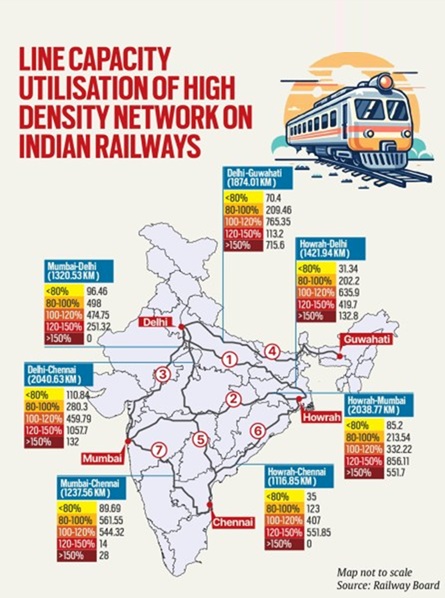
HDN comprises the railway stretches where both passenger and freight traffic are at saturation levels, leading to slower operations and increased delays.
A healthy rail system should operate at 70–80% utilisation.
The HDN far exceeds this threshold:
|
Capacity Utilisation |
Share of HDN |
|
Below 80% |
4.60% |
|
80–100% |
18.89% |
|
100–120% |
32.75% |
|
120–150% |
29.53% |
|
Above 150% |
14.11% |
Nearly 95% of HDN sections operate above the optimal limit.
This illustrates the extreme congestion on the HDN network.
National Rail Plan — 2051 Highlights:
This makes the HDN the most overstretched part of India’s railway system.
By 2051
By 2031 (Near-term Outlook)
Without capacity expansion, HDN congestion will reach critical thresholds much earlier than 2051.
With demand outpacing current capacity, Indian Railways has prioritised:
|
Year |
Track Added |
|
2021–22 |
1,983 km |
|
2022–23 |
3,185 km |
|
2023–24 |
2,244 km |
|
2024–25 |
2,900+ km |
However, the HDN load demands much faster expansion.
The DFCs are expected to divert large volumes of freight from HDN, helping free up tracks for high-speed and suburban passenger services. This remains one of the most transformative interventions for HDN decongestion.
FAQs1. What is the purpose of expanding lines on the Badlapur–Karjat stretch ? To reduce congestion on the Mumbai–Chennai HDN and support higher suburban and long-distance traffic volumes. 2. What makes HDN corridors different from regular routes ? They carry the densest passenger and freight loads and operate far above optimal capacity. 3. Why is the HDN facing such heavy congestion ? Rapid growth in passenger demand, increased freight movement, and limited parallel infrastructure. 4. How will DFCs help reduce HDN overload ? By shifting freight trains from HDN to dedicated corridors, creating more capacity for passenger trains. 5. What does 150% utilisation mean ? The route is running 1.5 times the number of trains it was designed to handle—leading to delays and safety concerns. |



Our support team will be happy to assist you!

 Contact Us
  New Batch : 9555124124/ 7428085757
  Tech Support : 9555124124/ 7428085757