Prelims: India–Uzbekistan Relations, Central Asia, Comprehensive Strategic Partnership, SCO, Critical Minerals, Uranium, Dustlik Exercise, Preferential Trade Agreement
Mains: GS Paper II: India and its Neighbourhood, Bilateral Relations, Central Asia, International Relations
GS Paper III: Energy Security, Critical Minerals, Trade, Connectivity, Defence Cooperation |
Why in news?
Prime Minister Narendra Modi paid a State Visit to Uzbekistan from 29-30 August 2026, where he held talks with Uzbek President Shavkat Mirziyoyev. The two countries decided to elevate their relationship to a Comprehensive Strategic Partnership and set a target of increasing annual bilateral trade to USD 5 billion by 2030.
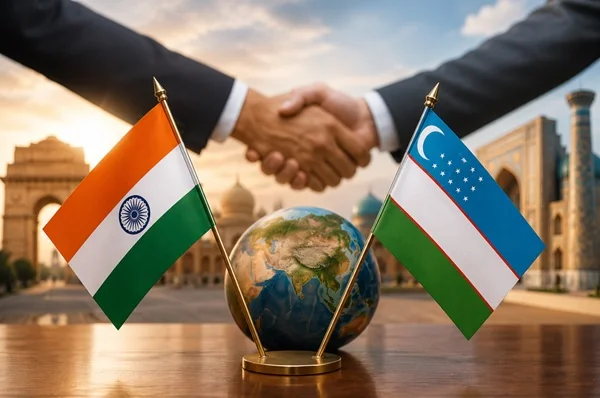
What happened during PM Modi's 2026 Uzbekistan visit?
- PM Modi and President Mirziyoyev held delegation-level discussions covering almost the entire spectrum of bilateral relations.
- The agenda included trade and investment, innovation and start-ups, Digital Public Infrastructure, UPI, defence and security, healthcare and pharmaceuticals, critical minerals, agriculture, education, tourism, space and people-to-people exchanges.
- The two leaders also decided to establish a Foreign Ministers-led mechanism to oversee the Comprehensive Strategic Partnership and elevate the Inter-Governmental Commission to ministerial level.
What agreements were signed?
The summit resulted in the exchange of agreements and MoUs covering a broad range of areas.
|
Area
|
Cooperation
|
|
Mining
|
Geology/mining and mineral-resource cooperation
|
|
Economic Cooperation
|
Strengthening bilateral economic collaboration
|
|
Higher Education
|
Education and research cooperation
|
|
Environment
|
Environmental cooperation
|
|
Tourism
|
Expansion of tourism cooperation
|
|
Culture
|
Cultural cooperation
|
|
Ayurveda
|
Traditional medicine cooperation
|
|
Archives
|
Cooperation between archival institutions
|
|
Capacity Building
|
Training and institutional cooperation
|
|
Sister-State Relations
|
Sub-national cooperation
|
|
Buddhist Heritage
|
Restoration of Fayaz Tepa and Kara Tepa
|
|
Sanskrit
|
ICCR Sanskrit Chair in Tashkent
|
India-Uzbekistan Relations
- India and Uzbekistan share centuries-old historical and cultural links arising from trade, movement of people, Buddhism and interactions between Central Asia and the Indian subcontinent.
- Modern diplomatic relations were established after Uzbekistan became independent following the dissolution of the Soviet Union. Over time, the relationship expanded from political and cultural engagement into trade, defence, energy, connectivity and security cooperation.
- The latest upgrade to a Comprehensive Strategic Partnership marks a significant broadening of these ties. Both sides have identified trade and investment, connectivity, digital transformation, energy transition, critical minerals, food security, healthcare, pharmaceuticals and education as priority sectors.
USD 5 Billion Trade Target by 2030
- Bilateral trade crossed USD 1 billion in 2025, while the number of joint ventures has reportedly increased sevenfold in recent years. The two countries are also connected by 14 direct flights per week. India and Uzbekistan now want to increase annual bilateral trade to USD 5 billion by 2030.
- Key sectors with significant trade potential include electrical goods, engineering products, automobiles, pharmaceuticals, agriculture and minerals.
- To achieve this target, both countries agreed to diversify traded goods, tackle non-tariff and investment barriers, promote industrial cooperation, digitise trade procedures and strengthen SME participation. A Joint Working Group will address non-tariff issues and investment barriers.
Major Future Deals
- Preferential Trade Agreement: A Joint Feasibility Study for such an agreement has already been completed. During the 2026 summit, the leaders directed the concerned ministries to explore the next steps on a time-bound basis.
- Uranium and Nuclear Energy Cooperation: The official joint statement says India and Uzbekistan will explore deeper cooperation in nuclear energy, geology, mining and strategic minerals, including peaceful uses of nuclear energy. Recent reporting around the summit also indicates that the countries are working towards a long-term framework for uranium supplies to India. For India, such cooperation could help diversify nuclear-fuel supply sources as nuclear power becomes a larger part of its long-term clean-energy strategy.
- Critical Minerals-An Emerging Strategic Partnership: India has also shown interest in participation by Indian companies in prospective mineral deposits in Uzbekistan. This is strategically important because critical minerals are essential for electric vehicles, renewable-energy systems, electronics, advanced manufacturing and defence technologies.
- Defence and Security Cooperation: Both countries conduct the Dustlik joint military exercise. Its latest edition was held in Uzbekistan's Namangan Region in April 2026. The two sides are exploring opportunities in the defence-industrial domain, security cooperation also covers counter-terrorism, intelligence sharing, cyber threats, drug trafficking, organised crime and violent extremism.
- Connectivity-The Biggest Economic Requirement: India and Uzbekistan do not share a direct land border, and India's direct overland access to Central Asia is constrained. Therefore, both countries agreed to develop multimodal transport routes and logistics corridors and work towards reducing freight transportation costs. For India, wider regional connectivity initiatives involving routes through Iran and the International North–South Transport Corridor (INSTC) can potentially improve access to Central Asian markets.
- Digital Technology, AI and Space: The two countries agreed to deepen cooperation in Artificial Intelligence, IT, start-ups, cyber security, digital transformation and space. The first IT Park in Tashkent was established in 2019 based on the Indian model with support from Software Technology Parks of India (STPI
- Pharmaceuticals and Healthcare: The countries are considering stronger cooperation around the Tashkent Pharma Park, including pharmaceutical manufacturing, localisation, technology transfer and investment. They also support the establishment of new medical centres, laboratories, research institutions and joint pharmaceutical manufacturing enterprises in Uzbekistan with Indian companies.
- Agriculture and Food Security: India and Uzbekistan agreed to strengthen agricultural value chains, agricultural exports, research, livestock, sustainable agriculture and food security. The two countries also plan to facilitate bilateral agricultural trade and cooperate on resource-efficient technologies.
India–Uzbekistan Cooperation in Multilateral Forums
- India and Uzbekistan also cooperate through platforms such as the Shanghai Cooperation Organisation (SCO) and the India-Central Asia dialogue format.
- Uzbekistan reiterated support for India's candidature for permanent membership of a reformed UN Security Council. Both sides also agreed to strengthen coordination on Global South issues.
Why is Uzbekistan strategically important for India?
- Gateway to Central Asia: Uzbekistan occupies a central geographical position in Central Asia and is important to India's wider regional engagement.
- Energy Security: Long-term uranium cooperation could diversify India's nuclear-fuel supplies.
- Critical Minerals: Mineral partnerships can help India create resilient supply chains for clean-energy and advanced technologies.
- Afghanistan: Its border with Afghanistan makes Uzbekistan an important security partner.
- Market for Indian Companies: Pharmaceuticals, healthcare, automobiles, engineering, education, IT and digital services have considerable potential.
- Counter-terrorism: Both countries have strong interests in preventing terrorism and extremism in the region.
What are the major challenges?
- Lack of Direct Land Connectivity: India's biggest disadvantage is the absence of a direct land route to Uzbekistan.
- High Logistics Costs: Longer transport routes make Indian goods less competitive.
- Ambitious Trade Target: Reaching USD 5 billion by 2030 requires a substantial increase in commercial activity.
- Regional Geopolitical Complexity: Central Asia sits at the intersection of major geopolitical interests.
- China's Economic Presence: China already has extensive infrastructure, investment and trade links across Central Asia. India therefore faces considerable economic competition.
- Russia's Historical Influence: Russia retains deep political, economic, cultural and security ties with the region.
- Afghanistan Instability: Instability in Afghanistan can affect security and regional connectivity.
Prelims MCQ
Q. With reference to India–Uzbekistan relations, consider the following statements:
- India and Uzbekistan are members of the Shanghai Cooperation Organisation (SCO).
- DUSTLIK is a joint military exercise conducted by India and Uzbekistan.
- India and Uzbekistan have set a target of USD 5 billion in bilateral trade by 2030.
Which of the statements given above are correct?
A. 1 and 2 only
B. 2 and 3 only
C. 1 and 3 only
D. 1, 2 and 3
Mains Practice Question
Q. “Uzbekistan occupies a significant place in India’s engagement with Central Asia.” Discuss.
|
FAQs
What is the India–Uzbekistan bilateral trade target for 2030?
Both countries have set a target of USD 5 billion by 2030.
What is the current status of India–Uzbekistan relations?
The relationship has been elevated to a Comprehensive Strategic Partnership.
Why is Uzbekistan important for India?
It is important for India's Central Asia outreach, energy security, critical minerals, trade and regional security.
What is the joint military exercise between India and Uzbekistan?
The two countries conduct the DUSTLIK joint military exercise.
What is the major challenge in India–Uzbekistan trade?
The lack of direct land connectivity and high transportation costs are major challenges.
|






 Contact Us
  New Batch : 9555124124/ 7428085757
  Tech Support : 9555124124/ 7428085757