Prelims: India–Japan Relations | Special Strategic and Global Partnership | Maritime Security | JAIMEX | Dharma Guardian | Veer Guardian | UNICORN | HADR | Indo-Pacific
Mains: GS Paper II – International Relations | Bilateral Relations | Indo-Pacific | GS Paper III – Defence Technology | Maritime Security | Indigenous Defence Manufacturing
Keywords: India-Japan relations, Shinjirō Koizumi, Rajnath Singh, Maritime Security MoA, UNICORN, JAIMEX, Veer Guardian, DRDO-ATLA, HADR, FOIP, MAHASAGAR, Indo-Pacific |
Why in News?
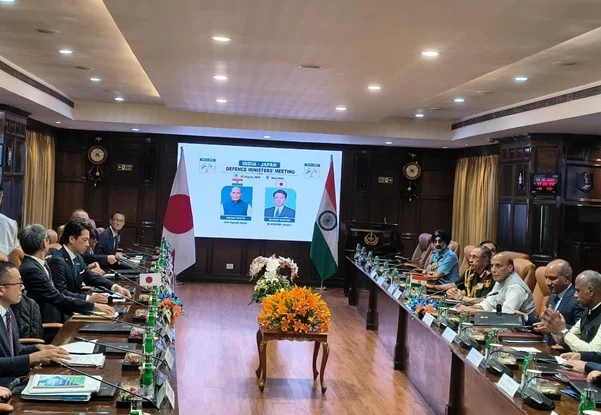
India’s Defence Minister Rajnath Singh and Japanese Defence Minister Shinjiro Koizumi held a bilateral defence dialogue in New Delhi during Koizumi’s maiden visit to India.
Important Point
- Both countries signed a Memorandum of Arrangement (MoA) on Maritime Security Cooperation.
- It provides a framework for stronger naval cooperation, maritime information sharing and Humanitarian Assistance and Disaster Relief (HADR).
- The visit is significant as India and Japan are expanding their Special Strategic and Global Partnership, particularly in defence technology and Indo-Pacific maritime security.
India–Japan Special Strategic and Global Partnership
- India and Japan elevated their relationship to a “Special Strategic and Global Partnership” in 2014.
- The partnership is based on shared democratic values, a rules-based international order and a common vision for a Free and Open Indo-Pacific (FOIP).
- Defence cooperation has expanded from high-level dialogue to military exercises, logistics, defence equipment and technology cooperation.
In simple terms:
Strategic Partnership → Military Exercises → Logistics → Defence Technology → Maritime Cooperation
What is the Maritime Security MoA?
The new Memorandum of Arrangement on Maritime Security Cooperation strengthens cooperation between the Indian Navy and Japan Maritime Self-Defense Force (JMSDF).
Major areas include:
- Maritime Domain Awareness (MDA)
- Maritime information sharing
- Search and Rescue
- Humanitarian Assistance and Disaster Relief (HADR)
- Naval exchanges and exercises
- Maritime logistics
Maritime Domain Awareness means having effective information about ships, activities and potential threats in the maritime domain. Such cooperation is important for protecting strategically significant Sea Lines of Communication (SLOCs) across the Indo-Pacific.
India–Japan Defence Cooperation
- Defence cooperation between India and Japan has accelerated significantly since 2014.
- The Acquisition and Cross-Servicing Agreement (ACSA) signed in 2020 facilitates reciprocal provision of supplies and services between their armed forces.
- It allows greater logistical cooperation during exercises, training, ship visits and other authorised activities.
- India and Japan have also expanded cooperation through regular Army, Navy and Air Force exercises.
Major Exercises
- Dharma Guardian: Bilateral exercise between the Indian Army and Japan Ground Self-Defense Force.
- JAIMEX: Japan–India Maritime Exercise involving the Indian Navy and Japan Maritime Self-Defense Force.
- Veer Guardian: Bilateral exercise between the Indian Air Force and Japan Air Self-Defense Force.
- Veer Guardian 2026 is significant as Japanese fighter aircraft are expected to participate in an exercise in India for the first time.
What is the UNICORN Project?
UNICORN is an integrated communications antenna system developed by Japan for naval vessels. India and Japan are cooperating on the system for the Indian Navy. It represents the first defence equipment transfer project between India and Japan. The project indicates that bilateral defence ties are moving beyond exercises towards technology and equipment cooperation.
In simple terms:
- Earlier → Dialogue + Military Exercises
- Now → Technology + Equipment + Joint Production
- Japan Technology + Make in India
India and Japan are exploring cooperation by combining Japanese technology with India’s manufacturing capabilities.
Important areas include:
- Naval shipbuilding
- Mine countermeasures
- Defence equipment
- Ship repair and maintenance
- Advanced maritime technologies
DRDO–ATLA Cooperation
- Both sides emphasised deeper defence R&D cooperation between India’s Defence Research and Development Organisation (DRDO) and Japan’s Acquisition, Technology & Logistics Agency (ATLA).
- The focus will be on advanced and emerging defence technologies. India and Japan also plan to convene a Defence Industry Forum to encourage greater cooperation between defence companies.
Indo-Pacific Logistics Network (IPLN)
India and Japan are working to strengthen cooperation through the Indo-Pacific Logistics Network (IPLN).
The initiative supports partner countries during natural disasters by facilitating transportation of:
- Personnel
- Relief materials
- Humanitarian supplies
It can improve regional HADR capabilities and strengthen India–Japan coordination during emergencies.
India–Japan 2+2 Dialogue
Both countries decided to accelerate discussions for the Fourth India–Japan Foreign and Defence Ministerial (2+2) Meeting, expected to be held in Tokyo later in 2026.
The mechanism brings together:
Foreign Ministers + Defence Ministers of India and Japan
It enables both sides to discuss defence, foreign policy and regional security under a common framework.
FOIP and MAHASAGAR
- Japan promotes the Free and Open Indo-Pacific (FOIP) vision.
- India has articulated MAHASAGAR – Mutual and Holistic Advancement for Security and Growth Across Regions.
- Both approaches emphasise maritime security, regional stability, connectivity and cooperation with partner countries.
- Their convergence provides strategic momentum to India–Japan cooperation across the Indo-Pacific.
China Factor
- India–Japan defence cooperation has gained strategic importance amid China’s growing military and maritime presence in the Indo-Pacific.
- Both countries support freedom of navigation, secure sea routes, a rules-based international order and opposition to unilateral changes in the status quo through force or coercion.
- India’s strategic position in the Indian Ocean and Japan’s location in the Western Pacific make cooperation between them particularly important.
- The partnership is officially presented as supporting a free, open and stable Indo-Pacific, rather than simply as an anti-China alliance.
Significance for India
- Maritime Security: Better information sharing can strengthen India’s Maritime Domain Awareness.
- Defence Technology: Japan can provide expertise in advanced electronics, communications, sensors and shipbuilding.
- Make in India: Japanese technology combined with Indian manufacturing can support defence indigenisation.
- Operational Reach: Logistics and ship-repair cooperation can increase the operational reach of the Indian Navy.
- Defence R&D: DRDO–ATLA cooperation can help India develop emerging defence technologies.
- HADR: Better coordination can improve responses to cyclones, earthquakes, tsunamis and other natural disasters.
Challenges
- Defence projects can take considerable time to move from agreements to implementation.
- Differences in procurement systems may slow joint projects.
- Technology transfer and intellectual property issues need careful negotiation.
- Joint defence manufacturing between India and Japan remains below its full potential.
Prelims MCQ
Q. Consider the following pairs regarding India–Japan defence exercises:
- Dharma Guardian – Army
- JAIMEX – Navy
- Veer Guardian – Air Force
Which of the pairs given above are correctly matched?
A. 1 and 2 only
B. 2 and 3 only
C. 1 and 3 only
D. 1, 2 and 3
Mains Practice Question
Q. Examine the growing India–Japan defence partnership and discuss its significance for India’s maritime security and the emerging strategic architecture of the Indo-Pacific.
|
FAQs
1. What is the India–Japan Maritime Security MoA?
It provides a framework for naval cooperation, maritime information sharing, MDA and HADR.
2. What is UNICORN?
It is a Japanese integrated communications antenna system being taken forward for the Indian Navy.
3. What is JAIMEX?
JAIMEX is the bilateral maritime exercise between India and Japan.
4. What is Veer Guardian?
It is the bilateral air exercise between India and Japan.
5. Why is Japan important for India’s defence sector?
Japan offers advanced technology, maritime capabilities and opportunities for defence manufacturing and R&D cooperation.
|






 Contact Us
  New Batch : 9555124124/ 7428085757
  Tech Support : 9555124124/ 7428085757