Prelims: Special Campaign 6.0, E-Waste (Management) Rules, 2022, Ministry of Steel, Swachhata, Administrative Reforms
Mains: GS Paper II Governance, Administrative Reforms, Accountability and Citizen-Centric Administration GS Paper III Environmental Conservation, E-Waste Management and Sustainable Development
Keywords: Special Campaign 6.0, Ministry of Steel, E-Waste Management, E-Waste (Management) Rules 2022, Mechanised Cleaning, Swachhata, Pendency Clearance, Administrative Reforms, Circular Economy, Citizen-Centric Governance, Sustainable Governance |
Why in News?
The Ministry of Steel, along with its Public Sector Undertakings (PSUs), will participate in Special Campaign 6.0, which will be implemented from October 2 to October 31, 2026.
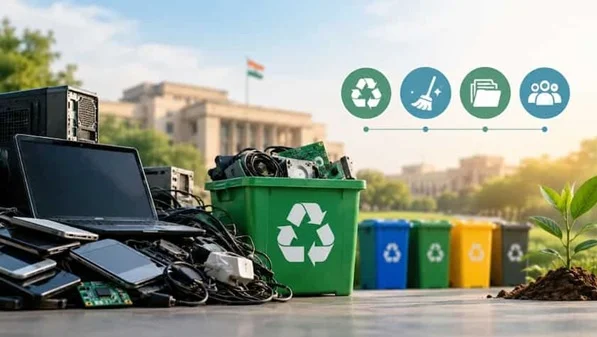
This year, the campaign will place special emphasis on the collection, segregation and proper disposal of e-waste in accordance with the E-Waste (Management) Rules, 2022.
Background
- The Government of India conducts Special Campaigns to improve cleanliness, record management and administrative efficiency across government offices and institutions.
- Special Campaign 6.0 builds upon the progress made during Special Campaign 5.0, which was conducted in October 2025.
- During the previous campaign, the Ministry of Steel and its PSUs focused on clearing pending matters, disposing of obsolete files and records, streamlining scrap disposal and optimising available office space.
- The new campaign seeks to further institutionalise cleanliness and administrative efficiency as a continuous part of governance rather than treating them as one-time activities.
Key Features of Special Campaign 6.0
- E-Waste Management: The Ministry of Steel and its PSUs will focus on the proper collection, segregation and disposal of electronic waste. E-waste will be handled in accordance with the E-Waste (Management) Rules, 2022 and other applicable guidelines.
- Mechanised Cleaning: The campaign will promote greater use of mechanised cleaning methods in government offices and premises. The objective is to improve workplace hygiene while making cleaning operations more efficient and systematic.
- Disposal of Pending Matters: A major component of Special Campaign 6.0 will be the faster disposal of pending administrative matters. Special attention will be given to pending references related to the Prime Minister's Office, State Governments, Parliament and VIP references.
- Awareness and Public Engagement: Digital platforms and outreach initiatives will be used to spread awareness about cleanliness and sustainable practices. The campaign also aims to encourage wider participation in Swachhata activities among employees and other stakeholders.
Why is E-Waste Management Important?
- The rapid expansion of digital infrastructure and electronic devices has resulted in a corresponding increase in electronic waste.
- E-waste may contain valuable metals and reusable materials. However, improper disposal can release hazardous substances that may contaminate soil and water and pose risks to human health and the environment.
- Proper collection, segregation, recycling and disposal of electronic waste are therefore essential for both environmental protection and the development of a Circular Economy.
Significance of Special Campaign 6.0
- Special Campaign 6.0 links administrative reforms with environmental sustainability.
- Its focus on e-waste management can promote responsible resource use within government institutions, while clearance of pending matters can improve administrative efficiency and accountability.
- Better record management and disposal of obsolete material can also help optimise office space and improve working conditions.
- The campaign also reflects an attempt to make cleanliness and administrative efficiency a continuous feature of government functioning.
Relevance for India
- India is rapidly expanding its Digital Governance and E-Governance ecosystem, leading to greater use of electronic equipment across government institutions.
- As the use of electronic devices increases, responsible management of these products at the end of their useful life also becomes an important aspect of governance.
- Special Campaign 6.0 therefore seeks to integrate Swachhata, Sustainability and Administrative Efficiency within government institutions.
- It can also contribute to India's broader objectives of responsible waste management, resource efficiency and citizen-centric governance.
Challenges
- Effective identification and segregation of e-waste require adequate awareness and institutional capacity across government offices.
- The implementation capacity of different PSUs and offices may also vary, making uniform execution a challenge.
- Another concern is ensuring that clearance of pending matters focuses on the quality of disposal and resolution, rather than merely reducing numerical pendency.
- Maintaining cleanliness and efficient record management after the formal campaign ends will also be critical for achieving long-term results.
Way Forward
- Government offices should maintain updated inventories of electronic equipment and obsolete e-waste to enable timely and safe disposal.
- E-waste should be transferred only through authorised collection, recycling and disposal mechanisms in accordance with existing regulations.
- Government institutions can also strengthen digital record management, periodic cleanliness audits and real-time monitoring of pending matters.
- Most importantly, Special Campaign initiatives should become part of the regular administrative work culture rather than remaining limited to a specific campaign period.
Prelims MCQs
Q. Consider the following statements regarding Special Campaign 6.0:
- Its Implementation Phase will be conducted from October 2 to October 31, 2026.
- E-waste management is one of its major focus areas.
- The campaign is limited only to the headquarters of the Ministry of Steel.
Which of the statements given above are correct?
(a) 1 only
(b) 1 and 2 only
(c) 2 and 3 only
(d) 1, 2 and 3
Mains Question
“Special Campaign 6.0 goes beyond cleanliness by integrating environmental sustainability with administrative efficiency.” Discuss in the context of e-waste management and good governance.
|
FAQs
What is Special Campaign 6.0?
Special Campaign 6.0 is an initiative aimed at improving cleanliness, administrative efficiency, record management, pendency clearance and sustainable practices in government institutions.
When will Special Campaign 6.0 be conducted?
Its Preparatory Phase will run from September 15 to September 30, 2026, while the Implementation Phase will take place from October 2 to October 31, 2026.
Why has e-waste management been included in the campaign?
The increasing use of electronic equipment in government institutions generates obsolete electronic devices that require proper collection, segregation and environmentally safe disposal.
Who will participate in the campaign?
The Ministry of Steel and its Public Sector Undertakings (PSUs) will participate in Special Campaign 6.0.
What are the major focus areas of Special Campaign 6.0?
The four major focus areas are e-waste management, mechanised cleaning, disposal of pending matters, and awareness and public engagement.
|






 Contact Us
  New Batch : 9555124124/ 7428085757
  Tech Support : 9555124124/ 7428085757