
- UPSC Exam
- State PCS
- One Day Exam
- Current Affairs
- PT Quiz
- Downlaods
- About Coaching
- Blog
- Videos

| Mains: GS Paper II (Polity & Governance), Higher Education, Institutional Autonomy, Statutory Bodies, Government Policies & Interventions, Education Reforms Keywords Indian Statistical Institute Bill 2026, ISI Bill 2026, Indian Statistical Institute, ISI Act 1959, Institution of National Importance, P.C. Mahalanobis, Board of Governors, Academic Council, Institutional Autonomy, Ministry of Statistics and Programme Implementation (MoSPI), Higher Education Reforms, Governance Reforms, Kolkata Headquarters, UPSC Current Affairs |
The Government of India has introduced the Indian Statistical Institute Bill, 2026 in Parliament to replace the Indian Statistical Institute Act, 1959.
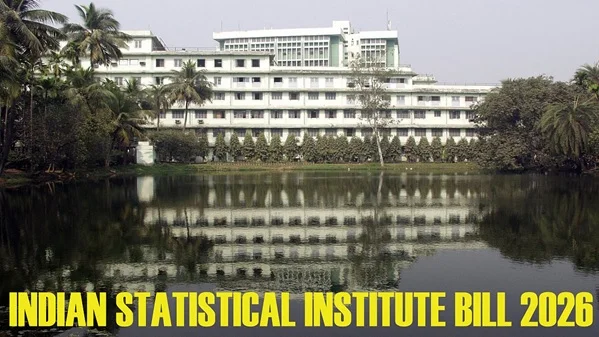
The Indian Statistical Institute (ISI) is India's premier institution dedicated to statistics, mathematics, computer science, quantitative economics, data science, and interdisciplinary research.
Key Facts
The Bill proposes a comprehensive restructuring of ISI's governance system.
According to the government, ISI's existing governance model is outdated.
Currently,
The government argues that this system has delayed institutional reforms for decades and needs to be replaced with a more efficient governance framework.
The proposed Board will consist of 11 members, including:
The Academic Council will function as the Institute's principal academic body.
Its responsibilities include:
Faculty members argue that the proposed governance model gives excessive powers to the Central Government in appointing Board members, thereby weakening ISI's academic independence.
Critics point out that:
As a result, the government may directly or indirectly influence a majority of the Board.
Several professors have alleged that the Bill was prepared without adequate consultation with:
The government has rejected these allegations and stated that:
|
Feature |
ISI Act, 1959 |
ISI Bill, 2026 |
|
Legal Status |
Registered Society |
Statutory Body Corporate |
|
Governance |
General Body |
Board of Governors |
|
Executive Authority |
Governing Council |
Board of Governors |
|
Academic Body |
Limited |
Academic Council |
|
Decision Making |
Slow |
Faster |
|
Government Role |
Limited |
Greater Representation |
|
Headquarters Mention |
Kolkata Mentioned |
No Explicit Mention |
Prelims MCQQ. With reference to the Indian Statistical Institute Bill, 2026, consider the following statements:
Which of the statements given above is/are correct? A. 1 and 2 only Mains Practice Question"The Indian Statistical Institute Bill, 2026 seeks to modernise the governance structure of one of India's premier research institutions. Critically examine the key provisions of the Bill and discuss the concerns regarding institutional autonomy." |
1. What is the Indian Statistical Institute Bill, 2026?It is a proposed law to replace the Indian Statistical Institute Act, 1959 and establish a modern governance framework for the Indian Statistical Institute (ISI). 2. Why is the Bill controversial?Critics argue that the proposed governance structure increases the Central Government's role in appointments, potentially reducing ISI's institutional autonomy. 3. What are the major changes proposed in the Bill?The Bill proposes converting ISI into a Statutory Body Corporate, creating a Board of Governors, establishing an Academic Council, and replacing the existing society-based governance model. 4. Will ISI's headquarters be shifted from Kolkata?No. The Government has officially clarified that there is no proposal to shift ISI's headquarters from Kolkata. 5. Why is this topic important for UPSC?The Bill is relevant for GS Paper II (Governance, Education Reforms, Statutory Bodies and Institutional Autonomy) and is also important for UPSC Prelims from the perspective of Institutions of National Importance and current legislative developments. |



Our support team will be happy to assist you!

 Contact Us
  New Batch : 9555124124/ 7428085757
  Tech Support : 9555124124/ 7428085757