Prelims: EOS-05, GSLV-F17, Geosynchronous Orbit, Geostationary Orbit, Sub-GTO, Earth Observation Satellites, GSLV, Cryogenic Engine, Satish Dhawan Space Centre.
Mains: GS Paper III: Space Technology, Indigenisation of Technology, Disaster Management, Applications of Remote Sensing, Agriculture and Environmental Monitoring. |
Why in news?
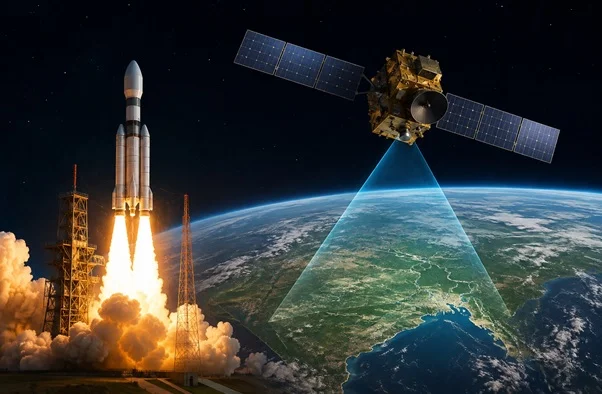
ISRO has scheduled the GSLV-F17/EOS-05 mission for September 4, 2026. The launch is scheduled for 2:55 AM IST from Sriharikota.
Key Facts
|
Feature
|
Details
|
|
Satellite
|
EOS-05
|
|
Type
|
Earth Observation Satellite
|
|
Launch Vehicle
|
GSLV-F17
|
|
Launch Date
|
September 4, 2026
|
|
Launch Time
|
2:55 AM IST
|
|
Launch Site
|
Satish Dhawan Space Centre, Sriharikota
|
|
Launch Pad
|
Second Launch Pad
|
|
Initial Orbit
|
Sub-Geosynchronous Transfer Orbit (Sub-GTO)
|
|
Major distinction
|
India's first imaging satellite from geosynchronous orbit
|
|
Organisation
|
ISRO
|
What is EOS-05?
- An advanced Earth-observation spacecraft designed to obtain images of the Earth's surface for monitoring and observation applications.
- Its defining feature is its intended operation from geosynchronous orbit. Most conventional remote-sensing satellites operate in Low Earth Orbit (LEO) and observe a location as they repeatedly pass over it.
- A geosynchronous imaging platform, by contrast, can repeatedly view a very large region from roughly 36,000 km above Earth, offering much greater temporal continuity for regional monitoring.
What is a Geosynchronous Orbit?
- An orbit in which a satellite's orbital period is approximately equal to Earth's rotation period-about 24 hours. A special case is the geostationary orbit, where the satellite travels in a circular orbit above the equator and appears nearly stationary over one longitude.
- For Earth observation, this high-altitude perspective can provide large-area coverage, repeated observations, frequent monitoring and quicker identification of changes.
What is Sub-GTO?
- The GSLV-F17 will not directly place EOS-05 into its final operational orbit. ISRO states that the spacecraft will initially be injected into a Sub-Geosynchronous Transfer Orbit (Sub-GTO).
- A transfer orbit acts as an intermediate trajectory. After separation from the launch vehicle, the spacecraft can use its onboard propulsion and orbital manoeuvres to move toward its intended operational orbit.
Why is Geosynchronous Earth Observation Important?
- A conventional LEO remote-sensing satellite travels around Earth and can observe a particular region only when its orbit brings it over that area. EOS-05's high-altitude geosynchronous perspective is intended to allow repeated monitoring of a large region. This could complement India's existing LEO Earth-observation satellites rather than replace them.
LEO vs Geosynchronous Earth Observation
|
Low Earth Orbit Satellites
|
EOS-05-type Geosynchronous Observation
|
|
Much closer to Earth
|
Around 36,000 km altitude in operational GSO
|
|
Pass over regions periodically
|
Can repeatedly observe a broad region
|
|
Often provides finer spatial detail
|
Emphasises wide coverage and temporal frequency
|
|
Excellent for detailed mapping
|
Useful for monitoring rapidly changing conditions
|
Major Applications of EOS-05
- The spacecraft's repeated large-area observation capability can strengthen India's ability to monitor changes on the Earth's surface.
- Potential civilian applications include disaster monitoring, agriculture and vegetation assessment, environmental monitoring, land-use changes, water resources, floods, cyclones and forest fires.
- The principal advantage is the possibility of observing evolving situations more frequently than with satellites that only pass over an area periodically.
- Earth-observation satellites primarily provide observations and data; they do not independently constitute an end-to-end disaster-warning system.
- Satellite information normally has to be combined with meteorological observations, ground sensors, models and disaster-management agencies.
Strategic Importance
- A December 2025 parliamentary reply from the Department of Space explicitly described GSLV-F17/EOS-05 as the launch of an Earth Observation Satellite for a "strategic user."
- A satellite capable of frequently revisiting broad areas can strengthen situational awareness and strategic monitoring. At the same time, specific claims about its classified capabilities, targets or surveillance performance should be treated cautiously unless officially disclosed.
GSLV-F17 Launch Vehicle
- GSLV is one of India's operational launch-vehicle families and is designed to carry satellites toward higher-energy orbits, including transfer orbits used for geosynchronous missions. ISRO currently lists PSLV, GSLV and LVM3 among India's operational launch vehicles. GSLV programme is India's indigenous cryogenic upper-stage technology, which is crucial for high-energy orbital missions.
The Earlier GISAT Attempt
- In August 2021, ISRO launched EOS-03/GISAT-1 aboard GSLV-F10. The mission could not accomplish its objective after the cryogenic upper stage failed to ignite.
- EOS-05 therefore represents an important renewed effort to establish an operational Indian imaging capability from geosynchronous orbit.
Why EOS-05 Matters for India
- It can improve temporal resolution-how frequently a region can be observed.
- Its broad field of view can support large-area monitoring.
- It can complement India's existing remote-sensing and meteorological satellites.
- Its potential applications extend across governance, agriculture, environment, disaster management and strategic requirements.
Significance for Disaster Management
- India is vulnerable to a wide variety of natural hazards, including cyclones, floods, landslides, forest fires, drought and coastal hazards.
- Satellite imagery is an important part of disaster management because it can help identify the extent of flooding, monitor environmental changes, assess affected areas and support response planning.
- Effective disaster management ultimately depends on integrating satellite data, weather satellites, river gauges, ground sensors, forecasting models, disaster-management agencies and local administration.
Challenges and Limitations
- A geosynchronous imaging satellite also involves technological trade-offs. Because it operates far farther from Earth than LEO remote-sensing satellites, obtaining detailed imagery requires sophisticated optics, detectors, pointing accuracy and data-processing systems. Cloud cover can also limit observations by optical sensors.
Significance for India's Space Programme
- Technological significance: It aims to establish India's first imaging satellite capability from geosynchronous orbit.
- Developmental significance: Frequent Earth observation can strengthen disaster management, agriculture, environmental monitoring and resource management.
Prelims MCQ
Q. EOS-05, recently in the news, is primarily associated with which of the following?
A. Satellite navigation
B. Earth observation
C. Human spaceflight
D. Space astronomy
Mains Practice Question
Q. How can Earth Observation Satellites contribute to India’s developmental and strategic requirements? Discuss with reference to the EOS-05 mission.
|
FAQs
Which rocket will launch EOS-05?
EOS-05 is scheduled to be launched aboard GSLV-F17, the 19th flight of India's Geosynchronous Satellite Launch Vehicle.
When will EOS-05 be launched?
The mission is scheduled for 4 September 2026 at 2:55 AM IST.
From where will EOS-05 be launched?
It will be launched from the Satish Dhawan Space Centre (SDSC-SHAR), Sriharikota.
What is the main significance of EOS-05?
Its major significance lies in strengthening India's capability for frequent, large-area Earth observation from geosynchronous orbit.
What is a geosynchronous orbit?
A geosynchronous orbit is one in which a satellite's orbital period matches Earth's rotation period, approximately 24 hours.
|






 Contact Us
  New Batch : 9555124124/ 7428085757
  Tech Support : 9555124124/ 7428085757