Why in News?
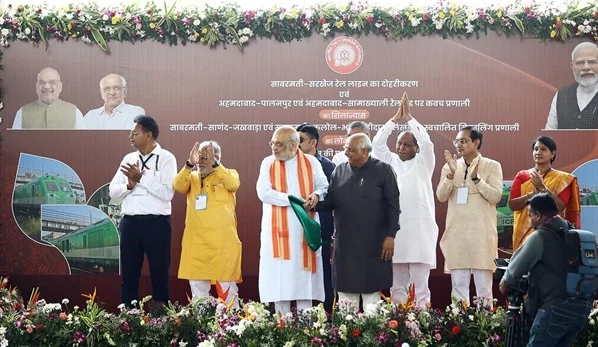
- Union Home and Cooperation Minister Amit Shah flagged off India’s first LNG-powered train from Sabarmati Railway Station in Ahmedabad, Gujarat, on September 27, 2026.
- The train uses a dual-fuel system based on Liquefied Natural Gas (LNG) and diesel. The initiative is aimed at reducing diesel consumption, fuel costs and emissions from railway operations.
- The event also saw the launch and inauguration of several railway infrastructure and safety projects in Gujarat. According to the official release, development works worth ₹1,472 crore were inaugurated or launched.
Important Points
- LNG can replace around 40% of diesel consumption in the current system.
- Two Driving Power Cars (DPCs) of 1,400 horsepower each were converted for LNG-diesel operation.
- More than 2,000 km of field trials have been completed.
- LNG use can help reduce fuel consumption, emissions and dependence on diesel.
- Kavach is an indigenous Automatic Train Protection (ATP) system for improving railway safety.
- WAG-12 is a high-power electric freight locomotive used for heavy freight movement.
- Automatic signalling helps improve railway capacity and safe train operations.
- Dedicated Freight Corridors (DFCs) are designed to improve freight movement and reduce congestion on existing railway routes.
- Railway electrification is important for energy security, decarbonisation and sustainable transport.
- The initiative is relevant to Make in India, Atmanirbhar Bharat and indigenous railway technology.
What is India’s First LNG-Powered Train?
The train uses an LNG-diesel dual-fuel technology in its Driving Power Cars (DPCs).
Under the project:
- Two DPCs of 1,400 horsepower each have been converted to operate on LNG and diesel.
- LNG can replace around 40% of diesel consumption.
- More than 2,000 km of field trials have been completed.
- The technology is expected to reduce fuel consumption and emissions such as carbon dioxide, nitrogen oxides and particulate matter.
The dual-fuel system also allows the train to continue operating on diesel when LNG is not available.
Major Railway Projects Launched in Gujarat
Along with the LNG-powered train, several railway projects were inaugurated or launched at Sabarmati.
1. WAG-12 Locomotive Maintenance Shed
- A WAG-12 locomotive maintenance shed was inaugurated at Sabarmati at a cost of around ₹700 crore.
- The facility will provide maintenance support for high-power WAG-12 electric locomotives used for transporting heavy and long freight trains.
2. Kavach Safety System
- The indigenous Kavach automatic train protection system was launched for railway sections covering around 404 km in the Ahmedabad Division.
- The system is designed to improve railway safety by helping prevent train collisions and controlling risks associated with overspeeding and human error.
3. Automatic Signalling System
- An Automatic Block Signalling System was also introduced on selected railway sections.
- The system helps maintain safe distances between trains and can improve the capacity and efficiency of railway routes.
4. Sabarmati–Sarkhej Railway Line Doubling
- The Sabarmati–Sarkhej railway line doubling project was also included in the railway development package.
- The project is expected to increase railway capacity and improve connectivity in the region.
Amit Shah’s Remarks on Railway Modernisation
- Addressing the gathering, Amit Shah highlighted the changes in Indian Railways during the last 12 years and referred to projects such as Dedicated Freight Corridors, rapid rail systems, modern railway stations and indigenous safety technologies.
- He also highlighted the expansion of railway electrification and the increased use of modern railway infrastructure.
- According to the official release, Shah said that railway electrification had reached 99.6% and that India was moving towards complete electrification of its railway network.
- Shah also referred to the reduction in railway diesel consumption and said the government aims to eliminate diesel use in the Railways by 2030.
Significance of the LNG-Powered Train
The introduction of LNG technology in railway operations is significant for several reasons:
- Reduced diesel dependence: LNG can partially replace diesel in railway operations.
- Lower emissions: LNG-based operation can reduce certain emissions compared with conventional diesel use.
- Alternative fuel: It provides another fuel option for non-electrified or suitable railway operations.
- Energy efficiency: The technology can help reduce fuel consumption and operating costs.
- Cleaner transport: It supports efforts to promote lower-emission transportation.
India’s Railway Electrification Push
- Railway electrification has expanded rapidly in recent years. The government has also focused on modern signalling, automatic train protection systems, dedicated freight corridors and high-capacity electric locomotives.
- According to government figures cited at the event, annual railway electrification increased from 75 km in 2010–11 to about 7,188 km in 2023–24.
Challenges of LNG-Powered Trains
- LNG Infrastructure: Adequate LNG storage, refuelling and distribution facilities are required along railway routes.
- High Initial Cost: Converting locomotives and developing LNG infrastructure can involve significant upfront investment.
- Safety Concerns: LNG is stored at very low temperatures, requiring specialised handling, storage and safety systems.
- Limited Applicability: LNG-powered trains may have greater relevance on routes that are not fully electrified; India’s expanding railway electrification may limit their long-term use.
- Supply Chain Challenges: Reliable and uninterrupted LNG availability is necessary for regular operations.
- Environmental Concerns: Although LNG can reduce some emissions compared with diesel, it is still a fossil fuel and does not provide zero-emission transport.
- Methane Leakage: Leakage of methane during production, transportation or storage can reduce the overall climate benefit of LNG.
- Technology Adaptation: Long-term field testing is required to assess operational efficiency, maintenance needs and reliability on different railway routes.
- Competition with Electrification: Rapid railway electrification provides a low-emission pathway, creating a need to clearly define where LNG offers additional value.
Conclusion
The launch of India’s first LNG-powered train from Sabarmati marks a new step towards the use of alternative fuels in railway transport. Along with the LNG train, projects related to Kavach, automatic signalling, railway line doubling and WAG-12 locomotive maintenance are aimed at improving railway safety, capacity and operational efficiency in Gujarat.
Prelims Practice Question
Consider the following statements regarding India’s first LNG-powered train:
- It uses a dual-fuel system involving LNG and diesel.
- It was flagged off from Sabarmati Railway Station in Gujarat.
- LNG can completely replace diesel in the train under the current system.
Which of the statements given above is/are correct?
(a) 1 and 2 only
(b) 2 and 3 only
(c) 1 and 3 only
(d) 1, 2 and 3
Mains Practice Question
“Discuss the role of railway electrification, alternative fuels and indigenous safety technologies in transforming India’s railway infrastructure.”
|
FAQs
1. What is India’s first LNG-powered train?
It is a railway train using LNG-diesel dual-fuel technology, allowing LNG to partially replace conventional diesel fuel.
2. Where was India’s first LNG-powered train flagged off?
It was flagged off from Sabarmati Railway Station in Ahmedabad, Gujarat, on September 27, 2026.
3. What is the significance of LNG in Railways?
LNG can help reduce diesel consumption, fuel costs and certain emissions, making it a potential alternative fuel for suitable railway operations.
4. What is Kavach?
Kavach is India’s indigenous Automatic Train Protection (ATP) system, developed to enhance railway safety.
5. What is WAG-12?
WAG-12 is a high-power electric freight locomotive designed for hauling heavy and long freight trains.
|





 Contact Us
  New Batch : 9555124124/ 7428085757
  Tech Support : 9555124124/ 7428085757