
- UPSC Exam
- State PCS
- One Day Exam
- Current Affairs
- PT Quiz
- Downlaods
- About Coaching
- Blog
- Videos

| Prelims: (Economy + CA) Mains: (GS 3 – Indian Economy, Growth & Development, Public Finance, Banking & Financial Stability, Governance) |
As Union Budget 2026 approaches, India’s macroeconomic indicators project stability and relatively strong growth amid global uncertainty. However, a closer reading of RBI data (Financial Stability Report, Annual Report 2024–25) and recent Budget documents reveals a structural shift in India’s growth model — households are saving less and borrowing more, thereby absorbing risks earlier shared by the State.
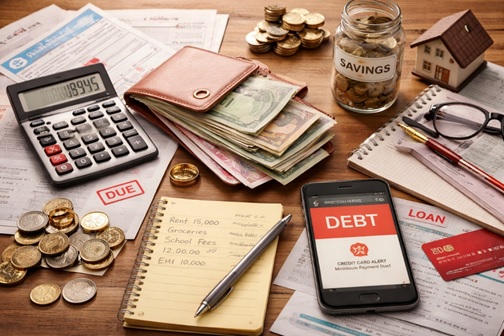
Headline indicators suggest stability:
Limitation: Debt-to-GDP ratios reveal how much debt exists, not why households are borrowing, nor their capacity to service debt under income stress.
According to the RBI Annual Report (2024–25):
Inference: Consumption stability masks underlying income fragility.
Implication: Credit is acting as a shock absorber, not as a growth accelerator.
Balance Sheet Position (Stock):
Households remain net holders of financial wealth, indicating no immediate balance sheet insolvency.
Flow Dynamics (Critical Insight):
Inference: Financial wealth may still rise, but the shock-absorbing buffer is thinning, weakening household resilience to future shocks.
At the State Level — A Quiet Transfer of Risk:
Result: States have become fiscally leaner but less responsive to household income stress, effectively shifting risk onto households.
At the Union Level:
This strategy:
Conclusion: Growth-enhancing, but not household-neutral.
Risk: Any shock — income slowdown, tighter financial conditions, unemployment — could trigger abrupt consumption retrenchment, destabilising growth.
Key Challenges:
Policy Options:
FAQs1. Why are household finances important for India’s macroeconomic stability? Because private consumption accounts for nearly 60% of GDP, household spending acts as the economy’s primary stabiliser. 2. Is India facing a household debt crisis? No. Household debt at 41.3% of GDP is lower than many peers, but the concern lies in why households are borrowing and their declining savings buffer. 3. What does “credit as a cushion, not capital” mean? It means borrowing is being used to maintain consumption rather than to invest in assets or income-generating activities. 4. How have fiscal policies contributed to rising household borrowing? Both State and Union governments have prioritised capital expenditure while compressing revenue spending, reducing income support and shifting risk to households. 5. What should Budget 2026 focus on to address this issue? Enhancing disposable incomes, promoting job creation, strengthening household savings, and balancing capital expenditure with income-smoothing measures. |



Our support team will be happy to assist you!

 Contact Us
  New Batch : 9555124124/ 7428085757
  Tech Support : 9555124124/ 7428085757