India’s Indigenous Unmanned Surface Vessel (USV): A New Milestone in Naval Self-Reliance
Why in News?
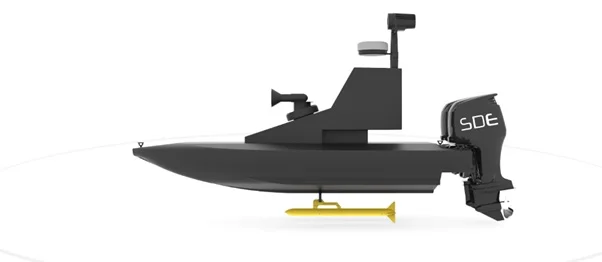
India has achieved an important milestone in naval technology by developing indigenous Unmanned Surface Vessels (USVs).
Developed by Sagar Defence Engineering, these vessels can strengthen the Indian Navy’s surveillance, reconnaissance, and special operations capabilities.
The vessels were showcased at the Indian Navy’s Swavlamban innovation and indigenisation programme in Delhi.
This development is significant at a time when unmanned systems are transforming naval warfare in regions such as the Black Sea and the Red Sea.
What Is an Unmanned Surface Vessel (USV)?
An Unmanned Surface Vessel (USV) is a watercraft that operates without a crew on board.
It can be controlled remotely or operate autonomously with the help of suitable onboard systems.
It may be equipped with sensors, cameras, navigation systems, and other mission-specific equipment.
Its major applications include maritime surveillance, reconnaissance, coastal security, identification of suspicious vessels, force protection, and support for special operations.
Armed USVs can also be used for targeted military operations when equipped with appropriate weapon systems.
Sagar Defence Engineering
Sagar Defence Engineering was established in 2015 by Captain Nikunj Parashar and his co-founders.
The company develops autonomous boats, unmanned systems, and drone technologies for the Indian Armed Forces, particularly the Indian Navy.
Its growth highlights the increasing role of private companies, startups, and indigenous research in India's defence sector.
According to reports, the company has started supplying 12 armed Unmanned Surface Vessels to the Indian Navy under an iDEX-Sprint contract. These include its signature vessel, Matangi.
Key Features of the Matangi USV
High-speed interceptor vessels such as Matangi are designed for surveillance and offensive operations. According to reports, they feature a 12.7 mm stabilised remote-controlled gun system, advanced electro-optical and radar tracking, and anti-jamming GPS navigation.
They can be used for patrolling shallow waters, monitoring suspicious activities, and supporting special operations when required.
Some vessels have reportedly been deployed by the Indian Army for patrolling at Pangong Tso Lake in eastern Ladakh.
The company also develops multi-purpose quadcopters and hexacopter drones. In addition, it has worked with Israel Aerospace Industries (IAI) on the development and introduction of the Point Blank precision-strike system in India.
Significance of the Swavlamban Exhibition
The Indian Navy’s Swavlamban initiative aims to promote innovation, indigenous technology, and domestic manufacturing in the defence sector.
It encourages collaboration between the Navy, defence industries, startups, and research institutions.
Other companies also showcased unmanned maritime systems and related technologies at the exhibition.
Zen Technologies presented a prototype of a multi-purpose autonomous surface vessel, while C14 showcased its Tandav autonomous vessel platform and AquaScan system for underwater vision for divers.
The space-sector company GalaxEye presented a satellite-based maritime surveillance solution.
These initiatives highlight India's growing emphasis on integrating vessels, sensors, artificial intelligence, satellites, and communication systems to strengthen maritime security.
Strategic Significance of USVs for India
Enhanced Maritime Surveillance: Unmanned vessels can improve surveillance of India's maritime zones and important sea routes.
Reduced Risk to Personnel: Deploying unmanned vessels in high-risk areas can reduce the danger to naval personnel.
Faster Military Response: High-speed interceptor vessels can assist in identifying and monitoring suspicious boats and supporting appropriate responses.
Security of the Indian Ocean Region: USVs can improve the monitoring of maritime trade routes, ports, and strategically important sea areas.
Defence Self-Reliance: Indigenous development can reduce dependence on foreign technology, promote domestic manufacturing, and create opportunities for future defence exports.
Promotion of Technological Innovation: Private-sector and startup participation can encourage research in artificial intelligence, autonomous navigation, sensors, and marine robotics.
Major Challenges
The expansion of unmanned maritime systems presents several technological and operational challenges.
These include cyberattacks, communication disruptions, GPS jamming, operations in adverse weather, and ensuring sensor reliability under challenging maritime conditions.
Integration with existing naval platforms, maintenance, cost, testing, and large-scale production are also important concerns.
The use of armed autonomous systems requires clear accountability and compliance with international humanitarian law.
Way Forward
India should increase investment in secure communications, cybersecurity, indigenous sensors, artificial intelligence, and reliable navigation systems.
Collaboration among the Indian Navy, the Defence Research and Development Organisation (DRDO), private industries, and startups should be strengthened.
Testing under real maritime conditions, regular maintenance, skilled human resources, and clear operational standards are essential.
Unmanned vessels should be developed as complementary assets to conventional warships, maritime patrol aircraft, and satellite-based surveillance systems.
Practice Question
Question 1. With reference to Unmanned Surface Vessels (USVs), consider the following statements:
They can be operated remotely or through autonomous systems.
They can be used for maritime surveillance and reconnaissance.
Every USV is necessarily equipped with weapons.
Which of the statements given above is/are correct?