
- UPSC Exam
- State PCS
- One Day Exam
- Current Affairs
- PT Quiz
- Downlaods
- About Coaching
- Blog
- Videos

| Prelims: Indian Army, Land Warfare Doctrine, Army Commanders’ Conference, Operation Sindoor, multi-domain operations Mains: GS Paper III – Security Challenges; Defence Modernisation; Technology in Warfare Keywords: Land Warfare Doctrine 2026, Indian Army, Rajnath Singh, drones, artificial intelligence, multi-domain operations, Atmanirbharta, Operation Sindoor |
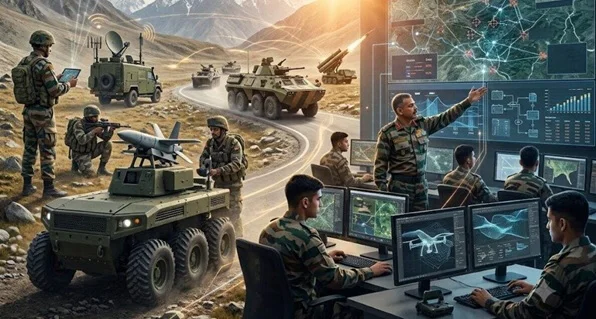
The doctrine responds to a battlefield increasingly shaped by drones, artificial intelligence, precision weapons, persistent surveillance and networked operations. These technologies can change how forces gather information, identify targets and coordinate action.
The framework emphasises coordination among the armed forces and integration of capabilities across multiple domains. Land power remains central, while operations increasingly connect with activity in areas such as cyber, space and the electromagnetic spectrum.
The doctrine highlights the role of soldiers and commanders alongside unmanned systems. Man–unmanned teaming can combine human judgment with the reach and persistence of robotic or remotely operated platforms. The reporting also highlights human leadership and the need to operate in technologically contested environments.
Commanders are expected to adapt operational approaches to the threat, terrain and mission. Resilient logistics and the ability to sustain operations when communications or technology are disrupted are also identified as important themes.
The doctrine places emphasis on Atmanirbharta in defence and a broader national effort. This recognises that future military preparedness depends not only on the armed forces, but also on indigenous defence capabilities, infrastructure and coordination with institutions beyond the military.
The doctrine is reported as aligned with Defence Forces Vision 2047, linking the Army’s future preparedness to long-term defence transformation and integration.
The Land Warfare Doctrine 2026 gives the Indian Army a refreshed framework for preparing for future conflict. Its focus on technology, jointness, adaptable leadership, resilient logistics and self-reliance reflects the changing battlefield. Its effectiveness will ultimately depend on how consistently these principles shape training, procurement and operational readiness.
Prelims MCQWith reference to India’s Land Warfare Doctrine 2026, consider the following statements:
Which of the statements given above is/are correct? A. 1 and 2 only Mains QuestionHow does the Land Warfare Doctrine 2026 address the changing character of warfare? Discuss the challenges involved in translating its principles into operational capability. |
1. What is the Land Warfare Doctrine 2026?It is a high-level framework guiding how the Indian Army prepares for and approaches future land conflicts. 2. Who released the doctrine?Defence Minister Rajnath Singh released it on 23 October 2026. 3. When was the previous Land Warfare Doctrine issued?The previous doctrine was released in December 2018. 4. What major changes in warfare does the new doctrine address?It addresses the growing role of drones, AI, precision warfare, surveillance, information warfare and operations across multiple domains. 5. Why is the doctrine significant for India?It provides a framework for adapting Army preparedness to evolving threats, integrating capabilities and strengthening self-reliance in defence. |



Our support team will be happy to assist you!

 Contact Us
 New Batch : 9555124124/ 7428085757
 Tech Support : 9555124124/ 7428085757
