New
Hindi Medium: (Delhi) - GS Foundation (P+M) : 21st Sept. 2026, 11:30 AM Hindi Medium: (Prayagraj) - GS Foundation (P+M) : 22nd Sept. 2026, 8:00 AM English Medium: (Delhi) - GS Foundation (P+M) : 6th Aug 2026 English Medium: (Prayagraj) - GS Foundation (P+M) : 19th Aug 2026, 11:00 AM Hindi Medium: (Delhi) - GS Foundation (P+M) : 21st Sept. 2026, 11:30 AM Hindi Medium: (Prayagraj) - GS Foundation (P+M) : 22nd Sept. 2026, 8:00 AM English Medium: (Delhi) - GS Foundation (P+M) : 6th Aug 2026 English Medium: (Prayagraj) - GS Foundation (P+M) : 19th Aug 2026, 11:00 AM

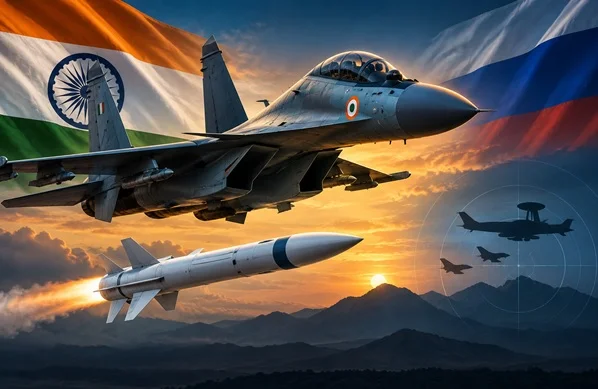
India’s Su-30MKI to Integrate Russian RVV-BD Missile: Key Facts, Range Missile, Importance of Radar, Strategic Significance and Challenges

Prelims: Su-30MKI, RVV-BD, BVR air-to-air missiles, Astra missile, BrahMos, Defence Acquisition Council, HAL, DRDO and India-Russia defence cooperation.
Mains: GS Paper II (International Relations): India-Russia strategic partnership, defence cooperation and India's strategic autonomy.
GS Paper III (Security & Defence Technology): Fighter-aircraft modernisation, missile technology, indigenous defence production, Atmanirbhar Bharat and technological self-reliance.

Why in news?

  • The Defence Ministry is taking up a proposal to modify the Su-30MKI so it can employ the RVV-BD, a Russian very-long-range air-to-air missile. 

Key Facts 

Particular

Details

Aircraft

Su-30MKI

Operator

Indian Air Force

Missile proposed

RVV-BD

Origin of missile

Russia

Type

Very/long-range air-to-air missile

Reported range for proposed weapon

Up to ~300 km

Primary role

Beyond-Visual-Range aerial engagement

Potential high-value targets

AEW&C/AWACS, reconnaissance and other support aircraft

Proposal considered by

Defence Acquisition Council

Su-30MKI fleet

More than 260 aircraft reported in service

Related Indian missile programme

Astra family

What is the Su-30MKI?

  • A twin-engine, two-seat, multirole fighter aircraft developed from Russia’s Su-30 family and customised for India. 
  • It combines a Russian-origin airframe with a mix of systems and weapons developed or sourced from multiple countries, while India has progressively increased indigenous maintenance, production and integration capabilities.
  • The aircraft is produced in India under licence by Hindustan Aeronautics Limited (HAL) and constitutes one of the largest components of the IAF’s combat fleet. More than 260 Su-30MKIs are currently reported to be in service.
  • Su-30MKI's broad roles are Air Superiority, Air Defence, Ground Attack, Maritime Strike and Long-Range Strike. 

What is the RVV-BD Missile?

  • A Russian long-range air-to-air missile intended to engage aerial targets at extended distances. It belongs to the broader lineage associated with Russia’s R-37 family of long-range missiles. Contemporary reporting on the Indian proposal describes a capability of engaging targets at distances of up to around 300 km.
  • It is particularly relevant for engaging high-value airborne platforms such as AEW&C/AWACS aircraft, reconnaissance aircraft and other high-value support aircraft. 
  • These aircraft often operate behind frontline fighters and provide surveillance, command-and-control or other force-multiplying capabilities.

What is a Beyond-Visual-Range Missile?

  • A BVR air-to-air missile allows a fighter to engage an aerial target at a distance where the pilot cannot directly see it.
  • Traditional close-range combat: Fighter Visual contact Short-range missile/gun Target
  • BVR combat: Sensor detects target Target data processed Missile launched from long distance Missile guides towards target

Why Does India Want the RVV-BD?

  • A fighter carrying a very-long-range missile could potentially threaten high-value support aircraft without first having to penetrate deeply into heavily defended airspace.
  • Existing situation: Su-30MKI Radar/Sensors Existing BVR weapons
  • Proposed capability: Upgraded Su-30MKI Long-range detection/targeting network RVV-BD Engagement at much greater distance

Why are AWACS/AEW&C Aircraft important?

  • Airborne Warning and Control System (AWACS) and Airborne Early Warning and Control (AEW&C) aircraft act as airborne surveillance and command nodes.
  • They can help detect aircraft at long distances, track multiple targets, coordinate fighter operations, improve situational awareness, support command and control. 

What Modifications would Su-30MKI need?

  • The fighter and weapon need to communicate effectively. Integration can require changes to weapons-management software, avionics and interfaces, targeting and radar compatibility, launch and guidance functions and testing and certification.
  • Reports on the current proposal specifically indicate modifications to the Su-30MKI for operational integration of the RVV-BD. The precise technical configuration, however, has not been publicly detailed.

Why Radar matters

  • A very-long-range missile is useful only if the wider combat network can provide sufficiently accurate target information.
  • Long-range Sensor + Targeting Data + Long-range Missile = Effective BVR Capability
  • Better radar, avionics, electronic warfare and networking can substantially improve the aircraft's ability to exploit long-range weapons.

Su-30MKI Modernisation

  • The Ministry of Defence’s own reporting confirms continuing work related to indigenous systems for the Su-30MKI; for example, its annual reporting has referenced an indigenous Radar Warning Receiver (R-118) for the aircraft.
  • The larger modernisation concept commonly referred to as the “Super Sukhoi” upgrade has been associated with improvements in radar, avionics, electronic warfare, weapons integration, cockpit systems and indigenous content. 
  • The RVV-BD proposal should therefore be understood as part of a broader effort to keep the Su-30MKI effective in an increasingly complex air-combat environment, although it is a distinct proposal rather than necessarily the same procurement package.

Astra vs RVV-BD

  • RVV-BD: Could provide a very-long-range capability based on an established Russian missile family.
  • Astra family: Builds India's indigenous technological base and progressively reduces dependence on imported air-to-air weapons.

Su-30MKI and BrahMos

RVV-BD

BrahMos

Air-to-air missile

Primarily air-launched cruise missile for surface targets

Targets aircraft

Targets land/sea targets

BVR air combat

Long-range precision strike

Strengthens air superiority

Strengthens strike capability

What is the Defence Acquisition Council?

  • The DAC is the Defence Ministry's apex body for major capital-acquisition decisions. It is chaired by the Defence Minister.
  • A proposal being considered by the DAC does not mean that the weapon has already been purchased. Defence acquisition generally involves multiple subsequent stages.

Strategic Importance 

  • Longer Air-to-Air Engagement Range: The proposed missile could significantly expand the distance at which the Su-30MKI can threaten certain aerial targets.
  • Threat to High-Value Platforms: The ability to threaten AEW&C and reconnaissance platforms could affect an adversary's surveillance and command network.
  • Stand-Off Capability: Longer-range weapons allow fighters to engage some targets without approaching as closely to hostile aircraft or air-defence systems.
  • Extending Su-30MKI Relevance: New sensors, electronic warfare systems and weapons can help keep the large Su-30MKI fleet operationally relevant even as newer-generation fighters enter service.

India's Air-Combat Modernisation

  • The RVV-BD proposal should also be viewed within India's wider effort to modernise its air-combat capability.
  • This includes Su-30MKI modernisation, Rafale fleet, Tejas programme, Astra missile family, BrahMos integration, AEW&C capabilities and Air-defence systems.
  • The objective is not merely to acquire individual weapons but to create an increasingly networked air-combat ecosystem.

India-Russia Defence Cooperation

  • Russia has historically been a major source of military platforms and technology for India, including Su-30MKI fighters, MiG-series aircraft, T-90 tanks, S-400 air-defence systems and various naval platforms and systems.
  • India's defence policy increasingly emphasises Atmanirbhar Bharat, domestic manufacturing and indigenous research and development.

Challenges

  • Integration Complexity: A new weapon needs extensive software, avionics and flight testing before operational clearance.
  • Cost: Modernising a large fighter fleet and acquiring sophisticated missiles can require substantial expenditure.
  • Foreign Dependence: Continued reliance on imported high-end weapons can create supply-chain and geopolitical vulnerabilities.
  • Sensor-Weapon Matching: A very-long-range missile achieves its full potential only when supported by adequate detection, tracking and targeting capabilities.
  • Electronic Warfare: Modern BVR warfare involves intense electronic countermeasures, meaning nominal missile range alone does not determine combat effectiveness.

Prelims MCQ

Q. With reference to the RVV-BD missile, consider the following statements:

  1. It is a Russian-origin long-range air-to-air missile.
  2. India is considering its integration with the Su-30MKI fighter aircraft.
  3. It is primarily meant for engaging ground targets.

Which of the statements given above is/are correct?

A. 1 only

B. 1 and 2 only

C. 2 and 3 only

D. 1, 2 and 3

Mains Practice Question 

Q. How can the modernisation of fighter aircraft strengthen India’s air defence capabilities? Discuss.

FAQs

What is the RVV-BD?

The RVV-BD is a Russian-origin long-range air-to-air missile designed to engage aerial targets at extended ranges.

Which Indian fighter aircraft is proposed to carry the RVV-BD?

India is considering integrating it with the Indian Air Force's Su-30MKI fighter aircraft.

What is the reported range of the RVV-BD?

Current reporting on India's proposal describes an engagement range of up to around 300 km, although actual effective range varies with operational conditions.

What is the Su-30MKI?

The Su-30MKI is a twin-engine, two-seat multirole fighter aircraft and a major component of the Indian Air Force's combat fleet.

What is the Defence Acquisition Council (DAC)?

The DAC is the Defence Ministry's apex body for major capital acquisition decisions and is chaired by the Defence Minister.

Have any Query?

Our support team will be happy to assist you!

OR