Why in News?
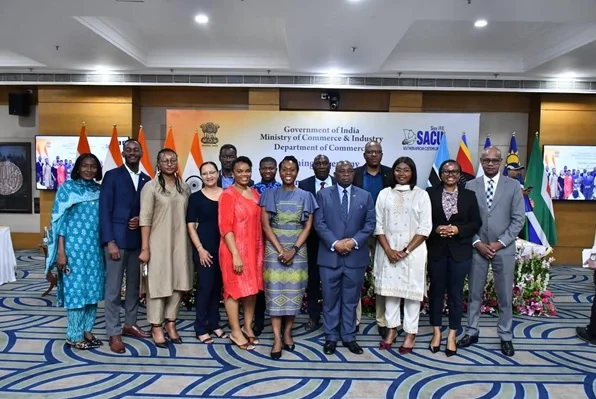
- India and the Southern African Customs Union (SACU) have signed the Terms of Reference (ToR) to begin negotiations for a Preferential Trade Agreement (PTA).
- The agreement is expected to strengthen economic ties, improve market access, and deepen India's engagement with Africa. Both sides aim to conclude negotiations within one year.
What is the Southern African Customs Union (SACU)?
- The Southern African Customs Union (SACU) is the oldest customs union in the world, established in 1910.
- It is a regional economic organization that promotes economic integration among its member countries through a common customs system and coordinated trade policies.
- Member Countries
- South Africa,
- Botswana,
- Namibia,
- Lesotho,
- Eswatini (formerly Swaziland).
- Headquarters :-Windhoek, Namibia
Key Features of SACU
1. Common External Tariff (CET)
- All member countries apply a single external tariff on imports coming from countries outside SACU.
- This ensures uniform customs duties across the customs union.
2. Free Movement of Goods
- Goods can move freely among member countries without customs duties or quantitative restrictions.
- It creates a single customs territory.
3. Customs Revenue Sharing
- Customs and excise revenues collected under the Common External Tariff are pooled and distributed among member states using an agreed formula.
4. Coordinated Trade Policies
- Members coordinate decisions relating to trade, customs administration, industrial development, and external trade negotiations.
5. Dominance of South Africa
- South Africa contributes nearly 91% of SACU's total economic output.
- It is India's largest trading partner within the SACU bloc.
SACU and the Southern African Development Community (SADC)
- All SACU members are also members of the Southern African Development Community (SADC), which seeks broader regional integration in Southern Africa.
SADC Members include:
- Angola, Botswana, Democratic Republic of Congo, Lesotho, Malawi, Mauritius, Mozambique, Namibia, Seychelles, South Africa, Tanzania, Zambia, Zimbabwe, Madagascar, Comoros, Eswatini.
What is a Preferential Trade Agreement (PTA)?
A Preferential Trade Agreement (PTA) is a trade arrangement under which participating countries agree to reduce or eliminate tariffs on selected products while retaining tariffs on others.
Features
- Partial tariff reduction.
- Limited product coverage.
- Improves market access.
- Encourages bilateral and regional trade.
- Acts as a stepping stone toward a Free Trade Agreement (FTA).
Terms of Reference (ToR) Signed Between India and SACU
The ToR provides the framework for PTA negotiations. It covers eight major chapters:
- Trade in Goods
- Market Access
- Customs Procedures
- Sanitary and Phytosanitary (SPS) Measures
- Technical Barriers to Trade (TBT)
- Trade Remedies
- Rules of Origin
- Dispute Settlement
Importance of the India–SACU PTA
1. Expanding India's Presence in Africa
- Enhances India's strategic and economic engagement with Southern Africa.
- Supports India's vision of becoming a trusted development partner in Africa.
2. Improved Market Access
- Indian exporters will gain better access to SACU markets.
- Reduced tariffs will improve the competitiveness of Indian products.
3. Boost to Bilateral Trade
- Promotes trade diversification.
- Encourages investment and supply-chain integration.
4. Strategic Significance
- Helps India counter growing global competition in Africa.
- Strengthens South-South cooperation.
5. Opportunities for Indian Industries
Likely beneficiary sectors include:
- Pharmaceuticals
- Automobiles and auto components
- Engineering goods
- Textiles
- Chemicals
- Information Technology services
- Agricultural products
Benefits for SACU Countries
- Greater access to the large Indian market.
- Increased foreign investment.
- Technology transfer and industrial cooperation.
- Employment generation.
- Diversification of export destinations.
Challenges
- Differences in tariff structures.
- Sensitive agricultural products.
- Compliance with SPS and TBT standards.
- Rules of Origin negotiations.
- Balancing domestic industry interests with trade liberalization.
India–Africa Trade Relations
- Africa is an important partner under India's Global South outreach.
- India is among Africa's largest trading partners.
- India imports:
- Gold
- Coal
- Minerals
- Crude oil
- India exports:
- Pharmaceuticals
- Machinery
- Engineering goods
- Automobiles
- Textiles
- Chemicals
- Food products
The proposed PTA is expected to further strengthen these economic linkages.
Difference Between PTA, FTA, Customs Union and Common Market
|
Agreement
|
Tariff Reduction
|
Common External Tariff
|
Free Movement of Goods
|
Free Movement of Labour & Capital
|
|
Preferential Trade Agreement (PTA)
|
Partial
|
No
|
Limited
|
No
|
|
Free Trade Agreement (FTA)
|
Almost Complete
|
No
|
Yes
|
No
|
|
Customs Union
|
Complete
|
Yes
|
Yes
|
No
|
|
Common Market
|
Complete
|
Yes
|
Yes
|
Yes
|
Way Forward
- Complete PTA negotiations within the proposed timeline.
- Improve customs cooperation and digital trade facilitation.
- Enhance connectivity and logistics between India and Southern Africa.
- Promote investment partnerships and technology exchange.
- Strengthen India–Africa cooperation under the Global South framework.
FAQs: India–SACU Preferential Trade Agreement (PTA)
Q1. What is the Southern African Customs Union (SACU)?
Answer: The Southern African Customs Union (SACU) is the world's oldest customs union, established in 1910. It comprises South Africa, Botswana, Namibia, Lesotho, and Eswatini and promotes free trade among its members through a common external tariff and coordinated trade policies.
Q2. Why is India negotiating a Preferential Trade Agreement (PTA) with SACU?
Answer: India aims to expand trade, improve market access, strengthen economic cooperation with Southern Africa, diversify export markets, and deepen its strategic engagement with Africa under its Global South policy.
Q3. What is a Preferential Trade Agreement (PTA)?
Answer: A Preferential Trade Agreement (PTA) is a trade arrangement in which participating countries reduce or eliminate tariffs on selected goods, providing preferential market access without removing tariffs on all products.
|






 Contact Us
  New Batch : 9555124124/ 7428085757
  Tech Support : 9555124124/ 7428085757