Prelims: International Relations, Climate Change, Law of the Sea, Small Island Developing States, Global Governance
Mains Perspective: GS Paper III Environment & Climate Change
GS Paper II International Relations, International Institutions and International Law
Keywords: Sea-level rise, UN Political Declaration 2026, Small Island Developing States, SIDS, statehood, UNCLOS, maritime zones, Exclusive Economic Zone, climate-induced displacement |
Why in News?
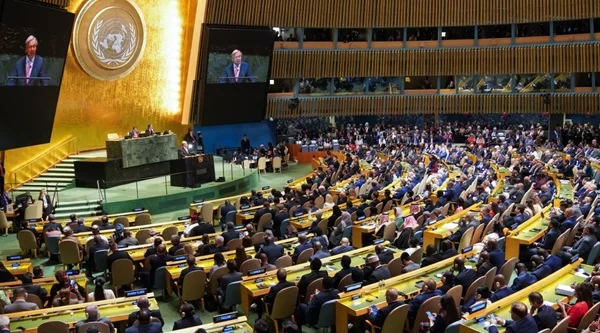
- On 24 September 2026, the United Nations General Assembly adopted a Political Declaration addressing the existential threats posed by sea-level rise. The declaration recognises the need for continuity of statehood and legal certainty for countries whose territory is threatened by rising seas.
- The development is particularly significant for Small Island Developing States (SIDS) and low-lying coastal countries, where sea-level rise threatens territory, population, livelihoods and national identity. The UN has warned that up to 1.2 billion people could face displacement by 2050 without adequate adaptation measures.
What is the UN Declaration on Sea-Level Rise?
The declaration is a political, non-legally binding commitment adopted at a high-level UN meeting on sea-level rise. Its central objective is to establish greater international cooperation on the consequences of rising seas, particularly for vulnerable states.
The declaration addresses three interconnected issues:
- Continuity of Statehood: Countries should not automatically lose their statehood merely because climate change causes severe territorial loss or even physical submergence.
- Stability of Maritime Zones: Existing maritime zones established under the United Nations Convention on the Law of the Sea (UNCLOS) should retain legal certainty despite changes to coastlines.
- Protection of People: States should strengthen measures for adaptation, early-warning systems, risk information, livelihoods, cultural heritage and the rights of people affected by displacement.
The UN meeting specifically identified statehood, maritime zones and protection of affected populations as major legal and humanitarian concerns.
Why is Continuity of Statehood Important?
- Traditional international law considers territory, population and government among the important elements associated with statehood.
- This creates a difficult question for countries such as Tuvalu, Kiribati and the Maldives, where sea-level rise can progressively reduce habitable land.
If a country's physical territory becomes uninhabitable or disappears, questions could arise regarding:
- Does the country continue to exist as a sovereign state?
- What happens to its UN membership?
- Will its citizens retain their nationality?
- Can its government continue to represent the country?
- What happens to its maritime zones and natural resources?
The UN declaration supports a “presumption in favour of continued statehood”, providing an important political basis for maintaining the international legal identity of vulnerable countries.
Maritime Rights and UNCLOS
One of the most important aspects of the declaration concerns maritime zones. Under UNCLOS, coastal states possess maritime zones such as:
- Territorial Sea – up to 12 nautical miles
- Contiguous Zone – up to 24 nautical miles
- Exclusive Economic Zone (EEZ) – up to 200 nautical miles
- Continental Shelf – subject to UNCLOS provisions
For small island states, these maritime areas can be far more significant economically than their land territory.
- Kiribati has a vast ocean area compared with its extremely small land area. Fisheries, seabed resources and other marine economic activities are therefore closely connected with its national economic survival.
- The sea-level-rise debate raises the question of whether changing coastlines should automatically alter previously established maritime zones. The emerging international position seeks greater legal stability and certainty for vulnerable states.
Sea-Level Rise: The Scientific Dimension
The UN General Assembly President noted that global mean sea level increased from around 2.1 mm annually during 1993–2002 to approximately 4.7 mm annually during 2015–2024.
Major impacts include
- Coastal flooding: Higher sea levels increase the frequency and severity of coastal flooding during storms and high tides.
- Saltwater intrusion: Seawater can enter freshwater systems and agricultural land, affecting drinking water and food production.
- Coastal erosion: Beaches, wetlands and inhabited coastal areas can progressively disappear.
- Displacement: People may be forced to relocate when their homes become unsafe or economically unviable.
- Loss of cultural heritage: For island communities, land is closely connected with identity, traditions and historical heritage.
The UN has warned that rising seas could contribute to displacement affecting up to 1.2 billion people by 2050, when combined with related pressures such as flooding, water stress and food insecurity.
Why Small Island States Are Particularly Vulnerable
- Small Island Developing States contribute relatively little to global greenhouse-gas emissions but face disproportionate consequences from climate change.
- The issue is therefore not simply environmental. It involves sovereignty, international law, migration, human rights, security and economic survival.
- The UN has highlighted that for some island states, substantial loss of territory or complete submergence could raise fundamental questions about nationality, culture and statehood.
Sea-Level Rise and India
India is also vulnerable because of its long coastline, densely populated coastal regions, major ports and economically important coastal cities.
Potential impacts include:
- Coastal flooding and erosion
- Saltwater intrusion into groundwater
- Threats to agriculture and fisheries
- Damage to ports and coastal infrastructure
- Displacement of coastal populations
- Greater pressure on urban infrastructure
Cities such as Mumbai, Kolkata and other densely populated coastal areas require long-term adaptation planning. The issue is therefore relevant to India's climate security, coastal management, disaster management and blue economy.
International Law and Climate Change
- The sea-level-rise debate has increasingly moved from climate policy into the field of international law.
- In May 2024, the International Tribunal for the Law of the Sea (ITLOS) issued an advisory opinion concerning states' obligations relating to climate change and marine pollution.
- In July 2025, the International Court of Justice (ICJ) issued its advisory opinion on states' obligations regarding climate change.
Major Challenges
1. Non-binding nature
The declaration is a political declaration rather than a legally binding treaty. Its effectiveness will therefore depend heavily on implementation and subsequent state practice.
2. Adaptation finance gap
Developing countries require substantial resources for coastal protection, resilient infrastructure, relocation and disaster preparedness.
The challenge is particularly severe for small states with limited fiscal capacity.
3. Planned relocation
Some communities may eventually need to relocate. This creates difficult questions concerning:
- Citizenship
- Land ownership
- Cultural identity
- Political representation
- Livelihoods
- International migration
4. Maritime boundary uncertainty
Even if the principle of stability is politically accepted, questions surrounding baselines, maritime boundaries and implementation under UNCLOS remain legally complex.
5. Loss of cultural heritage
For island communities, losing physical territory can also mean losing sacred places, historical sites, traditional livelihoods and cultural landscapes.
Key priorities should include
- Strengthening adaptation: Coastal protection, resilient infrastructure, mangrove restoration and climate-resilient urban planning should be expanded.
- Improving early-warning systems: Vulnerable communities need reliable forecasting, coastal monitoring and accessible risk information.
- Closing the finance gap: Climate finance should become more accessible to developing and small island states, particularly through grants and concessional financing.
- Legal certainty: International law should provide greater clarity regarding continued statehood, nationality and maritime zones.
- Planned relocation: Where relocation becomes unavoidable, it should protect human rights, livelihoods, cultural identity and political participation.
- Climate mitigation: Long-term protection from sea-level rise ultimately requires significant reductions in greenhouse-gas emissions.
MCQ
Consider the following statements regarding the UN Political Declaration on sea-level rise:
- It supports the continuity of statehood of countries affected by sea-level rise.
- It seeks legal stability regarding established maritime zones.
- It is a legally binding treaty under UNCLOS.
- It calls for stronger adaptation, early-warning systems and protection of affected communities.
Which of the statements given above are correct?
A. 1 and 2 only
B. 1, 2 and 4 only
C. 2 and 3 only
D. 1, 2, 3 and 4
Mains Question
“Sea-level rise is no longer merely an environmental challenge but a question of sovereignty, international law and human security.” Discuss in the context of the UN Political Declaration on sea-level rise.
|
FAQs
1. What did the UN declare on sea-level rise in 2026?
The UN General Assembly adopted a Political Declaration addressing the existential threats posed by sea-level rise and supporting international cooperation on statehood, maritime zones, adaptation and protection of affected populations.
2. Does a country automatically lose statehood if it becomes submerged?
The declaration supports a presumption in favour of continued statehood, meaning physical territorial loss due to sea-level rise should not automatically result in the disappearance of a state's international legal identity.
3. Why is UNCLOS important in the sea-level-rise debate?
UNCLOS provides the principal international legal framework governing maritime zones, including territorial seas and EEZs. Stability of these zones is particularly important for small island states.
4. How does sea-level rise affect India?
India faces risks to coastal cities, ports, agriculture, fisheries, groundwater and coastal infrastructure, making sea-level rise an important component of India's climate and disaster-management strategy.
5. Is the UN declaration legally binding?
No. It is a political declaration. Its significance lies in establishing common political commitments and strengthening international consensus rather than creating a new legally binding treaty.
|







 Contact Us
  New Batch : 9555124124/ 7428085757
  Tech Support : 9555124124/ 7428085757