New
GS Foundation (P+M) - Delhi : 19th Jan. 2026, 11:30 AM Spring Sale UPTO 75% + 10% Off, Valid Till : 6th Feb., 2026 GS Foundation (P+M) - Prayagraj : 09th Jan. 2026, 11:00 AM Spring Sale UPTO 75% + 10% Off, Valid Till : 6th Feb., 2026 GS Foundation (P+M) - Delhi : 19th Jan. 2026, 11:30 AM GS Foundation (P+M) - Prayagraj : 09th Jan. 2026, 11:00 AM

India–U.S. Trade Understanding 2026: Rebalancing Commerce, Deepening Strategic Ties

Prelims: (Economy + CA)
Mains: (GS 2 – International Relations, GS 3 – Indian Economy, Trade & External Sector)

Why in News ?

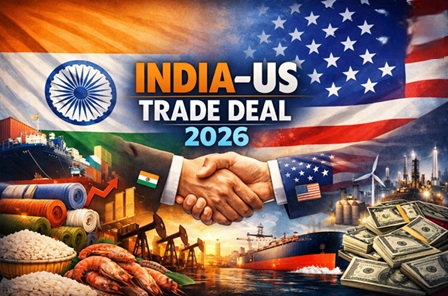
India has committed to importing goods worth $100 billion annually from the United States for five years as part of a broader trade understanding that also involves significant tariff reductions by the U.S.
The move comes after a phase of escalating trade tensions, particularly the U.S. decision in August 2025 to raise tariffs on Indian goods to 50%, and marks a major recalibration of bilateral economic relations.
Background and Context: India–U.S. Trade Relations

  • India and the United States share a rapidly expanding trade relationship, driven by:
    • Strategic convergence,
    • Supply chain diversification,
    • Geopolitical realignments.
  • The U.S. is India’s largest trading partner, particularly in:
    • Services,
    • Pharmaceuticals,
    • Engineering goods,
    • IT and digital services.
  • However, trade relations have also been marked by:
    • Disputes over tariffs,
    • Market access barriers,
    • Digital trade regulation,
    • Agricultural imports and subsidies.

Escalation and Negotiation Trigger

  • In August 2025, the U.S. imposed 50% tariffs on several Indian goods, citing:
    • Persistent trade imbalances,
    • Market access concerns.
  • This escalation:
    • Threatened India’s export competitiveness,
    • Heightened uncertainty for Indian exporters and investors.
  • The 2026 trade understanding emerges as a de-escalatory and stabilising mechanism, seeking to:
    • Restore predictability,
    • Protect domestic sensitivities,
    • Reinforce strategic trust.

Key Features of the India–U.S. Trade Deal 2026

1. Large-Scale Import Commitment

  • India has committed to importing $100 billion worth of U.S. goods annually for five years, more than double the $45.62 billion imported in FY25.
  • Major import categories include:
    • Energy products (oil, gas, coal),
    • Aircraft and aircraft parts,
    • Technology and high-value manufactured goods,
    • Precious metals,
    • Nuclear-related equipment,
    • Selected agricultural products.

2. Tariff Reduction by the United States

  • The U.S. has agreed to reduce tariffs on Indian goods to 18%, down from the earlier 50%.
  • This significantly:
    • Restores market access,
    • Enhances export competitiveness in:
      • Engineering goods,
      • Textiles,
      • Auto components,
      • Pharmaceuticals.

3. Protection of Sensitive Sectors

  • India has maintained explicit protection for:
    • Genetically modified (GM) agricultural products,
    • Dairy,
    • Poultry,
    • Maize, cereals, and corn.
  • This calibrated approach reflects:
    • India’s commitment to food security,
    • Protection of small and marginal farmers,
    • Continuity with India’s long-standing agricultural trade policy.

Agriculture and Market Access Framework

  • India has allowed quota-based or limited access for select commodities such as:
    • Cotton,
    • Pulses,
    • Chestnuts,
    • Onions.
  • Market access has also been extended to:
    • Apples,
    • Wine,
    • Spirits,
    • Beer — products already permitted under India’s agreements with partners like the EU and New Zealand.
  • The government has reiterated that:
    • No compromise has been made on farmer welfare, and
    • Safeguards remain in place to prevent market distortion.

Strategic and Economic Significance

1. Addressing Trade Imbalances

  • The deal seeks to:
    • Reduce persistent U.S. trade deficits, particularly in goods and agriculture.
  • For India, it:
    • Eases tariff pressure,
    • Ensures continued access to the world’s largest consumer market.

2. Energy Security and Diversification

  • Large-scale imports of:
    • Oil,
    • Natural gas,
    • Coal,
  • Support India’s:
    • Energy diversification strategy,
    • Reduction of dependence on geopolitically volatile regions,
    • Long-term supply stability.

3. Industrial and Technological Upgradation

  • Increased imports of:
    • Aircraft,
    • Advanced machinery,
    • Nuclear and high-tech equipment,
  • Can:
    • Support infrastructure development,
    • Enable technology transfer,
    • Strengthen domestic manufacturing capacity.

4. Geopolitical and Strategic Alignment

  • Beyond economics, the deal:
    • Reinforces India–U.S. strategic alignment,
    • Reflects growing convergence amid:
      • Global supply chain reconfiguration,
      • Decoupling pressures,
      • Strategic competition with China.
  • Trade is increasingly being used as a:
    • Tool of diplomacy,
    • Instrument of strategic reassurance and partnership consolidation.

Concerns and Criticism

1. Fiscal and Trade Deficit Risks

  • Fixed import commitments may:
    • Constrain India’s trade flexibility,
    • Widen the merchandise trade deficit if exports do not grow proportionately.

2. Farmer and MSME Concerns

  • Farmer organisations fear:
    • That surplus U.S. agricultural produce could seek deeper market access over time,
    • Potentially affecting domestic prices, incomes, and livelihoods.
  • MSMEs worry about:
    • Increased competition from high-value manufactured imports.

3. Absence of a Formal Free Trade Agreement (FTA)

  • Despite its scale, the deal:
    • Falls short of a comprehensive FTA,
    • Lacks a robust dispute resolution mechanism,
    • Leaves uncertainty about long-term enforceability and institutional oversight.

Way Forward

  • India must:
    • Closely monitor implementation and ensure safeguard clauses remain effective.
  • Simultaneously, it should:
  • Push for export expansion in:
    • Services,
    • Manufacturing,
    • Digital trade,
    • Technology and innovation sectors.
  • Strengthening:
    • Domestic productivity,
    • Competitiveness,
    • Supply chain resilience,
  • Will be critical to maximising gains and ensuring that trade liberalisation aligns with national development priorities.

FAQs

1. What is the core feature of the India–U.S. Trade Deal 2026 ?

India’s commitment to import $100 billion worth of U.S. goods annually for five years, alongside U.S. tariff reductions on Indian exports.

2. Why is this deal strategically significant for India ?

It strengthens India–U.S. geopolitical alignment, enhances energy security, and reinforces India’s position in global supply chain realignment.

3. How does the deal affect Indian farmers ?

While limited agricultural market access is provided, India has protected sensitive sectors and maintained safeguards to ensure farmer welfare.

4. Why is the absence of a formal FTA a concern ?

Without an FTA, the arrangement lacks strong legal enforceability, institutional dispute resolution, and long-term certainty.

5. What should India focus on going forward ?

Expanding exports, strengthening domestic competitiveness, safeguarding vulnerable sectors, and aligning trade policy with development and constitutional values.

Have any Query?

Our support team will be happy to assist you!

OR