Prelims : Defence + CA
Mains : GS Paper 3 – Security, Maritime Security, Indian Ocean Region |
Why in News ?
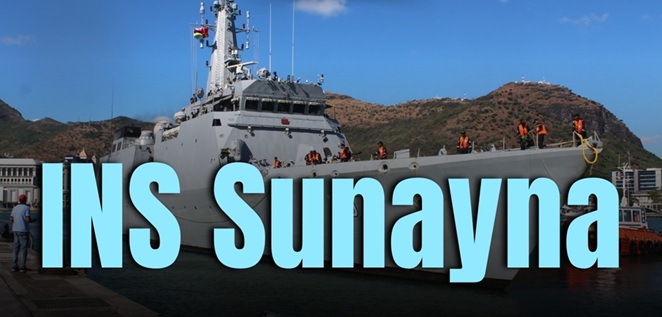
- The Indian Navy’s offshore patrol vessel INS Sunayna has reached Malé as part of its deployment under the Indian Ocean Ship (IOS) SAGAR initiative.
- The deployment highlights India’s efforts to enhance maritime cooperation, regional security, and presence in the Indian Ocean Region (IOR).
Background and Context
- India has been actively strengthening its maritime engagement in the Indian Ocean Region (IOR) through initiatives like SAGAR (Security and Growth for All in the Region).
- Such deployments aim to promote regional stability, humanitarian assistance, and cooperative security frameworks.
- The IOS SAGAR initiative reflects India’s role as a net security provider in the region.
About INS Sunayna
- INS Sunayna is the second Saryu-class offshore patrol vessel of the Indian Navy.
- It was indigenously designed and constructed by Goa Shipyard Limited, reflecting India’s growing defence manufacturing capability.
- The vessel was commissioned on 15th October 2013 at Kochi.
- It operates under the Southern Naval Command of the Indian Navy.
Functions and Roles
- INS Sunayna is designed to undertake a wide range of operations, including :
- Coastal and offshore patrolling
- Ocean surveillance and monitoring
- Protection of sea lines of communication (SLOCs)
- Escort and fleet support operations
- These roles are critical for ensuring maritime security, trade safety, and strategic presence in the IOR.
Key Features of INS Sunayna
1. Propulsion and Speed
- The vessel is powered by two diesel engines, enabling it to achieve speeds exceeding 25 knots.
- It is equipped with an automatic power management system, enhancing operational efficiency.
2. Advanced Systems
- The ship is fitted with modern navigation, communication, and electronic support systems, ensuring effective surveillance and coordination.
3. Armament Capability
- INS Sunayna is equipped with :
- A 76 mm main gun with electro-optic fire control system
- Close-in Weapon Systems (CIWS)
- CHAFF launchers for defence against missile threats
4. Aviation Capability
- The vessel has the capability to operate and carry a helicopter, significantly enhancing its surveillance and operational reach.
Significance of the Deployment
1. Strengthening Maritime Security
- The deployment enhances India’s ability to monitor strategic sea lanes and ensure regional security in the Indian Ocean.
2. Promoting Regional Cooperation
- Port calls like the one at Malé help strengthen defence and diplomatic ties with neighbouring countries, especially island nations.
3. Supporting SAGAR Vision
- It reinforces India’s commitment to Security and Growth for All in the Region (SAGAR), promoting inclusive maritime development.
4. Showcasing Indigenous Defence Capability
- The deployment highlights India’s progress in indigenous shipbuilding and defence self-reliance (Atmanirbhar Bharat).
Challenges
- Increasing geopolitical competition in the Indian Ocean Region
- Need for sustained naval presence and capacity building
- Ensuring coordination among regional maritime stakeholders
Way Forward
- Strengthen maritime partnerships and joint exercises with IOR countries
- Enhance naval infrastructure and surveillance capabilities
- Promote indigenous defence production and technological innovation
- Expand initiatives like SAGAR for inclusive regional development
Practice Questions
Prelims :
Q. INS Sunayna belongs to which class of vessels ?
(a) Kolkata-class destroyer
(b) Saryu-class offshore patrol vessel
(c) Shivalik-class frigate
(d) Arihant-class submarine
Mains :
“Discuss the importance of offshore patrol vessels like INS Sunayna in ensuring maritime security and promoting India’s strategic interests in the Indian Ocean Region.”
FAQs
Q1. What is INS Sunayna ?
An offshore patrol vessel of the Indian Navy.
Q2. Which initiative is it deployed under ?
Indian Ocean Ship (IOS) SAGAR initiative.
Q3. Where has it recently been deployed ?
Malé, Maldives.
Q4. What are its main functions ?
Patrolling, surveillance, escort duties, and protection of sea lanes.
Q5. Why is it significant ?
It strengthens India’s maritime security and regional cooperation in the Indian Ocean.
|






 Contact Us
  New Batch : 9555124124/ 7428085757
  Tech Support : 9555124124/ 7428085757