The Integrated Guided Missile Development Program (IGMDP) was launched by India in 1983 with the aim of making the country self-sufficient in the field of missile technology.
This program was initiated to strengthen India’s defence capabilities and reduce dependence on foreign technology.
Under this program, a range of advanced missiles was developed, significantly enhancing India’s strategic and defence posture.
Purpose: Designed to intercept low-level targets such as aircraft and drones.
Significance: Provides defence against air threats at close ranges, including near-surface threats.
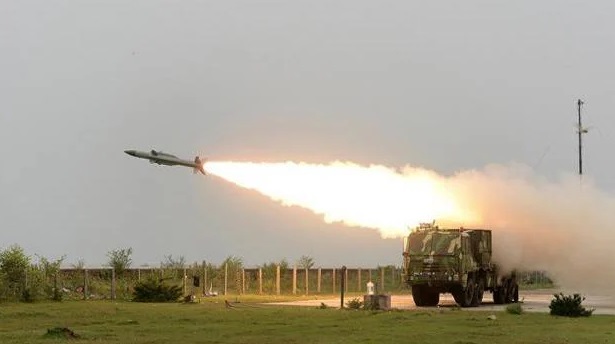
Akash (Medium-Range Surface-to-Air Missile):
Type: Medium-range surface-to-air missile (SAM)
Range:25-30 km
Purpose: Designed for defense against a variety of aerial threats, including aircraft and missiles.
Significance: Provides air defense protection for military and civilian infrastructure.
Nag (Third-Generation Anti-Tank Missile):
Type:Anti-tank guided missile (ATGM)
Range: 3-4 km
Purpose: Designed to destroy heavily armoured targets, especially enemy tanks.
Significance:The Nag missile enhances India’s ground defense capabilities, especially in tank warfare.
Agni Prime
The Agni Prime missile, a nuclear-capable, medium-range ballistic missile, has a range of 1,000 to 2,000 kilometres.
Type: Agni Prime is a new-generation, advanced variant of the Agni class of missiles, a two-stage canisterized solid propellant ballistic missile.
Range: The missile has a maximum range of 1,000 to 2,000 kilometers.
Purpose:It is designed as a medium-range ballistic missile (MRBM).
Significance: It is lighter than all the earlier Agni series of missiles and is a key component of India's nuclear deterrence.
Development:It was developed by the Defence Research and Development Organisation (DRDO) as a successor for Agni-I and Agni-II missiles.
Test: The Agni Prime missile was successfully flight-tested in June 2021.
Canisterized: It is a canister launched missile, which means it can be launched from rail or road, stored for long periods, and transported as per operational requirements.
Key Achievements of IGMDP
IGMDP played a critical role in India’s missile development by creating indigenous capabilities for missile technology, marking a significant advancement in the country's defense sector.
It provided India with the capability to develop a variety of missiles, including surface-to-surface, surface-to-air, and anti-tank systems.
The successful development of missiles like Prithvi, Agni, Akash, Trishul, and Nag laid the foundation for India’s nuclear deterrence strategy and modernized its defense infrastructure.






 Contact Us
  New Batch : 9555124124/ 7428085757
  Tech Support : 9555124124/ 7428085757