Why in News?
The International Day of Clean Air for Blue Skies is being observed on 7 September 2026 worldwide.
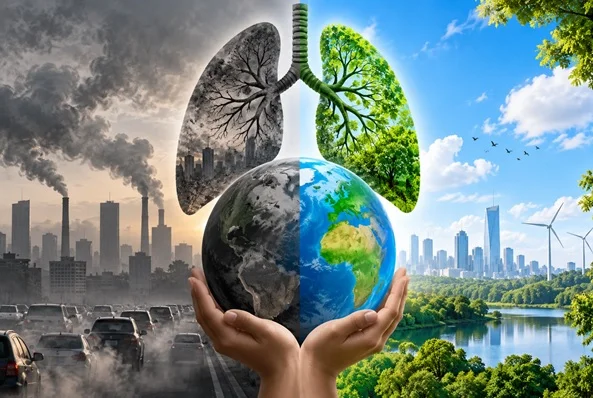
Key Facts
|
Particular
|
Details
|
|
Observed on
|
7 September
|
|
2026 Theme
|
Clean Air for Climate Action
|
|
Established by
|
United Nations General Assembly
|
|
UN Resolution
|
A/RES/74/212
|
|
Resolution adopted
|
19 December 2019
|
|
First observed
|
7 September 2020
|
|
Facilitated by
|
United Nations Environment Programme (UNEP)
|
Background of the day
- The first International Day of Clean Air for Blue Skies was observed on 7 September 2020, with “Clean Air for All” as its theme. The UN invited UNEP to facilitate the observance in collaboration with relevant organisations.
- The Day seeks to build a global community of action, recognising that air pollution often crosses political and geographical boundaries and therefore requires cooperation at the individual, local, national, regional and international levels.
International Day of Clean Air for Blue Skies 2026
- The 2026 observance goes beyond viewing clean air only as an environmental issue. It stresses that reducing air pollution can generate substantial benefits for health, economic prosperity and climate stability.
- Many major sources of air pollution particularly the burning of fossil fuels and biomass also release greenhouse gases. The 2026 campaign therefore focuses on the idea Clean Air Action, Climate Action, Better Health, Stronger Economy and Climate Benefits.
- The campaign also highlights new findings from the Global Economic Assessment of Integrated Climate and Clean Air Action, with 25 proven measures and policy reforms demonstrating how coordinated action can produce multiple benefits.
What is Air Pollution?
- Air pollution occurs when harmful chemical, physical or biological agents contaminate the atmosphere and alter its natural characteristics. Major sources include motor vehicles, industries, household cooking and heating, power generation, waste burning, agricultural activities and forest fires.
- Important air pollutants include Particulate Matter (PM2.5 and PM10), Nitrogen dioxide (NO₂), Sulphur dioxide (SO₂), Carbon monoxide (CO), Ground-level ozone (O₃), Lead (Pb), Ammonia (NH₃) and Volatile organic compounds and other toxic pollutants.
- India's National Ambient Air Quality Standards cover 12 parameters, including PM2.5, PM10, SO₂, NO₂, CO, ozone, lead, ammonia, benzene, benzo(a)pyrene, arsenic and nickel.
Why is Air Pollution a Major Global Concern?
- WHO estimates that in 2019, 99% of the global population lived in places where WHO air-quality guideline levels were not met. The combined effects of ambient and household air pollution are associated with approximately 6.7 million premature deaths annually.
- Outdoor air pollution alone was estimated to cause around 4.2 million premature deaths in 2019, with approximately 89% of these deaths occurring in low- and middle-income countries.
- Long-term exposure to polluted air can cause respiratory diseases, cardiovascular diseases, stroke, lung cancer and premature mortality.
Air Pollution and Climate Change
- Air pollution and climate change are closely interconnected because several activities responsible for air pollution also contribute to global warming.
- Fossil-fuel/Biomass burning → Air Pollutants + Greenhouse Gases → Poor Air Quality + Global Warming
- Air pollution affects ecosystems, biodiversity, agricultural productivity and economic development.
- The United Nations identifies air pollution as a problem that can worsen climate change, impose economic losses and reduce agricultural productivity.
Air Pollution and Sustainable Development Goals
|
SDG 3 (Good Health and Well-being)
|
Ensure healthy lives and promote well-being for all ages.
|
|
SDG 7 (Affordable and Clean Energy)
|
Ensure that everyone has access to affordable, reliable, sustainable, and modern energy sources
|
|
SDG 11 (Sustainable Cities and Communities)
|
Create cities and human settlements that are inclusive, safe, resilient, and sustainable
|
|
SDG 12 (Responsible Consumption and Production)
|
Ensure your consumption and production patterns are sustainable
|
|
SDG 13 (Climate Action)
|
Take immediate steps to combat climate change and its consequences
|
Measures taken by India
- The Ministry of Environment, Forest and Climate Change (MoEFCC) launched the National Clean Air Programme (NCAP) in January 2019 as a long-term national strategy for improving air quality.
- The programme initially aimed at reducing particulate-matter concentrations by 20–30% from the 2017 baseline. The target was subsequently revised to achieve up to 40% reduction in PM10 levels or achievement of the national standard of 60 µg/m³ by 2025-26.
- According to a July 2026 government update, clean-air action plans were being implemented for 130 cities. During FY 2025-26, 108 cities recorded reductions in annual PM10 concentrations compared with 2017-18; 26 achieved reductions exceeding 40%, while 14 cities met the National Ambient Air Quality Standards.
- The Pradhan Mantri Ujjwala Yojana (PMUY) has also contributed to the transition towards cleaner household cooking fuels. By 2026, the government highlighted that the programme had expanded LPG access to more than 10 crore women, while noting that sustained usage and affordability remain important priorities.
Prelims MCQ
Q. With reference to the “International Day of Clean Air for Blue Skies”, consider the following statements:
- It is observed every year on 7 September.
- It was designated by the United Nations General Assembly in 2019.
- UNEP facilitates its observance in collaboration with relevant organisations.
Which of the statements given above is/are correct?
A. 1 and 2 only
B. 2 and 3 only
C. 1 and 3 only
D. 1, 2 and 3
Mains Practice Question
Q. “Air pollution is a major challenge for public health and the environment in India.” Discuss the causes of air pollution and suggest measures to control it.
|
FAQs
When is the International Day of Clean Air for Blue Skies observed?
It is observed every year on 7 September.
Who established the International Day of Clean Air for Blue Skies?
It was designated by the United Nations General Assembly (UNGA) in 2019.
Which UN resolution established the Day?
It was established through UN General Assembly Resolution A/RES/74/212.
When was the first International Day of Clean Air for Blue Skies observed?
The first observance took place on 7 September 2020.
How many cities are covered under NCAP?
As of 2026, city-specific Clean Air Action Plans have been prepared for 130 cities.
|







 Contact Us
  New Batch : 9555124124/ 7428085757
  Tech Support : 9555124124/ 7428085757