Why in news?
The United Nations General Assembly proclaimed 23 October as the International Day of the Snow Leopard in 2024 through Resolution A/RES/79/143.
Key Facts
|
Particular
|
Details
|
|
Observed on
|
23 October
|
|
First Observance
|
2014, as an established conservation observance
|
|
UN General Assembly proclamation
|
2024
|
|
Scientific name
|
Panthera uncia
|
|
Common nickname
|
Ghost of the Mountains
|
|
IUCN Red List status
|
Vulnerable
|
|
Global conservation initiative
|
Global Snow Leopard and Ecosystem Protection Program (GSLEP)
|
|
Countries where it occurs
|
12 Asian countries
|
What is a Snow Leopard?
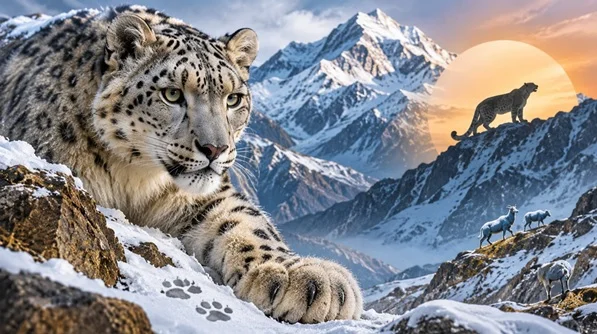
- The snow leopard (Panthera uncia) is a rare big cat found in the high-altitude mountain ranges of Central and South Asia. Its thick fur, long tail, broad paws and powerful hind legs help it survive in cold, rugged terrain.
- Its greyish-white coat, marked with dark rosettes, provides excellent camouflage against rocky slopes and snow-covered landscapes. Because it is elusive and rarely seen in the wild, it is popularly known as the “Ghost of the Mountains.”
- Snow leopards generally inhabit elevations of around 3,000-5,000 metres, although their distribution varies according to geography and climate.
- The species occurs across Afghanistan, Bhutan, China, India, Kazakhstan, Kyrgyzstan, Mongolia, Nepal, Pakistan, Russia, Tajikistan and Uzbekistan.
Why is Snow Leopard conservation important?
- Maintaining ecological balance: Snow leopards are apex predators in many high-mountain ecosystems. They help regulate populations of wild herbivores and contribute to the ecological balance of their habitats.
- Protecting mountain ecosystems: The Mountains that support snow leopards also sustain glaciers, snowfields, rivers and diverse wildlife. Protecting these landscapes helps safeguard water resources and ecosystem services on which millions of people depend.
- Preserving biodiversity: Snow leopards are an important indicator of the health of high-altitude ecosystems. Their survival reflects the condition of habitats, prey populations and the broader environment.
- Supporting local communities: Conservation programmes can create opportunities for community-based wildlife monitoring, responsible tourism and sustainable livelihoods.
Major Threats to Snow Leopards
- Habitat loss and fragmentation: Infrastructure development, mining and other human activities can disturb or divide their habitats.
- Climate change: Rising temperatures and changing snowfall patterns can alter mountain habitats and affect the distribution of prey.
- Declining prey populations: Reductions in wild prey can force snow leopards to target domestic livestock, increasing conflict with herders.
- Poaching and illegal wildlife trade: Snow leopards may be killed for their skins, bones and other body parts.
- Human-wildlife conflict: Livestock losses can lead to retaliatory killings when communities lack effective protection and compensation mechanisms.
Snow Leopard Conservation in India
- India is an important snow leopard range country, with populations distributed across the high-altitude regions of the Himalayas, including Ladakh, Jammu and Kashmir, Himachal Pradesh, Uttarakhand, Sikkim and Arunachal Pradesh.
- According to the Snow Leopard Population Assessment in India (SPAI) report, India recorded an estimated 718 snow leopards in its first nationwide assessment. Ladakh accounted for approximately 477 individuals, making it a major stronghold for the species.
Major Conservation Measures
- Project Snow Leopard: Launched in 2009, this initiative promotes landscape-level conservation of high-altitude wildlife and habitats, with an emphasis on community participation and ecological monitoring.
- Snow Leopard Population Assessment in India (SPAI): This national assessment used scientific methods to estimate the species’ distribution and population, strengthening the evidence base for conservation planning.
- Protected areas and habitat conservation: National parks, wildlife sanctuaries and other conservation landscapes help protect snow leopard habitats and their prey.
- Community participation: Livestock protection, awareness campaigns, responsible tourism and community-based monitoring can reduce conflict and create incentives for conservation.
- International cooperation: India participates in regional collaboration through the Global Snow Leopard and Ecosystem Protection Program, which brings together the 12 snow leopard range countries.
Global Efforts to Protect Snow Leopards
- The Global Snow Leopard and Ecosystem Protection Program (GSLEP) is a collaborative initiative involving governments, conservation organisations, researchers and local communities across the species’ range.
- Its work focuses on protecting snow leopard habitats, improving scientific knowledge, strengthening cross-border cooperation and supporting sustainable livelihoods.
- International frameworks also contribute to protection. The snow leopard is listed in Appendix I of the Convention on International Trade in Endangered Species of Wild Fauna and Flora (CITES), which provides strict controls on international commercial trade in the species.
- The Convention on the Conservation of Migratory Species of Wild Animals (CMS) also lists the species in Appendix I.
Prelims MCQ
Q. Consider the following statements about the snow leopard:
- Its scientific name is Panthera uncia.
- It is found in the Himalayan region.
- It is classified as Vulnerable by the IUCN.
Which of the statements given above are correct?
(a) 1 only
(b) 1 and 2 only
(c) 2 and 3 only
(d) 1, 2 and 3
Mains Practice Question
Q. Why is snow leopard conservation important in India? What are the main threats to its survival?
|
FAQs
When is International Snow Leopard Day celebrated?
It is celebrated every year on 23 October.
What is the scientific name of the snow leopard?
Its scientific name is Panthera uncia.
Why the snow leopard is called the “Ghost of the Mountains”?
Because it is difficult to spot in the mountains and blends easily with its surroundings.
What is the conservation status of the snow leopard?
It is classified as Vulnerable on the IUCN Red List.
How many snow leopards were estimated in India?
India’s first nationwide assessment estimated 718 snow leopards.
|






 Contact Us
 New Batch : 9555124124/ 7428085757
 Tech Support : 9555124124/ 7428085757
