

| Prelims: Initial Public Offering (IPO), SEBI, Book Building, Fresh Issue, Offer for Sale (OFS), Stock Exchanges and Investor Categories. Mains: GS Paper III – Indian Economy, Mobilisation of Resources, Capital Market Reforms, Investment and Economic Growth. Keywords: Jio Platforms IPO 2026, Initial Public Offering, SEBI, Primary Market, Book Building, Listing Gains, Capital Formation, Retail Investors, Investor Protection. |
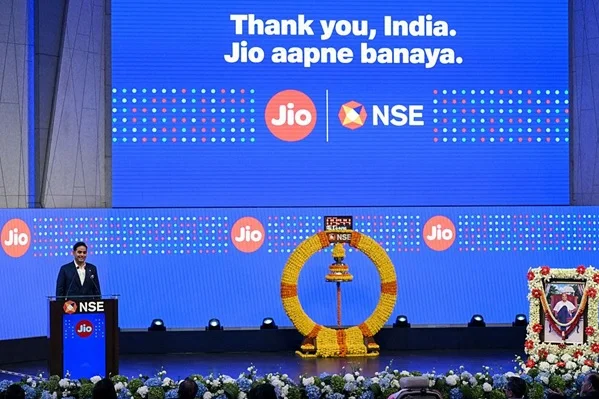
Jio Platforms Limited, the digital services subsidiary of Reliance Industries Limited (RIL), made its stock market debut on 28 October 2026, following India's largest Initial Public Offering (IPO), valued at approximately ₹30,213 crore.
|
Particulars |
Details |
|
Company |
Jio Platforms Limited |
|
Parent company |
Reliance Industries Limited |
|
IPO size |
Approximately ₹30,213 crore |
|
IPO opening date |
21 October 2026 |
|
IPO closing date |
23 October 2026 |
|
Price band |
₹1,065–₹1,119 per share |
|
Final issue price |
₹1,119 per share |
|
Lot size |
12 shares |
|
Minimum investment at issue price |
₹13,428 |
|
Overall subscription |
22.19 times |
|
Listing date |
28 October 2026 |
|
Listing price |
₹1,358 |
|
Listing premium |
21.36% |
|
First-day closing price |
₹1,419 |
|
Gain over issue price at closing |
26.81% |
|
Closing market capitalisation |
Approximately ₹13.07 lakh crore |
|
Basis |
Fresh Issue |
Offer for Sale (OFS) |
|
Meaning |
Company issues new shares |
Existing shareholders sell their shares |
|
Recipient of funds |
Issuing company |
Selling shareholders |
|
Effect on share capital |
Increases issued share capital |
Does not create new shares |
|
Main objective |
Raise new capital |
Provide liquidity or an exit |
|
Ownership impact |
Dilutes existing percentage ownership |
Transfers ownership between shareholders |
In India, IPO pricing generally follows two methods:
|
Book Building Method |
Fixed Price Method |
|
Company announces a price band |
Company announces a fixed issue price |
|
Investors bid within the specified range |
Investors apply at the fixed price |
|
Final price is determined after evaluating bids |
Price is known before subscription |
|
Market demand contributes to price discovery |
No price discovery through competitive bidding |
|
Investor Category |
Description |
|
Retail Individual Investors (RIIs) |
Individuals applying for shares worth up to ₹2 lakh |
|
Qualified Institutional Buyers (QIBs) |
Mutual funds, insurance companies, eligible banks, pension funds and foreign portfolio investors |
|
Non-Institutional Investors (NIIs) |
Investors who do not qualify as retail or institutional investors, including high-value individual applicants |
|
Anchor Investors |
Eligible institutional investors participating before the public issue opens |
|
Employee/Shareholder Categories |
Eligible investors applying under specific reserved portions, where provided |
Under Regulation 6(1) of the SEBI (Issue of Capital and Disclosure Requirements) Regulations, 2018, the principal financial requirements for the main-board profitability route include:
|
Criterion |
Requirement |
|
Net tangible assets |
At least ₹3 crore in each of the preceding three full years |
|
Operating profit |
Average operating profit of at least ₹15 crore during the preceding three years, with operating profit in each year |
|
Net worth |
At least ₹1 crore in each of the preceding three full years |
|
Change of company name |
Where applicable, at least 50% of preceding-year revenue must arise from the activity indicated by the new name |
|
Alternative route |
Companies not satisfying Regulation 6(1) may use the book-building route with at least 75% of the net offer allotted to QIBs, subject to conditions |
|
Law / Regulation |
Major Provisions |
|
SEBI Act, 1992 |
Establishes SEBI and its powers to regulate the securities market |
|
Companies Act, 2013 |
Governs company affairs, share issuance, prospectuses and corporate disclosures |
|
SEBI (ICDR) Regulations, 2018 |
Regulates eligibility, issue procedures and capital-raising disclosures |
|
Securities Contracts (Regulation) Act, 1956 |
Provides the legal framework for regulating securities contracts and recognised stock exchanges |
|
SEBI (LODR) Regulations, 2015 |
Establishes listing obligations, corporate governance and continuous disclosure requirements |
|
Depositories Act, 1996 |
Provides the framework for holding and transferring securities electronically |
Role of SEBI: SEBI safeguards investor interests, regulates market intermediaries and promotes transparency. It does not determine the commercial success of an IPO or set the issue price.
|
Challenge |
Explanation |
|
Overvaluation |
High issue prices may exceed sustainable business fundamentals |
|
Market volatility |
Share prices can fall after listing due to changing market conditions |
|
Information asymmetry |
Retail investors may struggle to interpret complex financial disclosures |
|
Listing-day speculation |
Short-term trading may increase volatility |
|
Corporate governance risks |
Related-party transactions and ownership concentration require monitoring |
|
Sectoral competition |
Business performance can be affected by competitors and technological changes |
|
Dilution of ownership |
A fresh issue reduces existing shareholders' percentage ownership unless they participate proportionately |
The listing of Jio Platforms on 28 October 2026 represents an important milestone in the evolution of India's capital markets. Its ₹30,213 crore IPO, strong institutional participation and substantial listing-day gains highlight the growing scale of India's equity market and investor interest in digital businesses.
Prelims Practice QuestionsQ. Which of the following institutions is the principal securities-market regulator responsible for regulating public issues of equity shares in India? A. Reserve Bank of India B. Securities and Exchange Board of India C. Insurance Regulatory and Development Authority of India D. Competition Commission of India Mains Practice Question"Initial Public Offerings (IPOs) play an important role in capital mobilisation, financial deepening and corporate governance." Examine the significance of IPOs for India's economic development. |
1. What is an Initial Public Offering (IPO)?An IPO is the first public offering of a company's shares, generally associated with its listing on a stock exchange. 2. Why was the Jio Platforms IPO significant?Jio Platforms raised approximately ₹30,213 crore through India's largest IPO, attracting strong investor demand and becoming one of India's most valuable listed companies. 3. What is the difference between an IPO and an FPO?An IPO is a company's first public offering of shares, whereas a Follow-on Public Offer (FPO) involves an already listed company making a subsequent public issue. 4. What is a listing premium?A listing premium is the percentage by which a share's initial stock exchange trading price exceeds its IPO issue price. Jio Platforms listed at a premium of 21.36%. 5. What is the role of SEBI in IPOs?SEBI regulates the securities market, prescribes disclosure and issue requirements, supervises intermediaries and protects investor interests. |