
- UPSC Exam
- State PCS
- One Day Exam
- Current Affairs
- PT Quiz
- Downlaods
- About Coaching
- Blog
- Videos

| Prelims: (Polity & Governance + CA) Mains: (GS 2 – Constitution, Judiciary, Governance & Social Justice) |
A Private Member’s Bill has been introduced in Parliament proposing constitutional amendments to promote diversity in judicial appointments and to establish regional benches of the Supreme Court of India.
The Bill has revived debate over judicial independence, representational equity, the collegium system, and structural reforms in the higher judiciary.
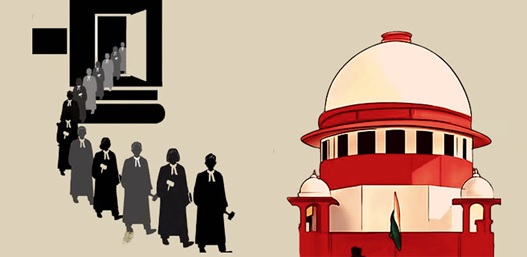
The Constitution of India provides the framework for appointing judges to the higher judiciary.
Supreme Court
High Courts
Seat of the Supreme Court
Initially, appointments were dominated by executive primacy. However, concerns regarding judicial independence led to a reinterpretation of constitutional provisions by the judiciary.
The collegium system was not created by constitutional amendment but through judicial interpretation.
First Judges Case (1981)
The Supreme Court upheld executive primacy in judicial appointments.
Second Judges Case (1993)
The Court reversed its earlier stance and established the collegium system, granting primacy to the judiciary.
Third Judges Case (1998)
Clarified the composition and functioning of the collegium.
Composition
Recommendations are sent to the Central Government, which may return them once for reconsideration. If reiterated, the government is constitutionally bound to appoint.
Criticisms of the Collegium
In 2014, Parliament enacted the 99th Constitutional Amendment to establish the National Judicial Appointments Commission Act, creating the National Judicial Appointments Commission (NJAC).
Composition of NJAC
However, in 2015, the Supreme Court struck down the NJAC as unconstitutional, holding that it violated the Basic Structure Doctrine by undermining judicial independence.
Thus, the collegium system continues to function.
The current debate focuses on inadequate representation of marginalised communities in higher judicial appointments.
Data Highlights (2018–2024)
The Private Member’s Bill proposes constitutional mandates for due representation of:
The proposal marks a shift from a purely merit-based model toward a socially representative judiciary.
The debate involves balancing two core constitutional principles:
Supporters argue that a diverse judiciary:
Opponents caution against excessive politicisation or quota-based appointments in constitutional courts.
Currently, the Supreme Court functions only from New Delhi.
As of January 2026, over 90,000 cases are pending before the Court.
The Bill proposes regional benches in:
These benches would handle all matters except constitutional cases, which would remain with Constitution Benches in Delhi.
Under Article 130, regional benches can be created without constitutional amendment, as the CJI may designate alternate seats with presidential approval.
The idea has been previously recommended by:
Rationale
Ensuring diversity in the judiciary requires systemic reform within the collegium process, including:
A long-term solution may involve revisiting a broad-based appointments commission that safeguards independence while ensuring accountability.
International examples such as the UK and South Africa demonstrate that participatory appointment systems can coexist with judicial autonomy.
Regarding regional benches, a phased implementation strategy may be adopted, beginning with one bench and expanding based on performance and administrative feasibility.
The issue represents a pivotal constitutional moment in redefining the character and accessibility of India’s judiciary.
FAQs1.What is the collegium system? It is a system evolved through Supreme Court judgments where senior judges recommend appointments and transfers in the higher judiciary. 2.Why was the NJAC struck down? The Supreme Court held that it violated the basic structure of the Constitution by compromising judicial independence. 3.Why is diversity in the judiciary being debated? There is limited representation of marginalised communities, women, and minorities in higher judicial appointments. 3.Can regional benches of the Supreme Court be established without constitutional amendment? Yes, Article 130 allows the Chief Justice of India to designate alternative seats with presidential approval. 4.What constitutional values are involved in this debate? The debate balances judicial independence with substantive equality and social justice. |



Our support team will be happy to assist you!

 Contact Us
  New Batch : 9555124124/ 7428085757
  Tech Support : 9555124124/ 7428085757