Context
Recently, DMK MP and senior advocate P. Wilson introduced a private member's bill in the Rajya Sabha. The primary objective of this bill is to ensure social diversity in the higher judiciary and establish regional benches of the Supreme Court to facilitate access to justice for ordinary citizens.
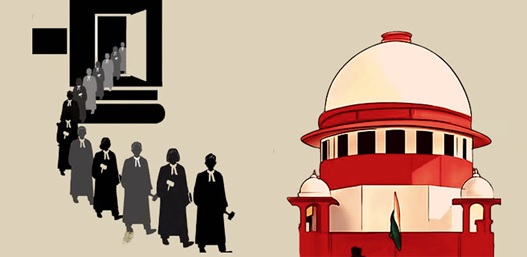
Current Constitutional Framework and Collegium System
- The Indian Constitution provides for the appointment of judges:
- Article 124: The President appoints judges of the Supreme Court after consultation with the Chief Justice (CJI).
- Article 217: Appointments to High Courts are made by the President in consultation with the CJI, the Governor of the concerned State, and the Chief Justice of the High Court.
- Article 130: Provides that the Supreme Court shall be located in Delhi, but the CJI may, with the permission of the President, hold its sittings at other places.
Evolution of the Collegium System
- Until the 1980s, the executive (government) dominated appointments. However, the Second Judges Case (1993) and the Third Judges Case (1998) brought the Collegium System into existence. In this system, the CJI and a group of senior-most judges decide on appointments.
- While this system protects the independence of the judiciary, it has often been criticized for lack of transparency and allegations of nepotism.
Key Proposals of the Bill: Diversity and Time Limits
- The Bill expresses concern that the current Collegium process focuses on merit but does not reflect India's social diversity.
Key Statistics (2018-2024)
- SC, ST, OBC Representation: Around 20%
- Female Participation: Less than 15%
- Religious Minorities: Around 5%
Proposed Reforms
- Proportional Representation: SC, ST, OBC, minorities, and women should be represented in proportion to their population during appointments.
- 90-Day Time Limit: The Central Government should be given a maximum of 90 days to notify the names recommended by the Collegium to avoid unnecessary delays in appointments.
Regional Benches: Decentralization of Justice
Currently, the Supreme Court is located only in New Delhi, posing a major obstacle to legal costs and distance for citizens of South and East India. The pendency of cases has exceeded 90,000 as of January 2026.
Resolutions of the Bill
- Four Regional Benches: Establishment of Regional Benches in Delhi, Kolkata, Mumbai, and Chennai.
- Division of Work: Regional benches will hear appeals and other routine matters, while the Delhi-based ‘Principal Constitution Bench’ will focus only on serious matters of constitutional importance.
Way Forward
- Reforms in the judiciary are possible not just through legislation, but through willpower.
- Inclusive NJAC: The National Judicial Appointments Commission (NJAC), abolished in 2015, could be brought back in a modified form along the lines of South Africa or the UK, with the participation of the Bar Council and academics.
- Responsibility of the Judiciary: The primary responsibility for ensuring social diversity lies with the judiciary itself. The Collegium should prioritize inclusivity in its selection criteria.
- Pilot Project: As per the Law Commission's recommendations, a regional bench could be established on a pilot basis, which could be expanded later.
Conclusion
This bill is a thought-provoking step towards making the Indian judiciary more democratic and accessible. This not only raises questions of representation but also emphasizes the need to modernize the justice infrastructure.






 Contact Us
  New Batch : 9555124124/ 7428085757
  Tech Support : 9555124124/ 7428085757