New
Hindi Medium: (Delhi) - GS Foundation (P+M) : 21st Sept. 2026, 11:30 AM Hindi Medium: (Prayagraj) - GS Foundation (P+M) : 20th Sept. 2026, 8:00 AM English Medium: (Delhi) - GS Foundation (P+M) : 6th Aug 2026 English Medium: (Prayagraj) - GS Foundation (P+M) : 19th Aug 2026, 11:00 AM Hindi Medium: (Delhi) - GS Foundation (P+M) : 21st Sept. 2026, 11:30 AM Hindi Medium: (Prayagraj) - GS Foundation (P+M) : 20th Sept. 2026, 8:00 AM English Medium: (Delhi) - GS Foundation (P+M) : 6th Aug 2026 English Medium: (Prayagraj) - GS Foundation (P+M) : 19th Aug 2026, 11:00 AM

Ladakh Autonomous Hill Development Councils: Powers, Functions, Latest Expansion and Challenges

Prelims: Indian Polity & Governance, Local Self-Government,  Ladakh Autonomous Hill Development Councils (LAHDCs), Sixth Schedule of the Constitution, Articles 244(2) and 275(1), Ladakh Administrative Reorganisation, Jammu and Kashmir Reorganisation Act, 2019
Mains: GS Paper II: Polity, Constitution, Governance and Federalism
GS Paper III: Internal Security & Border Management

Why in News?

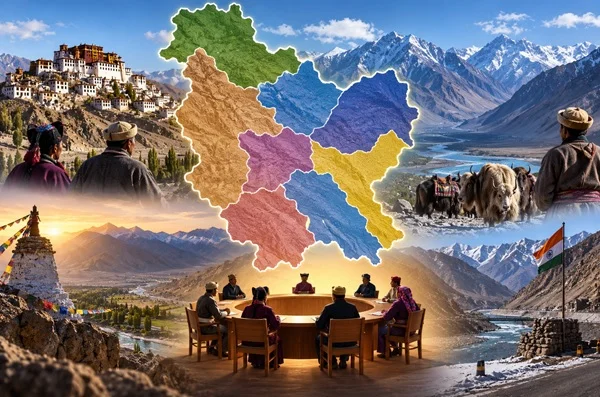
  • On 3 September 2026, Ladakh Lieutenant Governor Vinai Kumar Saxena approved the notification for establishing Ladakh Autonomous Hill Development Councils in all seven districts.

How Did Ladakh Go From 2 to 7 Districts? 

  • For years, Ladakh had only two districts (Leh and Kargil). In August 2024, the Ministry of Home Affairs gave in-principle approval for the creation of five additional districts.
  • On 27 April 2026, the Ladakh administration formally notified five new districts (Sham, Nubra, Changthang, Zanskar, Drass). The new districts were formally inaugurated on 29 April 2026.

Where Did the Five New Districts Come From?

  • Three new districts were carved out of the erstwhile Leh district (Nubra, Sham, Changthang and remaining Leh).
  • Two new districts were carved out of Kargil (Zanskar, Drass and remaining Kargil). 
  • The headquarters of the new districts are Sham (Khaltse), Nubra (Diskit), Changthang (Nyoma), Zanskar (Padum), Drass (Drass-Ranbirpura). 

What is LAHDC?

  • LAHDC stands for Ladakh Autonomous Hill Development Council. It is an elected institution of local self-governance designed to provide greater participation to local communities in development planning and administration.
  • Ladakh's hill councils historically functioned at the district level, particularly in Leh and Kargil. Their central purpose is to allow locally elected representatives to participate more directly in decisions concerning development priorities and local requirements.

Elections in the New Hill Councils

  • The establishment of the new councils is intended to pave the way for elected local self-governance in the five newly created districts. Once the institutional and electoral arrangements are completed, residents will be able to elect representatives to their respective councils.
  • This is important because merely creating a new administrative district creates government offices and officials, whereas an elected council adds an element of democratic representation and participatory governance.

What Do Autonomous Hill Development Councils Do?

  • Broadly, hill development councils are designed to participate in planning and implementation of development programmes suited to local requirements.
  • Areas relevant to local development can include agriculture, rural development, local infrastructure, education, public health, tourism, cultural activities, local roads, water management, environmental concerns, employment-oriented development, and welfare programmes.
  • Local representatives who understand regional geography, climate and social requirements can participate in deciding how resources should be used.

Why Does Ladakh Need Decentralised Governance?

  • Vast Geographical Area: Settlements are spread across an enormous mountainous region. People in remote areas may have to travel very long distances to access administrative services.
  • Difficult Terrain: High-altitude Mountains, passes, snow and severe winter conditions can make physical connectivity difficult.
  • Sparse Population: Ladakh's population is distributed across widely separated settlements, making conventional administrative delivery challenging.
  • Distinct Local Requirements: The needs of Changthang may differ significantly from those of Leh, Kargil, Drass, Nubra or Zanskar.
  • Border Location: Ladakh shares sensitive international frontiers and has immense strategic importance for India. Strong local governance and development are therefore also important for maintaining resilient border communities.

Significance of the Decision

  • Strengthening Grassroots Democracy: The most important impact is the expansion of elected local governance. Instead of development being shaped exclusively through the bureaucracy, local elected representatives can have a greater role.
  • Decentralisation of Governance: The decision reflects the principle: Power closer to people better understanding of local needs more responsive development
  • Representation for New Districts: The five new districts were created only in April 2026. Providing them with their own hill councils helps ensure that the administrative restructuring is accompanied by a mechanism for local democratic participation.
  • Region-Specific Development: Different parts of Ladakh have different development requirements.
    • Changthang: high-altitude pastoral communities and border-region challenges.
    • Nubra: tourism, connectivity and remote settlements.
    • Zanskar: difficult accessibility and infrastructure requirements.
    • Drass: extreme climate and strategic location.
    • Sham: rural development, connectivity and local economic needs.
  • Improved Service Delivery: Administrative decentralisation can reduce dependence on Leh and Kargil for every government-related requirement. It can potentially improve grievance redressal, local infrastructure planning, mwelfare implementation, public services and administrative accessibility.
  • Inclusive Development: Decentralised institutions can provide remote communities with a greater role in determining development priorities. This is particularly relevant for geographically isolated villages and tribal communities.
  • Strengthening Border Areas: Better roads, communications, health facilities, schools, livelihood opportunities and public services can encourage communities to remain economically viable in remote border regions.

Administrative Reforms in Ladakh During 2026

Period

Key Development

April 2026

Five new districts (Sham, Nubra, Changthang, Zanskar and Drass) were notified and inaugurated. 

May 2026

A UT-level committee was constituted to facilitate the operationalisation of the new districts

July 2026

17 new tehsils were created, increasing Ladakh’s total number of tehsils from 15 to 32

July 2026

The decision to extend the LAHDC framework to all seven districts of Ladakh was announced

September 2026

The Lieutenant Governor approved the notification for LAHDCs in all seven districts, strengthening decentralised govern

What is the Sixth Schedule Demand in Ladakh?

  • Since Ladakh became a Union Territory in 2019, several political and civil-society groups have sought stronger constitutional safeguards.
  • Among the major issues raised in public debate have been protection of land, jobs, culture, environment, tribal identity, and political representation.
  • There have also been demands concerning statehood and stronger constitutional safeguards, including demands associated with Sixth Schedule protection.

LAHDC vs Panchayati Raj Institutions

  • Panchayati Raj: Panchayati Raj Institutions form the rural local-government framework associated with Part IX of the Constitution and the 73rd Constitutional Amendment.
  • LAHDC: LAHDCs are special hill-development governance institutions created under Ladakh's applicable statutory framework. Their purpose is to provide greater autonomy and local participation at the hill/district level.

Challenges Ahead

  • Financial Resources: Local councils need adequate financial resources to implement development plans. Without sufficient funding, decentralisation may remain largely administrative.
  • Clear Division of Powers: Responsibilities of the UT administration, Deputy Commissioners, LAHDCs, Panchayati Raj Institutions, and other local authorities need clear coordination.
  • Administrative Capacity: New districts and councils require trained officials, offices, infrastructure, digital systems, staff, and financial-management capacity.
  • Difficult Geography: Decentralisation cannot by itself eliminate Ladakh's geographical difficulties. Connectivity and service delivery will remain challenging in remote high-altitude settlements.
  • Environmental Fragility: Ladakh has an extremely fragile mountain ecosystem. Development decisions involving tourism, roads, construction, water, waste, energy, and urban expansion must therefore balance economic development with ecological sustainability.
  • Local Aspirations: The new LAHDC arrangement will operate alongside wider debates over political representation and constitutional safeguards in Ladakh.

Prelims MCQ

Q. With reference to the Ladakh Autonomous Hill Development Councils (LAHDCs), consider the following statements:

  1. The LAHDC framework is being extended to all seven districts of Ladakh.
  2. Ladakh is a Union Territory without a legislature.
  3. LAHDCs are constitutional Autonomous District Councils established directly under the Sixth Schedule.

Which of the statements given above is/are correct?

A. 1 and 2 only

B. 2 and 3 only

C. 1 and 3 only

D. 1, 2 and 3

Mains Practice Question 

Q. Discuss how the expansion of Autonomous Hill Development Councils to all districts of Ladakh can strengthen decentralised governance and grassroots democracy in the Union Territory.

FAQs

What is LAHDC?

LAHDC stands for Ladakh Autonomous Hill Development Council.

How many districts does Ladakh have?

Ladakh has seven districts.

When were the five new districts notified?

They were notified in April 2026.

Which districts already had LAHDCs?

Leh and Kargil already had autonomous hill development councils.

How many LAHDCs will Ladakh have?

The LAHDC framework is being extended to all seven districts.

Have any Query?

Our support team will be happy to assist you!

OR