Why in News?
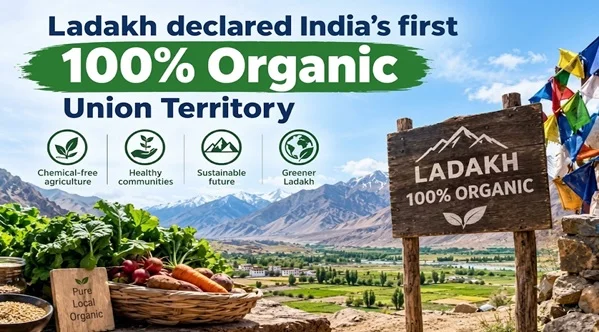
- Ladakh has been declared India’s first fully organic Union Territory after a multi-year transition towards chemical-free farming across Leh and Kargil districts.
- This achievement reflects the administration’s efforts to promote sustainable agriculture, protect the fragile Himalayan ecosystem and improve farmers’ livelihood opportunities.
Important Points
- Organic Farming: Uses permitted organic inputs and avoids prohibited synthetic chemical fertilisers and pesticides.
- Major Organic Products: Apricots, barley, buckwheat, sea buckthorn and vegetables.
- Environmental Benefits: Improves soil health, reduces chemical pollution and supports biodiversity.
- Major Challenges: Water scarcity, short growing seasons, transportation costs and limited market access.
What Does Fully Organic Mean?
- A fully organic agricultural system relies on approved organic inputs and farming practices instead of prohibited synthetic fertilisers and chemical pesticides. It focuses on maintaining soil fertility, conserving water, protecting biodiversity and producing food through environmentally sustainable methods.
- Ladakh’s organic transition aims to align agricultural practices with the region’s unique geographical and climatic conditions.
How Did Ladakh Become a Fully Organic Union Territory?
- Ladakh’s transition involved a phased programme to reduce and eliminate the use of synthetic fertilisers, chemical pesticides and other prohibited agricultural inputs.
- Key measures include:
- Ban on chemical fertilisers: In July 2026, the Lieutenant Governor ordered a complete ban on the procurement, distribution, sale, marketing and use of chemical and synthetic fertilisers for agricultural purposes across Ladakh.
- Supply of organic fertilisers: In March 2026, the administration arranged supplies of organic fertilisers for villages before the sowing season.
- Certification and monitoring: The transition involved efforts to strengthen organic certification, monitor farming practices and maintain compliance with organic standards.
- Farmer participation: Farmers across Leh and Kargil played an important role in shifting towards chemical-free cultivation.
Why Is Organic Farming Important for Ladakh?
1. Protection of the Fragile Ecosystem
- Ladakh is a cold desert region with limited rainfall, scarce water resources and fragile soils.
- Organic farming can help reduce the risk of chemical contamination, support soil health and protect the region’s sensitive ecosystem.
2. Sustainable Use of Natural Resources
- Organic farming practices can improve soil management and encourage efficient use of water and locally available organic materials.
- These practices are particularly important in high-altitude areas where agricultural resources are limited.
3. Better Market Opportunities
- Organic certification can help Ladakh’s agricultural products stand out in domestic and international markets.
- However, the actual price benefit depends on product quality, consumer demand, certification and access to buyers.
4. Improved Rural Livelihoods
- Ladakh’s farmers cultivate crops under difficult climatic conditions and often operate on small landholdings.
- Stronger market connections and better product branding could help them earn more from their produce.
Major Organic Products of Ladakh
- Ladakh’s agricultural products have the potential to benefit from its organic identity. Important products include:
- Apricots: A major fruit crop with opportunities for dried-fruit processing and value addition.
- Sea buckthorn: A nutrient-rich fruit used in food products, beverages and other processed goods.
- Buckwheat: A traditional crop suited to high-altitude farming.
- Barley: An important crop adapted to Ladakh’s climatic conditions.
- Vegetables: Locally grown vegetables that can support regional food security and local markets.
- Better storage, processing, packaging and transportation facilities will be important to increase the commercial value of these products.
Challenges in Organic Farming
- Despite its potential, Ladakh’s organic farming model faces several challenges.
- Limited growing season: Low temperatures and a short agricultural season restrict crop production.
- Water scarcity: Limited rainfall and dependence on local water sources make irrigation a major concern.
- High transportation costs: Difficult terrain and dispersed settlements increase the cost of transporting agricultural products to larger markets.
- Certification and quality control: Farmers need continued support to maintain certification standards and ensure consistent product quality.
- Market access: Organic status alone does not guarantee higher prices. Farmers need reliable buyers, better storage facilities, processing infrastructure and effective marketing.
Way Forward
To make organic farming economically sustainable, Ladakh needs to strengthen the entire agricultural value chain.
- Expand farmer training on organic farming, soil health and pest management.
- Improve storage, grading, packaging and food-processing facilities.
- Develop reliable market linkages for certified organic products.
- Promote local brands based on traceability and verified organic standards.
- Encourage research into climate-resilient crops and efficient irrigation.
- Support farmer cooperatives and local enterprises to improve bargaining power and reduce marketing costs.
Conclusion
Ladakh’s declaration as India’s first fully organic Union Territory marks an important step towards sustainable agriculture in the Himalayan region. However, the long-term success of this initiative will depend on maintaining organic standards, protecting natural resources and ensuring that farmers receive tangible economic benefits. With effective implementation and strong market connections, Ladakh could offer valuable lessons for sustainable farming in other ecologically sensitive regions of India.
Prelims Practice Question
Which Union Territory of India has become the first fully organic Union Territory?
(a) Jammu and Kashmir
(b) Ladakh
(c) Chandigarh
(d) Puducherry
Mains Practice Question
“Discuss the potential of organic farming in promoting sustainable agriculture and improving rural livelihoods in ecologically fragile regions such as Ladakh. Highlight the major challenges and suggest suitable measures.”
|
FAQs
1. Which Union Territory has become India’s first fully organic Union Territory?
Ladakh has been declared India’s first fully organic Union Territory.
2. Which districts are covered under Ladakh’s organic farming transition?
The transition covers Leh and Kargil districts.
3. Which crops are associated with Ladakh’s organic agriculture?
Important crops and products include apricots, sea buckthorn, buckwheat, barley and vegetables.
4. What are the major benefits of organic farming in Ladakh?
Organic farming can support soil health, reduce chemical contamination, conserve the fragile ecosystem and create opportunities for better market access.
5. What are the major challenges facing organic farming in Ladakh?
Key challenges include water scarcity, a short growing season, high transportation costs, certification requirements and limited access to markets.
|





 Contact Us
 New Batch : 9555124124/ 7428085757
 Tech Support : 9555124124/ 7428085757
