Prelims : Science & Technology + CA
Mains : GS 3 – Defence Technology, Indigenisation, Internal Security |
Why in News ?
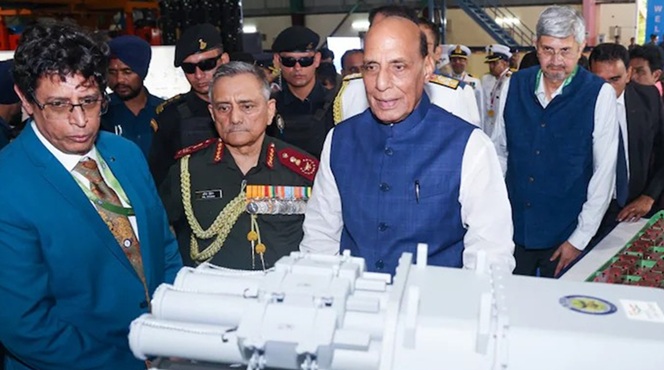
- The Rajnath Singh laid the foundation stone of a Large Cavitation Tunnel (LCT) facility at the Naval Science & Technological Laboratory in Visakhapatnam.
- The project is expected to significantly enhance India’s naval research, testing capabilities, and self-reliance in defence technology, reducing dependence on foreign testing facilities.
About Large Cavitation Tunnel (LCT)
- The Large Cavitation Tunnel (LCT) is a state-of-the-art hydrodynamic testing facility being developed by the Defence Research and Development Organisation.
- It will enable India to :
- Design, develop, and test naval systems indigenously
- Conduct advanced experiments on propulsion systems and underwater platforms
- The facility is being set up at :
- Naval Science & Technological Laboratory, Visakhapatnam
What is Cavitation ?
- Cavitation refers to the formation of vapour bubbles in a liquid due to pressure differences, which collapse violently and can:
- Damage propellers and underwater systems
- Generate noise, affecting stealth
- Controlling cavitation is critical for :
- Submarine stealth capabilities
- Efficient naval propulsion systems
Key Features of the LCT Facility
1. Advanced Hydrodynamic Testing Capability
- The facility will allow precise simulation of underwater conditions, enabling testing of naval platforms under realistic scenarios.
- This will help in optimising design and performance of ships, submarines, and propulsion systems.
2. Indigenous Design and Testing Ecosystem
- Earlier, India had to rely on foreign facilities for specialised testing, even after developing indigenous systems.
- With LCT, India can now complete the entire cycle of design, development, and testing domestically, marking a major step toward self-reliance.
3. Enhancement of Stealth Capabilities
- The facility will support research on :
- Noise reduction technologies
- Cavitation control mechanisms
- This is crucial for submarine stealth and survivability in modern naval warfare.
4. Boost to Propulsion System Development
- LCT will act as a core infrastructure for advancing propulsion technologies, improving :
- Efficiency
- Durability
- Operational performance
5. Support for Future Naval Platforms
- The facility will serve as a foundational backbone for the design and development of next-generation submarines and ships, enabling innovation in naval engineering.
Associated Developments at NSTL
- During the visit, several advanced technologies were showcased at the Naval Science & Technological Laboratory, including :
- Torpedoes
- Naval mines
- Decoys
- Autonomous Underwater Vehicles (AUVs)
1. Swarm AUV Technology
- Demonstration of man-portable swarm AUVs highlighted India’s growing capability in :
- Autonomous maritime operations
- Network-centric underwater warfare
2. Spin-off Technologies
- Innovations developed post Operation Sindoor show the dual-use potential of defence technologies, benefiting civilian sectors as well.
3. Emerging Areas of Research
- Work is ongoing in :
- Lithium-ion battery systems for defence applications
- Advanced underwater warfare systems
Significance of the Project
1. Strengthening Aatmanirbhar Bharat in Defence
- The project aligns with India’s push for indigenisation in defence manufacturing and R&D, reducing dependence on imports.
2. Strategic Naval Capability Enhancement
- Improved testing and design capabilities will :
- Strengthen India’s maritime security
- Enhance its position as a blue-water navy
3. Technological Leadership
- The facility positions India as a global leader in specialised naval testing infrastructure, boosting defence innovation.
4. Integration of Industry, Academia, and Research
- The project reflects collaboration between :
- Government
- MSMEs
- Academia
- Defence scientists
Challenges
1. High Capital and Technological Requirements
- Such advanced facilities require significant investment and continuous technological upgrades.
2. Skill and Expertise Development
- Effective utilisation depends on highly skilled researchers and engineers.
3. Integration with Production Ecosystem
- Translating research outputs into mass production and deployment remains a key challenge.
Way Forward
- Strengthen indigenous defence R&D ecosystem
- Promote public-private partnerships in defence innovation
- Focus on export potential of defence technologies
- Enhance integration of AI and automation in naval systems
Practice Questions
Prelims :
Q. What is the primary purpose of a cavitation tunnel ?
(a) Missile testing
(b) Underwater hydrodynamic testing
(c) Satellite communication
(d) Radar calibration
Mains :
“Discuss the role of indigenous defence infrastructure like the Large Cavitation Tunnel in strengthening India’s maritime security.”
FAQs
Q1. What is a Large Cavitation Tunnel (LCT) ?
It is an advanced testing facility used to simulate underwater conditions and study cavitation effects on naval systems.
Q2. Which organisation is developing the LCT ?
It is being developed by the Defence Research and Development Organisation at the Naval Science & Technological Laboratory.
Q3. Why is cavitation important in naval systems ?
Cavitation affects efficiency, noise, and durability of propulsion systems, making it crucial for stealth and performance.
Q4. How will the LCT benefit India ?
It will enable indigenous testing, reduce foreign dependence, and improve naval capabilities, especially for submarines and ships.
Q5. What are AUVs?
Autonomous Underwater Vehicles are unmanned systems used for underwater operations such as surveillance and mine detection.
|






 Contact Us
  New Batch : 9555124124/ 7428085757
  Tech Support : 9555124124/ 7428085757