Mains: GS Paper I & II – Indian Culture, Tribal Communities, Linguistic Diversity, Welfare of Vulnerable Sections, Digital Inclusion and Preservation of Cultural Heritage
Keywords: National Conclave on Tribal Languages & Museums, Mysuru, Ministry of Tribal Affairs, Adi Vaani, Jago AI Bot, CIIL, KSTRI, Tribal Languages, Tribal Freedom Fighter Museums, PVTGs, PM-JANMAN, Mysuru Declaration, Viksit Bharat@2047 |
Why in News?
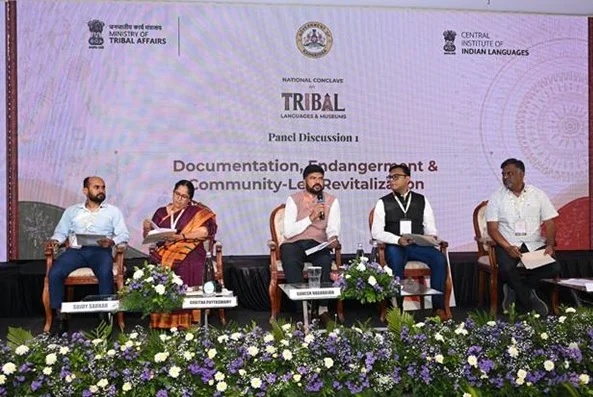
The Ministry of Tribal Affairs (MoTA) began the three-day National Conclave on Tribal Languages & Museums in Mysuru, Karnataka. It brought together policymakers, linguists, researchers, technologists and tribal community representatives.
Important Point
- The Conclave focuses on the documentation and revitalisation of tribal languages and strengthening Tribal and Tribal Freedom Fighter Museums across India.
- The upgraded Adi Vaani platform was launched with a new iOS application and five additional languages. The Ministry also launched “Jago”, its official AI conversational assistant.
- MoTA also signed an MoU with the Central Institute of Indian Languages (CIIL) for tribal-language documentation and corpus development.
What is the National Conclave on Tribal Languages & Museums?
- The National Conclave is organised by the Ministry of Tribal Affairs in collaboration with the Karnataka State Tribal Research Institute (KSTRI) and Central Institute of Indian Languages (CIIL).
- More than 150 participants from different states, institutions and tribal communities participated in the Conclave.
- The event focuses on documenting tribal languages, identifying languages facing decline and developing community-led models for their revival.
- It also discusses the use of modern technology and the strengthening of museums dedicated to tribal communities and tribal freedom fighters.
Why is the Preservation of Tribal Languages Important?
- Many tribal languages and dialects in India survive mainly through oral traditions. Knowledge is often transferred from one generation to another through stories, songs, folklore and community practices.
- When a language disappears, a community may also lose parts of its oral history, traditional knowledge, customs and cultural identity.
- Tribal languages also preserve valuable knowledge related to forests, biodiversity, medicinal practices and local ecosystems.
- Therefore, preserving these languages is not only a linguistic issue but also an important part of protecting India's cultural and knowledge heritage.
What is the Adi Vaani Platform?
- Adi Vaani is a technology-enabled initiative aimed at supporting the documentation, accessibility and preservation of tribal languages.
- The upgraded version of the platform was launched during the Mysuru Conclave with a new iOS application, five additional languages and a new Adi Vaani logo.
- The platform aims to bring tribal languages into the digital ecosystem and make language resources more accessible.
- Greater digital presence can also encourage younger generations to use tribal languages through smartphones and other modern communication platforms.
What is the ‘Jago’ AI Bot?
- Jago is the official AI conversational assistant of the Ministry of Tribal Affairs. It has been designed to make government information related to tribal communities easier to find and understand.
- It brings together trusted information on tribal welfare schemes, programmes, initiatives and official repositories through a single intelligent interface.
- Instead of searching through multiple government sources, users can interact with the AI assistant to find relevant information.
- Jago therefore represents the growing use of Artificial Intelligence in public service delivery and digital inclusion.
MoTA–CIIL MoU on Tribal Languages
- The Ministry of Tribal Affairs and CIIL signed a Memorandum of Understanding for language documentation and corpus development.
- Under the partnership, CIIL will provide linguistic support and share relevant data on tribal languages with the Ministry.
- A language corpus is an organised digital collection of words, sentences, texts, conversations and speech samples belonging to a language.
- Such datasets can support the development of digital dictionaries, Machine Translation, Automatic Speech Recognition, Text-to-Speech and AI-based language tools.
Karnataka Tribal Language Primers Released
- The Tribal Welfare Department of Karnataka and KSTRI released educational material in tribal languages during the Conclave.
- This included the Jenukuruba Primer for Class 1, covering Kannada, Mathematics and Environmental Studies (EVS), along with learning resources and flashcards.
- Educational material in familiar languages can make it easier for tribal children to understand basic concepts and participate in classroom activities.
- It can also help younger generations remain connected with their mother tongue and cultural identity.
Technology Meets Tribal Languages
- Technology was one of the major themes discussed at the Conclave. Experts examined how digital tools can support the documentation and revitalisation of tribal languages.
- Important technologies discussed included Automatic Speech Recognition (ASR), Text-to-Speech (TTS), Machine Translation, corpus building, keyboards and digital fonts.
- ASR can convert spoken language into written text, which is particularly useful for tribal languages that depend heavily on oral traditions.
- Similarly, Text-to-Speech and Machine Translation can make tribal-language content more accessible across digital and educational platforms.
Data Protection and Tribal Knowledge
- The use of AI and digital technologies also raises concerns regarding the collection and use of tribal-language data.
- Experts discussed issues such as data protection, misuse, commercialisation and safeguards for tribal linguistic knowledge.
- Language datasets may contain culturally sensitive knowledge belonging to particular communities.
- Therefore, digitisation must be based on informed consent, community participation and responsible use of linguistic data.
Multilingual Education for Tribal Students
- The Conclave also focused on multilingual education for tribal students, including pedagogy, curriculum and learning outcomes.
- Experts discussed the availability of primers, dictionaries and teacher handbooks, as well as gaps in tribal-language educational content.
- Children may face additional learning barriers when their first classroom language is completely different from the language spoken at home.
- Mother-tongue and multilingual education can improve understanding while allowing students to learn regional and national languages gradually.
Connection with PM-JANMAN
- The development needs of Particularly Vulnerable Tribal Groups (PVTGs) were also highlighted during discussions at the Conclave.
- PM-JANMAN – Pradhan Mantri Janjati Adivasi Nyaya Maha Abhiyan focuses on improving access to essential services and welfare interventions among PVTG communities.
- However, tribal development is not limited to infrastructure and economic support.
- Protection of language, traditional knowledge, cultural identity and dignity is also an important part of inclusive tribal development.
Mysuru Declaration
- The Conclave was also scheduled to include discussions on what tribal communities themselves expect from language and cultural preservation policies.
- These discussions were to be followed by the adoption and signing of the Mysuru Declaration.
- The Declaration can provide a common framework for future efforts related to tribal languages, cultural heritage and museums.
- It also highlights the importance of making tribal communities active participants in policies concerning their own language and heritage.
Significance for India
- Preserving Linguistic Diversity: India is home to a large number of tribal languages and dialects, many of which have limited written documentation. Systematic documentation can protect these languages and create resources for future generations.
- Protecting Traditional Knowledge: Tribal languages carry knowledge related to nature, agriculture, forests, medicinal practices and local ecosystems.
- Promoting Digital Inclusion: Platforms such as Adi Vaani and Jago can increase the presence of tribal communities and languages in the digital ecosystem.
- Improving Tribal Education: Mother-tongue and multilingual learning can help tribal students understand concepts more effectively during the early stages of education.
Key Challenges
- Declining Use Among Younger Generations: Some tribal languages are witnessing reduced use as younger generations increasingly shift towards dominant regional or national languages.
- Limited Digital Data: Many tribal languages do not have sufficient written texts, speech recordings or structured digital datasets.
- Educational Gaps: There is still a shortage of trained teachers, primers, dictionaries and teaching material in several tribal languages.
- Data Ownership and Privacy: Digitisation creates questions about who owns tribal linguistic and traditional knowledge.
Way Forward
Community-Led Documentation
Tribal communities should be active partners in deciding what linguistic and cultural knowledge should be documented.
Create Digital Language Archives
Oral histories, folk songs, stories, vocabulary and traditional knowledge should be systematically recorded and preserved.
Involve Tribal Youth
Tribal youth can be trained in language documentation, recording, translation and digital content creation.
Strengthen Mother-Tongue Education
More primers, dictionaries, teacher handbooks and digital educational resources should be developed in tribal languages.
Responsible Use of AI
AI-based language technologies should follow principles of consent, privacy, community ownership and responsible data use.Technology should support tribal communities rather than separate linguistic knowledge from the people who created and preserved it.
Prelims MCQ
Q. With reference to ‘Jago’, recently seen in the news, which of the following is correct?
A. It is a scholarship portal for tribal students.
B. It is the official AI conversational assistant of the Ministry of Tribal Affairs.
C. It is a programme for constructing Tribal Freedom Fighter Museums.
D. It is an e-commerce platform for tribal products.
Mains Practice Question
“The preservation of tribal languages is not merely a question of linguistic diversity but also of protecting cultural identity and traditional knowledge.” Discuss the role of technology in the preservation and revitalisation of tribal languages in India.
|
FAQs
Q1. Where was the National Conclave on Tribal Languages & Museums held?
Mysuru, Karnataka.
Q2. Which ministry organised the Conclave?
The Ministry of Tribal Affairs.
Q3. What is Jago?
It is the official AI conversational assistant of the Ministry of Tribal Affairs.
Q4. What new features were added to Adi Vaani?
An iOS application, five new languages and other upgraded features were introduced.
Q5. MoTA signed an MoU with which institution?
The Central Institute of Indian Languages (CIIL).
|





 Contact Us
  New Batch : 9555124124/ 7428085757
  Tech Support : 9555124124/ 7428085757