Why in News?
- The 72nd National Film Awards were announced on 18 July 2026 for outstanding achievements in Indian cinema during 2024.
- The President of India will present the awards on 22 September 2026 at Ekta Nagar, Gujarat. This is part of the Ministry of Information and Broadcasting’s decision to take the National Film Awards to different parts of the country instead of holding every ceremony in the National Capital.
- The Dadasaheb Phalke Award for 2024 will be conferred on veteran actor Anant Nag.
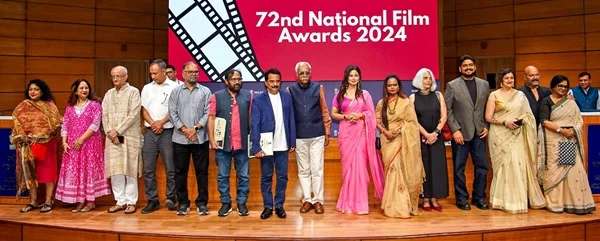
Important points
- Edition: 72nd National Film Awards
- Films covered: Films certified during 2024
- Winners announced: 18 July 2026
- Award ceremony: 22 September 2026
- Venue: Ekta Nagar, Gujarat
- Presented by: President of India
- Feature Film Jury Chairperson: Jayaraj
- Non-Feature Film Jury Chairperson: Aseem Sinha
- Best Writing on Cinema Jury Chairperson: A. Chandrasekhar
- Dadasaheb Phalke Award 2024: Anant Nag
What are the National Film Awards?
- The National Film Awards are the most prestigious national-level awards for excellence in Indian cinema.
- They were established in 1954 by the Government of India and are conferred annually by the Ministry of Information and Broadcasting.
- The awards recognise excellence in three major areas:
- Feature Films
- Non-Feature Films
- Writing on Cinema
- The Dadasaheb Phalke Award is the highest honour in Indian cinema and is given for outstanding contribution to the growth and development of Indian cinema.
History of the National Film Awards
- The history of Indian cinema is closely associated with Dadasaheb Phalke, who made Raja Harishchandra in 1913, considered India's first full-length feature film.
- The Film Enquiry Committee, established in 1949, recommended the creation of national film awards to encourage artistic and technical excellence in Indian cinema.
- The awards were established in 1954, with the first awards recognising films released in 1953.
Important Milestones
- 1954: National Film Awards were instituted as the State Awards for Films.
- 1967–68: Awards for actors and technicians were introduced. Uttam Kumar and Nargis received the first Best Actor and Best Actress honours.
- 1969: The Dadasaheb Phalke Award was instituted. Devika Rani was its first recipient.
- 1973: The Directorate of Film Festivals began administering the awards.
- 2022: The Directorate of Film Festivals was merged with the National Film Development Corporation (NFDC), which became the implementing body.
- 2026: The 72nd National Film Awards were announced, with the ceremony scheduled at Ekta Nagar, Gujarat.
Award Structure
The National Film Awards are divided into three main sections, along with the Dadasaheb Phalke Award, which is the highest honour in Indian cinema.
|
Section
|
Categories
|
Award
|
Cash Prize
|
|
Feature Films
|
26 (with special mentions)
|
Swarna Kamal / Rajat Kamal
|
₹3 lakh / ₹2 lakh
|
|
Non-Feature Films
|
16 (with special mentions)
|
Swarna Kamal / Rajat Kamal
|
₹3 lakh / ₹2 lakh
|
|
Best Writing on Cinema
|
2
|
Swarna Kamal
|
₹1 lakh
|
|
Dadasaheb Phalke Award
|
1
|
Swarna Kamal + Shawl
|
₹10 lakh
|
First National Film Awards
- The first edition of the National Film Awards had three major categories:
- Feature Films
- Documentary Films
- Children's Films
- Shyamchi Aai, a Marathi film, received the President's Gold Medal for the Best All-India Feature Film.
- Mahabalipuram received the President's Gold Medal for the Best Documentary Film.
- Do Bigha Zamin received a Certificate of Merit.
Purpose and Significance of the National Film Awards
The National Film Awards aim to:
- Encourage films of high artistic and technical quality.
- Promote films with social relevance.
- Help audiences understand the cultures and traditions of different regions.
- Promote the unity and integrity of India.
- Encourage the study of cinema as an art form.
- Recognise the contribution of filmmakers, actors, technicians and writers.
The awards also provide national recognition to films that may not have a large commercial audience.
Structure of the National Film Awards
The awards are divided into three main sections:
1. Feature Films
This section covers full-length films and includes awards such as:
- Best Feature Film
- Best Direction
- Best Actor in a Leading Role
- Best Actress in a Leading Role
- Best Supporting Actor
- Best Supporting Actress
- Best Children's Film
- Best Cinematography
- Best Music Direction
- Best Costume Design
- 2. Non-Feature Films
This section includes documentaries, short films, animation and other related forms.
Important categories include:
- Best Non-Feature Film
- Best Documentary
- Best Short Film
- Best Animation Film
- Best Arts and Culture Film
- Best Narration or Voice Over
- Best Script
3. Best Writing on Cinema
This section recognises:
- Best Book on Cinema
- Best Film Critic
Dadasaheb Phalke Award
- The Dadasaheb Phalke Award is the highest honour in Indian cinema.
- It was instituted in 1969 in memory of Dadasaheb Phalke, the pioneer of Indian cinema.
- Devika Rani was the first recipient of the award.
Dadasaheb Phalke Award 2024
- Veteran actor Anant Nag will receive the Dadasaheb Phalke Award for 2024.
- He was born on 4 September 1948 in Karnataka and began his acting career in the early 1970s.
- His first Kannada film was Sankalp, while his Hindi film debut was Ankur.
- He has worked in more than 300 films across six Indian languages. He is also widely known for his role in the television series Malgudi Days.
- He received the Padma Bhushan in 2025.
Recent Dadasaheb Phalke Award Recipients
- 2024: Anant Nag
- 2023: Mohanlal
- 2022: Mithun Chakraborty
- 2021: Waheeda Rehman
72nd National Film Awards: Major Award Winners
|
Award Category
|
Film
|
Awardee
|
|
Best Feature Film
|
Article 370 (Hindi)
|
Jio Studios & B62 Studios; Director – Aditya Suhas Jambhale
|
|
Best Direction
|
Amaran (Tamil)
|
Rajkumar Periasamy
|
|
Best Actor in a Leading Role
|
Bramayugam (Malayalam)
|
Mammootty
|
|
Best Actor in a Leading Role
|
Chandu Champion (Hindi)
|
Kartik Aaryan
|
|
Best Actress in a Leading Role
|
Article 370 (Hindi)
|
Yami Gautam
|
|
Best Actor in a Supporting Role
|
Bhakshak (Hindi)
|
Sanjay Mishra
|
|
Best Actress in a Supporting Role
|
Maharaja (Tamil)
|
Sachana Namidass
|
|
Best Actress in a Supporting Role
|
Mithya (Kannada)
|
Ropashree Varkady
|
|
Best Debut Film of a Director
|
Swatantrya Veer Savarkar (Hindi)
|
Randeep Hooda
|
|
Best Popular Film Providing Wholesome Entertainment
|
Kalki 2898 AD (Telugu)
|
Vyjayanthi Movies; Director – Nag Ashwin
|
|
Best Feature Film Promoting National, Social and Environmental Values
|
Captain Miller (Tamil)
|
Sathya Jyothi Films; Director – Arun Matheswaran
|
|
Best Children's Film
|
35 - Chinna Katha Kaadu (Telugu)
|
Nanda Kishore Emani
|
|
Best Non-Feature Film
|
Bhangaar (Marathi & English)
|
Sumira Roy
|
|
Best Documentary
|
Ram-Nami (Hindi)
|
Bharatbala Ganapathy
|
|
Best Debut Film of a Director – Non-Feature
|
Angen (Santhali)
|
Ravi Raj Murmu
|
|
Best Direction – Non-Feature
|
Statue of Unity - Ekta ka Prateek (Hindi)
|
Aanand L Rai
|
|
Best Book on Cinema
|
Naaniruvude Nimagaagi Naadiruvude Nanagaagi (Kannada)
|
Kenchanuru Pradeep Kumar Shetty
|
|
Best Film Critic
|
Hindi
|
Sanjeev Shrivastava
|
Recognition of India's Linguistic Diversity
- One of the important features of the National Film Awards is their recognition of India's linguistic and cultural diversity.
- The awards recognise films made in languages included in the Eighth Schedule of the Constitution. Films in other languages can also receive separate recognition.
- In the 72nd edition, films in languages such as:
- Marathi
- Santhali
- Tamil
- Malayalam
- Telugu
- Kannada
- Tulu
- Garhwali
- received recognition.
- Dholi in Garhwali and IMBU in Tulu were recognised under the relevant language provisions.
- The 72nd edition also marked the first recognition of a Santhali film in the Non-Feature Film section.
How are National Film Awards Selected?
Films certified by the Central Board of Film Certification (CBFC) during the relevant award year are eligible for consideration.
Entries are invited for the three major sections, and separate juries are constituted for:
- Feature Films
- Non-Feature Films
- Writing on Cinema
The jury members are selected from the fields of cinema, art, culture and humanities.
Two-Tier Selection for Feature Films
- Feature films are evaluated through a two-tier process.
- First, five regional panels examine the entries and shortlist films.
- After this, a central jury evaluates the shortlisted films and selects the winners.
- The Non-Feature Film and Writing on Cinema sections have separate juries.
- The Dadasaheb Phalke Award follows a different process. A specially constituted committee of eminent film personalities recommends the recipient.
Eligibility for National Film Awards
Some important eligibility conditions include:
- The film must be certified by the CBFC during the relevant award year.
- The film must carry English subtitles.
- A feature film must have a running time of more than 72 minutes.
- Certain dubbed, remade or re-edited versions that have already been submitted are not eligible.
National Film Awards and Indian Culture
- Cinema plays an important role in representing India's culture, identity, traditions and social realities.
- Indian cinema is produced in many languages and across different regions. The National Film Awards provide a common national platform for these diverse cinematic traditions.
- They also contribute to India's soft power by taking Indian stories, culture and artistic traditions to audiences around the world.
National Film Awards to Travel Beyond Delhi
- A major policy change is the decision to hold future National Film Awards ceremonies in different parts of India.
- The 72nd ceremony at Ekta Nagar, Gujarat, is part of this initiative.
- The move aims to bring the awards closer to audiences and filmmakers across different regions and reflects the idea of Ek Bharat, Shreshtha Bharat.
Conclusion
- The 72nd National Film Awards highlight the diversity and richness of Indian cinema. The recognition of films across languages and regions shows the growing national platform for different cinematic traditions.
- The decision to hold the ceremony at Ekta Nagar, Gujarat, and to take future editions to different parts of the country represents a wider effort to connect national cultural institutions with audiences across India.
- With Anant Nag receiving the Dadasaheb Phalke Award for 2024, the 72nd edition also honours a long contribution to Indian cinema.
Prelims Practice Question
With reference to the National Film Awards, consider the following statements:
- The National Film Awards were instituted in 1954.
- The Dadasaheb Phalke Award was instituted in 1969.
- Devika Rani was the first recipient of the Dadasaheb Phalke Award.
- The National Film Awards are given only for feature films.
Which of the statements given above are correct?
A. 1 and 2 only
B. 1, 2 and 3 only
C. 2, 3 and 4 only
D. 1, 2, 3 and 4
Mains Practice Question
Q. How do the National Film Awards contribute to promoting India's artistic excellence, linguistic diversity and cultural unity? Discuss.
|
FAQs
1. When were the National Film Awards instituted?
The National Film Awards were instituted in 1954.
2. Which ministry confers the National Film Awards?
The awards are conferred by the Ministry of Information and Broadcasting.
3. When was the Dadasaheb Phalke Award instituted?
The Dadasaheb Phalke Award was instituted in 1969.
4. Who was the first recipient of the Dadasaheb Phalke Award?
Devika Rani was the first recipient of the Dadasaheb Phalke Award.
5. Who won Best Feature Film at the 72nd National Film Awards?
Article 370 won the Best Feature Film award.
|






 Contact Us
  New Batch : 9555124124/ 7428085757
  Tech Support : 9555124124/ 7428085757