
- UPSC Exam
- State PCS
- One Day Exam
- Current Affairs
- PT Quiz
- Downlaods
- About Coaching
- Blog
- Videos

| Prelims: National Strategic Trade Command Centre, DGFT, Importer Exporter Code, Advance Authorisation, EPCG, Certificate of Origin, SCOMET. Mains: GS Paper II – Governance, Transparency and Accountability, E-Governance; GS Paper III – Indian Economy, External Trade, Export Promotion and Economic Development. Keywords: National Strategic Trade Command Centre, NSTCC, India Trade Governance, DGFT Dashboards, Trade Data Analytics, Export Promotion, SCOMET, Evidence-Based Policymaking. |
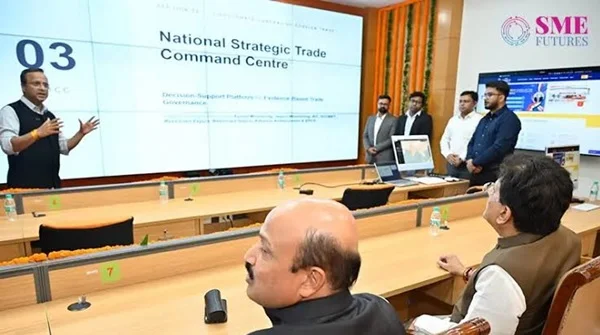
The NSTCC is an integrated trade monitoring and analytics initiative that provides policymakers and government officials with a consolidated view of India’s trade performance and administrative processes.
It brings together information on:
NSTCC brings together dashboards covering trade performance, export promotion schemes, approvals and application processing. This consolidated view can help officials identify areas requiring administrative attention.
The initial coverage includes the following domains:
|
Domain |
Full Form or Coverage |
|
IEC |
Importer Exporter Code |
|
Advance Authorisation |
Applications and processes under the Advance Authorisation scheme |
|
EPCG |
Export Promotion Capital Goods |
|
CoO |
Certificate of Origin |
|
SCOMET |
Special Chemicals, Organisms, Materials, Equipment and Technologies |
|
Restricted imports and exports |
Related regulatory permissions and application processes |
The official framework identifies three functions:
NSTCC is designed to support product-wise and market-wise analysis, assessment of trade agreement utilisation and identification of export opportunities. These capabilities can help policymakers examine where India’s export performance needs greater attention.
The Minister emphasised regular Inter-Ministerial Committee meetings to clear the backlog of applications expeditiously. Monitoring pending cases can improve administrative follow-up. However, faster disposal should involve timely scrutiny and decisions under applicable rules; it does not imply automatic approval.
Visibility into pending applications and processing timelines can help officials identify delays and assign responsibility for corrective action.
Integrated information can provide a stronger basis for evaluating whether a scheme or administrative process requires modification.
Earlier identification of processing problems can help authorities respond before delays become persistent.
A shared view of trade-related information can support coordination among officials handling different schemes and permissions.
The following are potential benefits, dependent on effective implementation:
These are implementation considerations rather than problems confirmed in the launch announcement.
NSTCC can strengthen India’s trade governance by connecting information with administrative decisions. Its success will depend on reliable data, institutional coordination and timely action on identified problems, while preserving the quality of regulatory scrutiny.
Prelims Practice QuestionThe National Strategic Trade Command Centre (NSTCC) primarily aims to: (a) Determine the exchange rate of the Indian rupee Mains Practice Question“Integrated data analytics can improve trade governance, but its effectiveness depends on institutional responsiveness.” Discuss with reference to the National Strategic Trade Command Centre. |
1. What is NSTCC?NSTCC stands for National Strategic Trade Command Centre. It supports the monitoring, analysis and governance of India’s international trade ecosystem. 2. Who launched NSTCC?Union Commerce and Industry Minister Piyush Goyal launched it in New Delhi on 15 October 2026. 3. What is the main objective of NSTCC?Its main objective is to help policymakers make evidence-based trade decisions using integrated information and analytics. 4. Which trade-related domains does NSTCC cover?Its dashboards cover IEC, Advance Authorisation, EPCG, Certificate of Origin, SCOMET, restricted imports and exports, and other trade facilitation processes. 5. How can NSTCC help exporters?By helping officials identify delays and procedural problems, NSTCC could support faster and more predictable administrative decisions. Its benefits depend on effective follow-up. |



Our support team will be happy to assist you!


 Contact Us
  New Batch : 9555124124/ 7428085757
  Tech Support : 9555124124/ 7428085757