Prelims
Geography of India | Rivers & Drainage | Environment & Ecology | Current Affairs
Mains
GS Paper II – India-China Relations, Border Management
GS Paper III – Infrastructure, Energy Security, Environment & Conservation
|
Why Is This in the News ?
- Environmental clearance has been granted to the 1,000 MW Naying Hydroelectric Project (NHEP) on the Siyom (Yomgo) River in Shi-Yomi district, Arunachal Pradesh — a district that hosts the strategically sensitive Mechuka sector close to the India-China Line of Actual Control (LAC).
- The clearance follows the completion of a mandatory environmental public hearing held at Yapik village in Tato circle, and a subsequent formal notification for acquisition of 331.50 hectares of land in the project area.
- The project had originally received concurrence from the Central Electricity Authority (CEA) way back in 2013, but progress stalled for over a decade owing to environmental and social concerns, including large-scale forest diversion.
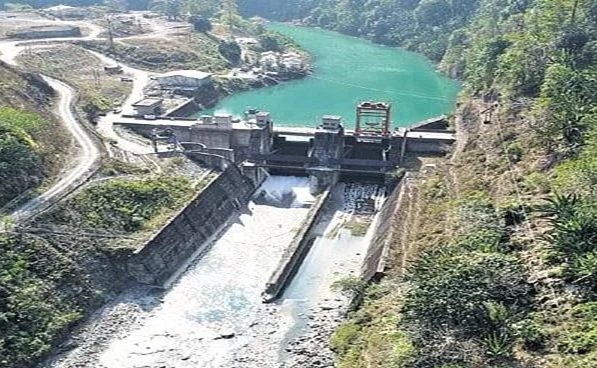
What Is the Naying Hydroelectric Project ?
It is a run-of-the-river scheme with peaking power capability, proposed on the Siyom (Yomgo) River a right-bank tributary of the Brahmaputra in Arunachal Pradesh's Shi-Yomi district.
|
Particular
|
Details
|
|
Location
|
Tato circle, Shi-Yomi district, Arunachal Pradesh — near the Mechuka sector and the India-China LAC
|
|
River
|
Siyom (Yomgo) River — a right-bank tributary of the Brahmaputra, about 170 km long; the Mouling National Park lies on its east bank
|
|
Installed Capacity
|
1,000 MW (4 x 250 MW)
|
|
Developer
|
North Eastern Electric Power Corporation (NEEPCO) in joint venture with the Arunachal Pradesh Hydropower Corporation Ltd (APHPCL)
|
|
Project Type
|
Run-of-the-river with peaking capability; concrete gravity dam, underground powerhouse, ~7.08 km headrace tunnel; gross head ~285 m
|
|
Estimated Cost
|
Approximately Rs 9,559 crore (Rs 95,590 million)
|
|
Expected Output
|
~4,966.77 GWh (million units) of electricity annually
|
|
Land Required
|
331.50 hectares notified for acquisition in Tato circle; involves diversion of forest land and felling of trees
|
|
Timeline
|
CEA concurrence obtained in 2013; construction expected to begin around 2028; commissioning targeted for 2032
|
|
Seismic Zone
|
Zone V — the highest earthquake-risk category under the Bureau of Indian Standards classification
|
What is Run-of-River Hydroelectric Project
- Run-of-river (RoR) : It generates electricity using the natural flow of a river with little or no large water storage.
- Features : Minimal reservoir, Lower submergence than conventional dams, reduced greenhouse gas emissions, less displacement compared to large storage dams, and continuous electricity generation depending on river flow.
Why is the Project Strategically Important ?
- Strengthening India's Position along the LAC : Its development will help improve electricity supply in remote border areas, strengthen military logistics, support border infrastructure, encourage permanent settlements, and enhance surveillance capabilities.
- Border Area Development : Reliable electricity promotes economic activities, tourism, healthcare, education, and digital connectivity. It also reduces migration from border villages, strengthening India's frontier presence.
Importance for India's Energy Security
-
Hydropower plays an important role in India's clean energy transition. Its advantages are renewable source of energy, low carbon emissions, grid stability, peak-load support, long operational life, and reduced dependence on imported fossil fuels. Hydropower complements solar and wind energy by providing flexible power generation.
Environmental Concerns
- Fragile Himalayan Ecosystem : The Himalayas are geologically young, earthquake-prone, and landslide-prone. Large infrastructure projects require extensive geological assessments.
- Impact on River Ecology : Construction may affect natural river flow, fish migration, sediment movement, and aquatic biodiversity.
- Forest Diversion : Hydropower projects often require diversion of forest land, which may impact wildlife habitats, biodiversity, and carbon sinks.
- Climate Change Risks : The Himalayan region faces increasing incidents of Glacial Lake Outburst Floods (GLOFs), cloudbursts, flash floods, and landslides. Hydropower infrastructure must incorporate climate-resilient design.
Importance of Arunachal Pradesh in Hydropower
- Arunachal Pradesh possesses India's largest untapped hydropower potential due to steep river gradients, perennial Himalayan river, high rainfall, and mountainous terrain.
- Major rivers include Siang, Subansiri, Dibang, Kameng, Siyom, Lohit. The state is often referred to as the "Hydropower Capital of India."
Government Initiatives
- National Hydropower Policy : Recognizes large hydropower projects as renewable energy and promotes sustainable development.
- PM Gati Shakti National Master Plan : Supports integrated infrastructure development, including strategic border connectivity.
- Vibrant Villages Programme : Promotes comprehensive development of villages along the northern border to improve livelihoods and strengthen border security.
- National Action Plan on Climate Change (NAPCC) : Hydropower contributes to India's efforts to expand clean energy and reduce carbon emissions.
India–China Dimension
Hydropower development in Arunachal Pradesh has strategic implications because :
- Several rivers originate in Tibet.
- China is constructing multiple hydropower projects on transboundary rivers, including the Yarlung Tsangpo (Brahmaputra).
- India seeks to strengthen infrastructure and ensure effective utilization of its water resources in accordance with international law.
Challenges
- Ecological degradation
- Rehabilitation and resettlement of affected communities
- High construction costs
- Geological instability
- Disaster vulnerability
- Local opposition
- Delays in project implementation
- Interstate and transboundary river concerns
Way Forward
- The Naying Hydroelectric Project reflects India's twin priorities of achieving energy security and strengthening strategic infrastructure along its northern borders.
- While the project can accelerate economic development and support India's clean energy transition, its implementation must be guided by scientific planning, robust environmental safeguards, transparent public consultation, and climate-resilient engineering.
- A balanced approach that integrates ecological sustainability with strategic and developmental objectives will be essential for ensuring long-term national interests while preserving the fragile Himalayan ecosystem.
PRELIMINARY MCQ
Q. With reference to the Naying Hydroelectric Project, consider the following statements:
- It is proposed on the Siyom River in Arunachal Pradesh.
- The project is a run-of-the-river hydroelectric project.
- The Siyom River is a tributary of the Brahmaputra River.
Which of the statements given above are correct?
(a) 1 and 2 only
(b) 2 and 3 only
(c) 1 and 3 only
(d) 1, 2 and 3
MAINS PRACTICE QUESTION
Q. "Large hydropower projects in the Himalayan region are essential for India's energy security and strategic interests but pose serious environmental challenges." Discuss with reference to the Naying Hydroelectric Project.
|
FAQs
1. Where is the Naying Hydroelectric Project located ?
It is proposed on the Siyom River in Arunachal Pradesh, near the India–China border.
2. What are the major environmental concerns ?
Potential impacts include ecological degradation, altered river flow, biodiversity loss, forest diversion, and increased disaster vulnerability in the fragile Himalayan ecosystem.
3. Which ministry grants environmental clearance for large hydropower projects ?
The Ministry of Environment, Forest and Climate Change (MoEFCC) grants environmental clearance based on the recommendations of the Expert Appraisal Committee (EAC).
4. Why Arunachal Pradesh is called the "Hydropower Capital of India" ?
Arunachal Pradesh has the largest hydropower potential in India due to its steep Himalayan terrain, perennial rivers, and high rainfall, making it ideal for hydroelectric power generation.
5. What is the difference between a storage hydropower project and a run-of-the-river project ?
A storage project uses a large reservoir to store water before generating electricity, whereas a run-of-the-river project generates electricity using the natural flow of the river with little or no water storage.
|






 Contact Us
  New Batch : 9555124124/ 7428085757
  Tech Support : 9555124124/ 7428085757