Why in News?
- The National Highways Authority of India (NHAI) has made Automated and Intelligent Machine-Aided Construction (AI-MC) mandatory for highway projects that are more than 20 km long and cost over ₹500 crore.
- The move aims to address concerns related to construction quality, durability, accuracy, transparency, and accountability in highway projects.
- Under the new norms, contractors will be required to use AI-MC throughout the construction process and across the entire spatial footprint of the project.
What is AI-MC?
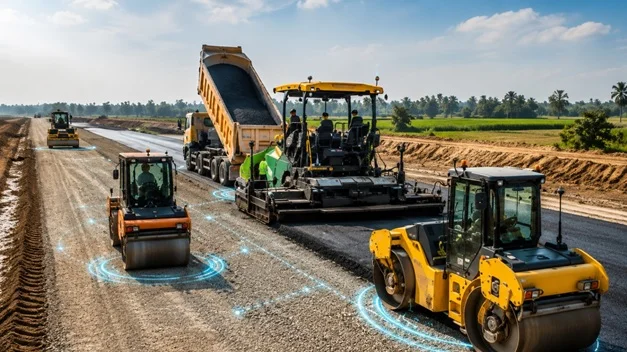
- Automated and Intelligent Machine-Aided Construction (AI-MC) is a technology-driven construction system that uses on-board computers, sensors, positioning systems, and digital monitoring tools integrated with heavy construction machinery.
- It can be deployed on machines such as: Graders, Pavers, Compactors, Dozers.
- The technology enables real-time monitoring, automated execution, accurate measurements, and quality control during road construction.
- Instead of relying primarily on manual inspection, AI-MC generates digital data on construction activities and helps ensure that work conforms to prescribed technical specifications.
Key Provisions of the New NHAI Norms
1. Mandatory for Large Highway Projects :-AI-MC will be compulsory for highway projects that meet both of the following criteria:
- Length: More than 20 km
- Project cost: More than ₹500 crore
2. End-to-End Deployment :-AI-MC will not be restricted to selected portions of a highway project.
Contractors will have to deploy the technology continuously throughout the project and across its entire spatial footprint.
3. Application Across Major Road Layers
The technology will be used across major stages of highway construction, including:
|
Road Construction Layer
|
Meaning
|
|
Embankment
|
Raised earth foundation supporting the road
|
|
Subgrade
|
Compacted soil layer forming the basic foundation of the pavement
|
|
Granular Sub-Base (GSB)
|
Layer of crushed stone, sand and gravel placed above the compacted soil
|
|
Pavement layers
|
Structural layers forming the road surface
|
4. Real-Time Data Sharing
- Contractors will be required to share real-time construction data with NHAI officials.
- This will create a digital record of construction activities from earthwork to pavement laying.
Why is AI-MC Being Introduced?
The rapid expansion of India's highway network has increased the need for high-quality, durable and technically compliant road construction.
Traditional monitoring often depends heavily on:
- Manual inspections
- Physical measurements
- Site visits
- Contractor-generated records
AI-MC can complement and reduce dependence on such manual processes by enabling continuous, technology-based monitoring and quality control.
Benefits of AI-MC
- Improved Construction Quality :-AI-MC can improve the accuracy and uniformity of different highway layers by monitoring construction parameters against prescribed standards.
- Reduction in Human Errors :-Automation and machine-based measurements can reduce errors associated with manual measurements and inspections.
- Better Durability of Roads :-Consistent construction of different road layers according to technical specifications can contribute to improved road durability and service life.
- Greater Transparency :-Real-time digital data can provide authorities with greater visibility into construction activities.
- Enhanced Accountability :-Digital records can help establish responsibility for deviations from prescribed construction standards.
- Prevention of Quality Compromise :-Continuous monitoring can reduce the possibility of contractors or sub-contractors compromising on construction standards.
- Data-Driven Governance ;-NHAI can use real-time construction data to identify deviations and undertake timely corrective action.
Why is End-to-End Deployment Important?
- The effectiveness of AI-MC depends on its continuous and comprehensive deployment.
- If the technology is used only at selected stages or on limited stretches, gaps may remain in the monitoring system.
- End-to-end AI-MC can therefore create an integrated chain: Construction → Real-Time Monitoring → Digital Data → Quality Control → Accountability
- This can help shift highway construction towards a more data-driven and technology-enabled system.
Challenges in Implementation
Despite its potential benefits, the implementation of AI-MC may face several challenges.
- Reluctance to Share Real-Time Data:-Some contractors may be reluctant to share continuous data with NHAI because real-time monitoring increases their accountability.
- High Initial Cost:-AI-enabled machinery, sensors, software and digital infrastructure may increase the initial cost of construction operations.
- 3Lack of Technical Skills :-Engineers, contractors and machine operators will require adequate training to operate AI-MC systems and interpret the resulting data.
- Data Reliability :-The usefulness of AI-MC depends on the accuracy and reliability of sensor-generated data. Mechanisms are therefore required to prevent data manipulation and technical errors.
- Digital Connectivity :-Reliable digital connectivity may be difficult to maintain at remote highway construction sites.
- Need for Institutional Capacity :-NHAI and other highway agencies need adequate technical capacity to process and act upon the large volume of real-time data generated by these systems.
AI-MC and the Lucknow-Kanpur Expressway
- AI-MC was reportedly deployed earlier during the construction of the Lucknow-Kanpur Expressway.
- However, its deployment was not uniform across the entire project or across all construction grades.
- The new NHAI norms seek to move beyond such piecemeal deployment and ensure comprehensive use of the technology in eligible highway projects.
FAQs
Q. 1 What is AI-MC?
Answer Automated and Intelligent Machine-Aided Construction (AI-MC) is a technology-driven road construction system that uses sensors, on-board computers, positioning systems and digital monitoring tools integrated with construction machinery.
Q.2 Which highway projects will require mandatory AI-MC deployment?
Answer AI-MC will be mandatory for highway projects that are more than 20 km long and cost over ₹500 crore.
Q. 3 Which construction machinery can use AI-MC?
Answer AI-MC can be integrated with heavy construction equipment such as graders, pavers, compactors and dozers.
Q.4 What is the purpose of AI-MC in highway construction?
Answer The technology aims to improve construction quality, accuracy, uniformity, durability, transparency and accountability through real-time monitoring and digital quality control.
|






 Contact Us
  New Batch : 9555124124/ 7428085757
  Tech Support : 9555124124/ 7428085757