
- UPSC Exam
- State PCS
- One Day Exam
- Current Affairs
- PT Quiz
- Downlaods
- About Coaching
- Blog
- Videos

| Prelims: Environment & Ecology, Biodiversity, Western Ghats, Biosphere Reserves, Species in News Mains: GS Paper III – Environment, Biodiversity and Conservation |
Recently, scientists from the Botanical Survey of India (BSI) discovered a new flowering plant species named Osbeckia ulotricha in the Agasthyamala Biosphere Reserve of the Western Ghats. The newly identified species belongs to the Melastomataceae family and has been recorded from the high-altitude shola-grassland ecosystem.
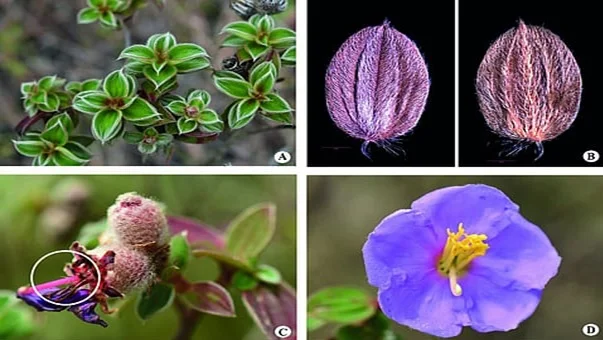
Osbeckia ulotricha is a newly identified flowering plant species belonging to the genus Osbeckia.
1. Woolly-Haired Species: One of the most distinctive features of Osbeckia ulotricha is its characteristic woolly or curly hair covering.
2. Leaves: Its leaves are primarily clustered near the apex of the plant.
3. Hypanthium: The species possesses a distinctive sub-globose hypanthium, or an almost rounded floral base. A hypanthium is a cup-like or tubular structure of a flower formed around the ovary.
4. Ovary: Its ovary is crowned with true bristles, which are fine and relatively stiff hairs present at the top.
5. Flowering and Fruiting: The species mainly flowers and produces fruits between February and May.
The species has been recorded at elevations of approximately 1,200–1,500 metres.
It primarily grows along the damp margins of: Tropical Montane Wet Temperate Forests (Shola Forests) and Montane Temperate Grasslands
The discovery has also brought the Agasthyamala Biosphere Reserve (ABR) into focus.
Agasthyamala Biosphere Reserve is located in the southern part of the Western Ghats. It extends across two Indian states: Kerala + Tamil Nadu The region is known for its exceptional biological diversity and high level of endemism.
The Agasthyamala Biosphere Reserve was established in 2001. In 2016, it was included in UNESCO's World Network of Biosphere Reserves (WNBR). Its international recognition highlights the ecological importance of the southern Western Ghats.
The biosphere reserve contains diverse vegetation types due to variations in altitude, rainfall and climate.
Major vegetation types include:
The Shola-Grassland ecosystem is particularly important because it supports several endemic and high-altitude species.
Shola forests are patches of montane evergreen forests found in the higher elevations of the Western Ghats, particularly in southern India. They generally occur together with rolling grasslands, forming a unique:
These ecosystems play an important role in:
They are also highly sensitive to changes in temperature, rainfall patterns, invasive species and human activities. Rivers Originating from the Agasthyamala Region Agasthyamala is also an important watershed region of the southern Western Ghats.
Important rivers associated with the region include:
Therefore, conservation of the Agasthyamala landscape is important not only for biodiversity but also for regional water security.
The biosphere reserve encompasses several important protected areas.
Together, these protected areas form an important conservation landscape in the southern Western Ghats.
The Western Ghats and its endemic species face several ecological pressures, including:
Species with a very small geographical range can be particularly vulnerable because even limited habitat degradation may affect a significant proportion of their population.
Prelims MCQQ. Consider the following statements regarding Osbeckia ulotricha:
Which of the statements given above are correct? (a) 1 and 2 only Mains QuestionQ. “The discovery of new endemic species highlights both the exceptional biodiversity and ecological vulnerability of the Western Ghats.” Discuss in the context of the recent discovery of Osbeckia ulotricha. |
Q1. What is Osbeckia ulotricha?Osbeckia ulotricha is a newly identified flowering plant species belonging to the Melastomataceae family. Q2. Where was Osbeckia ulotricha discovered?It was discovered in the Agasthyamala Biosphere Reserve in the southern Western Ghats. Q3. Which states share the Agasthyamala Biosphere Reserve?The biosphere reserve extends across Kerala and Tamil Nadu. Q4. When was Agasthyamala included in UNESCO's World Network of Biosphere Reserves?It was included in 2016. Q5. At what elevation is Osbeckia ulotricha found?It is associated with elevations of approximately 1,200–1,500 metres. |


Our support team will be happy to assist you!


 Contact Us
  New Batch : 9555124124/ 7428085757
  Tech Support : 9555124124/ 7428085757