
- Recently, the Parliamentary Standing Committee presented its report in the Lok Sabha on the Atal Mission for Rejuvenation and Urban Transformation (AMRUT/AMRUT 2.0).
- The report highlights the ground realities of urban infrastructure in India, particularly in water supply, sewerage, and wastewater management.
- The Committee not only identifies serious implementation challenges but also offers key recommendations to make the mission sustainable, financially viable, and institutionally robust.
AMRUT Mission:
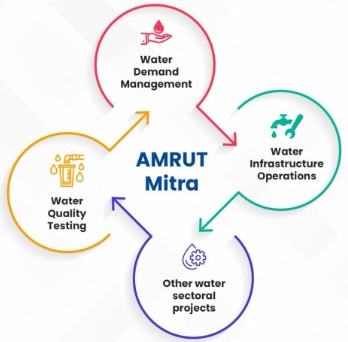
- Implementing Ministry: Ministry of Housing and Urban Affairs (MoHUA)
- Type of Scheme: Centrally Sponsored Scheme
- Launch:
- AMRUT: 2015
- AMRUT 2.0: 2021 onwards
Objectives:
- Urban water supply
- Sewerage and septage management
- Stormwater drainage
- Green spaces and parks
- Basic infrastructure for Non-Motorised Transport (NMT)
Financing and Financial Capacity
Key Challenges
- Inadequate financing for urban infrastructure, especially in backward and underserved cities.
- Absence of sustainable funding sources for Operation and Maintenance (O&M) of assets.
- Weak revenue-generation capacity of Urban Local Bodies (ULBs), leading to rapid deterioration of assets.
Committee’s Recommendations
- Increase central and multilateral financial support (World Bank, ADB, etc.).
- Aggressive promotion of Municipal Bonds and Public–Private Partnership (PPP) models.
- Creation of a Dedicated O&M Fund for AMRUT assets.
Implementation and Institutional Framework: Neglect of Local Governance
Key Challenges
Slow pace of implementation
- Projects worth ~₹1.90 lakh crore approved under AMRUT 2.0
- Only ~₹48,050 crore worth of projects completed
- Limited role of ULBs; dominance of State Parastatals and SPVs.
- Lack of integrated water management and long-term urban planning.
Committee’s Recommendations
- A national roadmap for strengthening the institutional and technical capacity of ULBs.
- 100% submission of City Water Action Plans (CWAPs) by all ULBs.
- National-level assessment and forecasting of urban drinking water demand for the next 25–30 years.
- Strict enforcement of convergence among central schemes such as AMRUT, SBM-U, Jal Jeevan Mission (Urban), and Smart Cities Mission.
Technical, Operational, and Monitoring Issues
Key Challenges
Poor reliability of data related to:
- Water supply coverage
- Non-Revenue Water (NRW)
- Water metering
- Wastewater reuse
Severe shortfall in sewage treatment:
- Total urban sewage generation: ~48,004 MLD
- Installed treatment capacity: ~30,001 MLD (2021)
A large share of wastewater continues to be discharged untreated into rivers.
Committee’s Recommendations
- Formulation of a National Urban Wastewater Reuse Policy.
- Rapid expansion of sewage treatment capacity and promotion of Reuse–Recycle models.
- Reduction of Non-Revenue Water through:
- Incentive-based mechanisms
- Accelerated deployment of smart water metering.
Way Forward
- The Parliamentary Committee’s report makes it clear that AMRUT is a necessary but incomplete reform initiative. Its success requires not just financial resources, but also:
- Empowered Urban Local Bodies
- Reliable, data-driven planning
- A long-term Urban Water Vision
- Financial self-reliance of cities
- Strong institutional coordination
- If AMRUT is redesigned to be climate-sensitive, financially sustainable, and citizen-centric, it can truly become the foundation of India’s urban future.






 Contact Us
  New Batch : 9555124124/ 7428085757
  Tech Support : 9555124124/ 7428085757