Prelims: (Economy + CA)
Mains: (GS 3 – Energy Security, Renewable Energy Transition; GS 2 – Welfare Schemes & Governance) |
Why in the News?
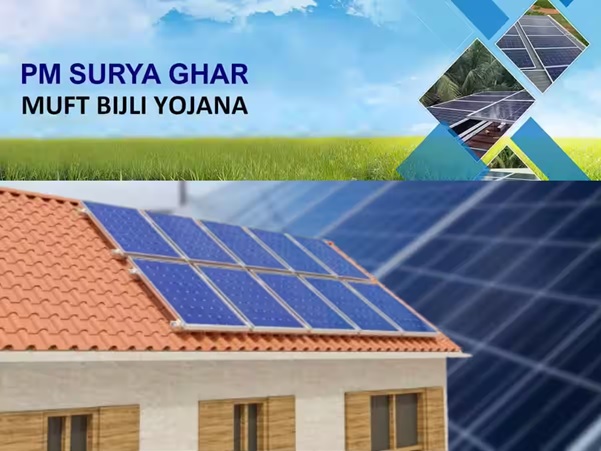
The Union Minister recently announced that rooftop solar installations under the PM Surya Ghar: Muft Bijli Yojana have crossed 30 lakh households since its launch in February 2024.
The milestone highlights accelerating adoption of decentralised solar power across India.
Background and Context
India has committed to expanding non-fossil fuel capacity and promoting distributed renewable energy as part of its climate and energy transition goals.
Rooftop solar is seen as a key pillar in:
- Reducing household electricity bills.
- Lowering dependence on fossil fuels.
- Strengthening energy security.
- Easing pressure on DISCOMs during peak demand.
The PM Surya Ghar scheme was launched in 2024 to accelerate rooftop solar penetration in the residential sector.
About PM Surya Ghar: Muft Bijli Yojana
The PM Surya Ghar: Muft Bijli Yojana aims to provide free electricity to households by promoting rooftop solar installations.
Core Objective
- Enable households to generate their own electricity.
- Reduce monthly power bills.
- Promote clean and decentralised energy production.
Subsidy Structure
The scheme provides financial assistance as follows:
- 60% subsidy on solar unit cost for systems up to 2 kW capacity.
- 40% subsidy on additional system cost for systems between 2–3 kW capacity.
- Subsidy capped at 3 kW capacity per household.
This structure ensures affordability while encouraging optimal system sizing.
Additional Components
1. Model Solar Village
- Development of one Model Solar Village in each district.
- Demonstration of decentralised renewable energy ecosystems.
2. Incentives to Local Bodies
- ₹1,000 incentive per rooftop solar installation.
- Applicable to:
- Urban Local Bodies (ULBs).
- Panchayati Raj Institutions (PRIs) at Gram Panchayat level.
This promotes grassroots-level ownership and monitoring.
Implementation Mechanism
National Level
- Implemented through a National Programme Implementation Agency (NPIA).
State Level
- State Implementation Agencies (SIAs) oversee execution.
- DISCOMs act as SIAs.
Role of DISCOMs
- Ensure availability of net meters.
- Conduct timely inspections.
- Commission installations.
- Facilitate grid connectivity.
DISCOMs receive performance-linked incentives for installing additional grid-connected rooftop solar capacity beyond baseline levels.
Eligibility Criteria
A household must:
- Be an Indian citizen.
- Own a house with a suitable rooftop.
- Have a valid electricity connection.
- Not have availed any other solar subsidy.
Significance of the Scheme
1. Energy Security
- Reduces peak demand pressure on the grid.
- Encourages decentralised energy generation.
2. Climate Goals
- Supports India’s renewable energy targets.
- Contributes to emissions reduction.
3. Financial Relief
- Lowers electricity bills for households.
- Provides long-term cost savings.
4. DISCOM Reform
- Promotes distributed generation.
- Improves demand-side management.
Challenges
- Financing constraints for households despite subsidy.
- DISCOM resistance due to revenue loss concerns.
- Net-metering policy inconsistencies across states.
- Technical limitations in urban high-rise buildings.
Way Forward
- Streamline subsidy disbursal processes.
- Strengthen net-metering frameworks nationwide.
- Expand awareness campaigns.
- Integrate rooftop solar with battery storage.
- Ensure DISCOM financial compensation mechanisms.
FAQs
1. What is PM Surya Ghar: Muft Bijli Yojana?
A central scheme promoting rooftop solar installations to provide free electricity to households.
2. What subsidy does it provide?
60% subsidy up to 2 kW and 40% for 2–3 kW systems, capped at 3 kW.
3. Who implements the scheme?
At the national level by NPIA and at the state level by DISCOMs as SIAs.
4. What is a Model Solar Village?
A demonstration village in each district showcasing decentralised solar adoption.
5. Why is rooftop solar important?
It reduces electricity bills, strengthens energy security, and supports climate goals.
|






 Contact Us
  New Batch : 9555124124/ 7428085757
  Tech Support : 9555124124/ 7428085757