Why in News?
- On 28 October 2026, the Union Cabinet approved the Pradhan Mantri Viksit Gram Swaraj Yojana.
- The Centrally Sponsored Scheme will be implemented from 2026–27 to 2030–31, with a total financial outlay of ₹7,395.55 crore.
- It aims to empower Gram Panchayats, enhance public participation in rural development and make local governance more transparent, accountable and effective.
Objectives of the Scheme
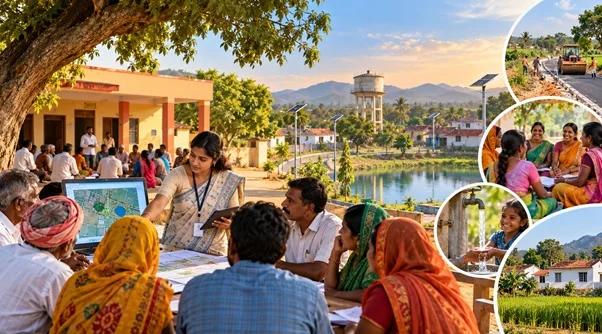
- The primary objective of the Pradhan Mantri Viksit Gram Swaraj Yojana is to develop Gram Panchayats into capable institutions for planning and implementing rural development initiatives.
- It seeks to establish better coordination among local needs, government schemes and available financial resources.
- The broader objective is to promote participatory development in rural areas and strengthen rural governance in line with the national vision of Viksit Bharat.
Key Features of the Scheme
- Financial Outlay: The scheme has a total outlay of ₹7,395.55 crore, comprising ₹4,869.48 crore from the Central Government and ₹2,526.07 crore from State Governments.
- Implementation Period: The scheme will be implemented from FY 2026–27 to FY 2030–31.
- Coverage: It will cover Gram Panchayats across all States and Union Territories. Eligible traditional rural local government institutions in areas where the Panchayati Raj system under Part IX of the Constitution does not apply will also be covered.
- Beneficiaries: Approximately 32 lakh elected representatives, Panchayat functionaries and other stakeholders will receive capacity-building and technical support.
- Annual Targets: The scheme aims to support the preparation of more than 2.55 lakh Gram Panchayat Development Plans and at least 2.55 lakh online audit plans annually. Each coordinated public awareness campaign will aim to reach at least one crore citizens.
Six Key Pillars of the Scheme
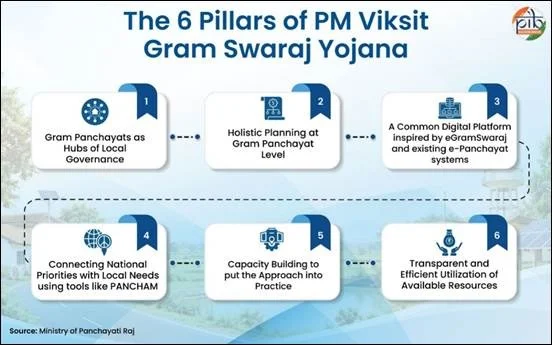
1. Gram Panchayats as Centres of Local Governance
- The scheme will place Gram Panchayats at the centre of local development planning.
- Panchayats will coordinate community priorities, government schemes and available resources.
- This will help prioritise development activities according to local needs.
2. Comprehensive Gram Panchayat Development Planning
- The scheme will improve coordination among the development programmes of various Central and State Government departments.
- This will help make Gram Panchayat Development Plans (GPDPs) more comprehensive and effective.
- Better coordination among departments will facilitate the identification of development gaps and the efficient utilisation of resources.
3. Promoting Digital Governance
- The scheme will strengthen digital integration by building on the existing eGramSwaraj platform and other e-Panchayat systems.
- A common digital platform will facilitate access to information on government schemes, beneficiaries, benefits, community assets and available resources.
- This will help Panchayats identify development gaps, monitor schemes and learn from the experiences of Panchayats in other States.
E-Gram Swaraj: Launched in 2020, eGramSwaraj is a digital platform that integrates various aspects of Panchayat functioning, including planning, budgeting, accounting, monitoring and asset management. It is integrated with platforms such as the Public Financial Management System (PFMS), Government e-Marketplace (GeM), BHASHINI, BharatNet and the India Meteorological Department (IMD).
4. Connecting National Priorities with Local Needs
- The scheme will promote awareness of government schemes and national development initiatives through Gram Sabhas and Panchayat forums.
- It aims to encourage citizens to participate in local development-related decision-making.
- The Panchayat Assistance and Messaging Chatbot (PANCHAM) will also support this initiative.
- Launched in January 2026, PANCHAM is a WhatsApp-based platform that provides Panchayat representatives, officials and citizens with information on government schemes, training materials, surveys and Panchayat services.
- It supports AI-enabled multilingual communication in 17 Indian languages.
5. Capacity Building and Training
- The scheme will provide training and technical assistance to elected Panchayat representatives and Panchayat functionaries.
- Training will cover the use of digital platforms, development planning, financial resource management, preparation of technical estimates and effective communication with citizens.
- These initiatives will strengthen the administrative and technical capacities of Panchayats.
6. Transparent and Efficient Utilisation of Resources
- The scheme will help Panchayats utilise Finance Commission grants and other available resources more effectively.
- It will also encourage the mobilisation of Own Source Revenue (OSR).
- Online accounting, auditing and public disclosure will strengthen financial transparency and accountability.
Major Annual Targets of the Scheme
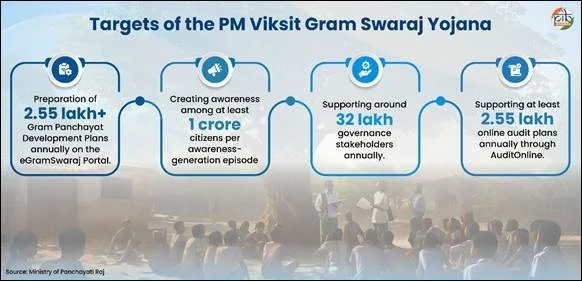
- Gram Panchayat Development Plans: Support the preparation of more than 2.55 lakh Gram Panchayat Development Plans annually on the eGramSwaraj portal.
- Public Awareness: Reach at least one crore citizens through each awareness-generation campaign. Gram Sabhas, Panchayat forums and digital platforms will be used to disseminate information about government schemes.
- Capacity Building: Provide training and digital support to approximately 32 lakh Panchayat representatives, functionaries and other stakeholders.
- Online Audits: Support at least 2.55 lakh online audit plans annually and facilitate the timely completion of the corresponding audits through AuditOnline.
- AuditOnline: Launched in 2020, AuditOnline is a digital platform for conducting online audits of Panchayati Raj accounts. It aims to strengthen financial management and transparency in Panchayats.
How Will the Scheme Be Implemented?
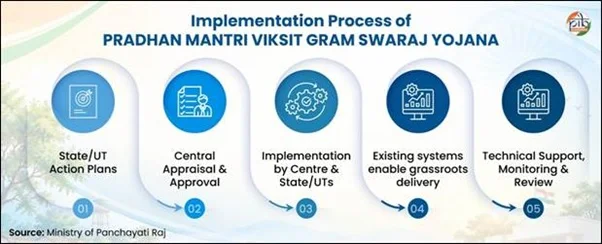
- The scheme will operate through existing government institutions and administrative systems.
- State Governments and Union Territory Administrations will submit Annual Action Plans.
- These plans will outline proposed activities, priorities and requirements.
- The designated Central Empowered Committee will appraise and approve the plans.
- The Central Government, State Governments and Union Territory Administrations will implement activities within their respective areas of responsibility.
- Technical assistance, monitoring and periodic reviews will support effective implementation.
- The scheme does not provide for the creation of permanent posts. However, contractual personnel may be engaged at the State, District and Block levels, depending on requirements.
Significance of the Scheme
- The Pradhan Mantri Viksit Gram Swaraj Yojana is an important initiative to make rural local governance more capable and accountable.
- It will help Gram Panchayats prepare development plans according to local needs, coordinate with government departments and utilise financial resources efficiently.
- The expansion of digital systems can improve scheme monitoring and financial transparency.
- Gram Sabhas and public awareness campaigns will create opportunities to strengthen citizen participation.
- The initiative can contribute to more inclusive, participatory and outcome-oriented rural development.
Major Challenges
- Effective coordination among State Governments and Gram Panchayats will be essential for the scheme's success.
- Differences in the digital and administrative capacities of Panchayat representatives may affect implementation.
- Limited internet connectivity and technological infrastructure in some rural areas may hinder digital integration.
- Integrating data across different government departments and completing audits on time may pose additional challenges.
- Strengthening Panchayats' own revenue sources and ensuring that digital governance remains responsive to the actual needs of rural communities will also be important.
Way Forward
- Regular training for Panchayat representatives, expansion of digital infrastructure and improved coordination among government departments should be prioritised.
- Gram Sabhas should play an effective role in identifying local development priorities.
- Regular social and financial audits, public disclosure of information and outcome-based monitoring should be strengthened to improve accountability.
- Greater emphasis should be placed on developing the own-source revenue capacity of Panchayats.
- Implementation should be assessed through measurable outcomes to ensure that development plans translate into tangible improvements in rural communities.
Conclusion
- The Pradhan Mantri Viksit Gram Swaraj Yojana aims to transform Gram Panchayats from institutions primarily responsible for implementing government schemes into capable, participatory and accountable institutions of local development.
- By integrating digital governance, capacity building, financial transparency and public participation, the initiative can strengthen rural self-governance and contribute to the broader vision of Viksit Bharat.
Multiple-Choice Question (MCQ)
|
Question 1. Consider the following statements regarding the Pradhan Mantri Viksit Gram Swaraj Yojana:
- It will be implemented from 2026–27 to 2030–31.
- It aims to strengthen the planning capacity, digital governance and financial accountability of Gram Panchayats.
- It provides for the creation of permanent posts.
Which of the statements given above is/are correct?
(a) 1 and 2 only
(b) 2 and 3 only
(c) 1 and 3 only
(d) 1, 2 and 3
|