Prelims: General Studies Paper I: Current Affairs, Internal Security, National Counter-Terrorism Policy, PRAHAAR and its seven pillars.
Mains: General Studies Paper III – Internal Security: Terrorism, cross-border terrorism, intelligence coordination.
Keywords: PRAHAAR, National Counter-Terrorism Policy, Counter-Terrorism Strategy, Internal Security, Terrorism in India, Whole-of-Government Approach, Whole-of-Society Approach, Counter-Radicalisation, Intelligence Sharing, ATS. |
Why in News?
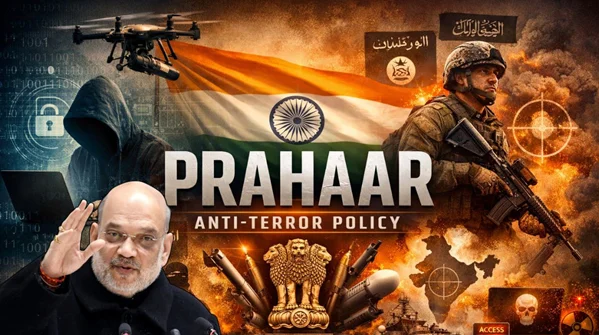
- Union Home Minister Amit Shah unveiled PRAHAAR Counter-Terrorism Policy and Strategy at a national counter-terrorism conference in New Delhi.
- The conference focused on implementing PRAHAAR through a whole-of-government and whole-of-society approach. The Home Minister emphasised that its principles should reach the police-station level and called for a proactive and result-oriented approach to counter-terrorism.
- The conference was attended by DGPs of 15 States and Anti-Terrorism Squad (ATS) chiefs from all States and Union Territories.
What is PRAHAAR?
- PRAHAAR is India’s comprehensive National Counter-Terrorism Policy and Strategy, designed to strengthen the country’s institutional response to terrorism.
- It moves beyond a purely reactive security response by integrating prevention, intelligence coordination, rapid response, human rights, international cooperation and post-attack resilience.
- The strategy seeks to bring together central and state governments, security agencies, law-enforcement institutions, international partners and wider society in a coordinated counter-terrorism framework.
Seven Pillars of PRAHAAR
- Prevention: The focus is on preventing terrorist attacks through intelligence gathering, surveillance, early identification of threats and timely intervention.
- Response: It aims to establish a rapid, coordinated and effective response mechanism for terrorist incidents, with institutionalised counter-terrorism responses at different levels.
- Aggregating Internal Capacities: This pillar focuses on integrating the capabilities and resources of different central and state agencies to improve intelligence sharing, investigation and operational coordination.
- Human Rights: Counter-terrorism operations are expected to remain consistent with human rights, constitutional principles and the Rule of Law.
- Attenuating Conditions for Terrorism: The strategy seeks to address conditions that can facilitate terrorism, including radicalisation, terrorist recruitment and other factors that enable extremist networks.
- Aligning International Efforts: Since terrorism increasingly operates across national borders, PRAHAAR emphasises international cooperation, intelligence sharing, extradition and coordinated action against transnational terrorist networks.
- Recovery & Resilience: This pillar focuses on restoring normalcy after terrorist incidents and strengthening the resilience of communities, institutions and critical systems.
Key Highlights of PRAHAAR Conference 2026
- Amit Shah stressed that the principles of PRAHAAR must percolate down to the police-station level. He also called for a proactive approach to every aspect of the strategy.
- The Home Minister emphasised the need to institutionalise an automated counter-terrorism response at every level and called for a result-oriented implementation of all seven pillars.
- He also highlighted the importance of coordination among different stakeholders to prevent delays in counter-terrorism operations.
Extradition Portal
- A new Extradition Portal was launched during the conference to improve coordination among agencies involved in bringing fugitives back to India.
- According to the Home Minister, between 2019 and 2026, 288 fugitive criminals were brought back to India from 36 countries.
- The initiative highlights the growing importance of international legal and institutional cooperation in tackling transnational crime and terrorism.
Action against Shahzad Bhatti Network
Amit Shah also highlighted inter-agency action against the Shahzad Bhatti network, which was linked to cross-border smuggling of weapons, explosives and narcotics.
According to the government:
- More than 40 modules were busted.
- More than 100 FIRs were registered.
- Around 350 individuals were arrested.
- The action extended across 15 States.
This illustrates the importance of intelligence sharing and coordination between central and state agencies in tackling organised and cross-border networks.
Significance of PRAHAAR
- PRAHAAR is significant because it seeks to create an integrated counter-terrorism framework rather than treating terrorism only as a law-and-order or policing challenge.
- Its seven-pillar framework covers the complete counter-terrorism cycle from prevention and response to international cooperation, recovery and resilience.
- The emphasis on a whole-of-society approach also recognises that countering terrorism requires cooperation beyond security agencies, including government institutions, communities, technology stakeholders and international partners.
Challenges
- Centre-State Coordination: India’s federal structure requires sustained coordination between central agencies and state police forces. Differences in capabilities, intelligence systems and operational procedures can affect real-time information sharing.
- Emerging Technology: Terrorist and organised criminal networks are increasingly exploiting technologies such as encrypted communications, drones, cyber platforms and digital financial systems.
- Terror Financing: Tracking illicit financial flows remains a major component of counter-terrorism efforts, particularly when funds move through complex domestic and international networks.
- Human Rights and Security: Effective counter-terrorism measures need to operate within the constitutional framework and maintain a balance between national security, individual rights and the Rule of Law.
- Transnational Terrorism: Cross-border movement of terrorists, weapons, narcotics, funds and fugitives makes international cooperation essential for effective counter-terrorism.
Way Forward
- Effective implementation of PRAHAAR requires stronger intelligence integration, police modernisation, inter-agency coordination and capacity building of state ATS and Counter-Terrorism Units.
- Technology-driven intelligence systems should be strengthened to detect emerging threats, while cyber intelligence, drone monitoring and terrorist-financing investigations should be integrated into the broader counter-terrorism architecture.
- International cooperation should also be strengthened through intelligence sharing, extradition mechanisms and coordinated action against transnational networks.
- Most importantly, the whole-of-society approach should ensure that counter-terrorism becomes a coordinated effort involving government agencies, law-enforcement institutions.
MCQ
With reference to PRAHAAR, India’s Counter-Terrorism Policy and Strategy, consider the following statements:
- Prevention is one of its pillars.
- Human Rights is one of its pillars.
- Aligning International Efforts is one of its pillars.
- Recovery & Resilience is one of its pillars.
Which of the statements given above are correct?
(A) 1 and 2 only
(B) 2, 3 and 4 only
(C) 1, 2, 3 and 4
(D) 1, 3 and 4 only
Mains Question
“PRAHAAR seeks to transform India’s counter-terrorism architecture from a reactive response mechanism into an integrated and proactive framework.” Discuss.
|
FAQs
1. What is PRAHAAR?
PRAHAAR is India’s National Counter-Terrorism Policy and Strategy, aimed at strengthening the country’s comprehensive response to terrorism.
2. How many pillars does PRAHAAR have?
PRAHAAR has seven pillars covering prevention, response, internal capacities, human rights, conditions conducive to terrorism, international cooperation, and recovery and resilience.
3. What approach does PRAHAAR follow?
It follows a whole-of-government and whole-of-society approach to counter-terrorism.
4. What is the Extradition Portal?
The Extradition Portal is designed to improve coordination among agencies involved in bringing fugitives back to India from other countries.
5. How many fugitive criminals were brought back to India between 2019 and 2026?
According to the Home Minister, 288 fugitive criminals were brought back from 36 countries during this period.
|






 Contact Us
  New Batch : 9555124124/ 7428085757
  Tech Support : 9555124124/ 7428085757