Prelims: (Defence & Security + CA)
Mains: (GS 3 – Internal Security; Terrorism; Role of Technology in Security Challenges) |
Why in the News?
The Centre has launched ‘Prahaar’, India’s first comprehensive counter-terrorism policy. Built on a zero-tolerance approach, it emphasises intelligence-led prevention and coordinated responses to extremist violence.
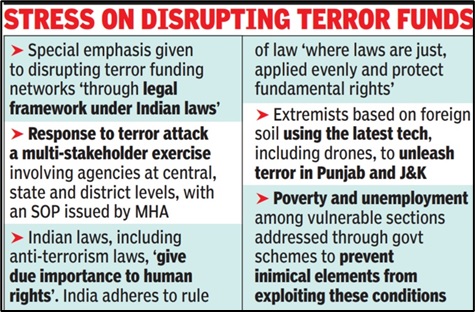
The framework aims to dismantle terror networks by cutting off access to funding, weapons, and safe havens, both within India and abroad, targeting not just terrorists but also their financiers and supporters.
Background and Context
India has faced persistent security challenges, including cross-border terrorism, radicalisation, sleeper cells, and technology-enabled terror financing. While India has strong legal instruments such as the Unlawful Activities (Prevention) Act (UAPA) and a robust institutional mechanism involving the NIA, IB, and state police forces, there has been no single integrated doctrine outlining a comprehensive national counter-terror strategy.
‘Prahaar’ seeks to fill this gap by institutionalising a unified, doctrine-based approach to counter-terrorism rooted in prevention, coordination, and resilience.
India’s First Counter-Terrorism Policy: Prahaar
The policy adopts a whole-of-government and whole-of-society approach, integrating intelligence, law enforcement, legal safeguards, and international cooperation.
Core Objectives
Prahaar aims to:
- Criminalise all terrorist acts without ambiguity.
- Starve terrorists and their supporters of funding, weapons, cyber tools, and safe havens.
- Ensure seamless coordination between central and state agencies.
- Strengthen prevention through proactive intelligence mechanisms.
Guiding Principles
- Zero Tolerance: No justification for terrorism under any circumstances.
- Victim-Centric Approach: Strong institutional support for victims of terror.
- No Religious Attribution: Terrorism is not linked to any religion, ethnicity, or civilisation.
- Recognition of State Sponsorship: Notes the use of terrorism as an instrument of state policy in the region.
Seven Strategic Pillars of Prahaar
Each letter of “Prahaar” represents a pillar:
1. Prevention
- Intelligence-led disruption of terror plots.
- Continuous monitoring of overground worker networks.
- Cyber surveillance to counter extremist propaganda.
2. Responses
- Swift, proportionate, graded counter-terror operations.
- Uniform anti-terror structures and SOPs across governance levels.
3. Aggregating Internal Capacities
- Whole-of-government approach.
- Modernisation of law enforcement agencies (LEAs).
- Enhanced inter-agency intelligence sharing.
4. Human Rights and Rule of Law
- Due process safeguards.
- Multi-level redressal and appeal mechanisms.
- Periodic legal reforms in counter-terror laws.
5. Attenuating Enabling Conditions
- Graded response to radicalisation.
- Legal action based on degree of involvement.
- Addressing socio-economic vulnerabilities among youth.
6. Aligning International Efforts
- Strengthened global counter-terror partnerships.
- Extradition and deportation under UN norms.
- Collaboration to counter misuse of ICT by terror groups.
7. Recovery and Resilience
- Whole-of-society rebuilding after terror incidents.
- Community resilience and psychological support systems.
Key Threat Perceptions
1. Cross-Border and State-Sponsored Terror
- Persistent cross-border infiltration and proxy warfare.
- Global terror outfits such as Al-Qaeda and Islamic State attempting recruitment and incitement.
- Drone-based arms and narcotics smuggling, particularly in Punjab and Jammu & Kashmir.
- Terror-crime nexus for logistics and recruitment.
2. Technology-Driven Terrorism
- Use of encrypted communication and dark web platforms.
- Cryptocurrency-based financing channels.
- Social media radicalisation pipelines.
- Emerging threats from CBRNED materials (chemical, biological, radiological, nuclear, explosive, digital).
- Misuse of drones, robotics, and cyberattacks by both state and non-state actors.
3. Organised Crime Nexus
- Terror groups leveraging criminal syndicates.
- Cross-border logistics support networks.
- Convergence of narco-terrorism and transnational organised crime.
Counter-Measures and De-Radicalisation
- Proactive takedown of online extremist propaganda.
- Strengthened intelligence collection and counter-terror operations.
- Community-based reintegration efforts involving psychologists, NGOs, legal experts, and religious leaders.
- Youth engagement through education and livelihood programmes.
Strategic Way Forward
- Enhanced coordination between intelligence and security agencies.
- Capacity-building at state and district levels.
- Investment in advanced surveillance and forensic technologies.
- Partnerships with private enterprises in cybersecurity and AI.
- Standardisation of procedures across all governance tiers.
Significance
- Institutionalises India’s counter-terror strategy into a formal doctrine.
- Integrates intelligence, law enforcement, and socio-economic interventions.
- Addresses emerging tech-enabled threats.
- Reinforces India’s global commitment to counter-terror cooperation.
- Strengthens resilience against radicalisation and extremist narratives.
FAQs
1. What is ‘Prahaar’?
India’s first comprehensive counter-terrorism policy aimed at strengthening coordinated and intelligence-driven action against terrorism.
2. What makes Prahaar different from previous measures?
It institutionalises a unified doctrine combining prevention, response, legal safeguards, and resilience under one structured framework.
3. Does Prahaar address online radicalisation?
Yes, it focuses on countering cyber propaganda, encrypted communication misuse, and cryptocurrency-based terror financing.
4. How does Prahaar ensure human rights?
It emphasises due process, graded response, and legal redressal mechanisms within counter-terror operations.
5. Why is international cooperation important under Prahaar?
Terror networks are transnational; extradition treaties, intelligence sharing, and UN cooperation are critical to dismantling global linkages.
|






 Contact Us
  New Batch : 9555124124/ 7428085757
  Tech Support : 9555124124/ 7428085757