New
Hindi Medium: (Delhi) - GS Foundation (P+M) : 14th Oct. 2026, 06:00 PM Hindi Medium: (Prayagraj) - GS Foundation (P+M) : 22nd Sept. 2026, 8:00 AM English Medium: (Delhi) - GS Foundation (P+M) : 26th Sept. 2026 English Medium: (Prayagraj) - GS Foundation (P+M) : 19th Aug 2026, 11:00 AM Hindi Medium: (Delhi) - GS Foundation (P+M) : 14th Oct. 2026, 06:00 PM Hindi Medium: (Prayagraj) - GS Foundation (P+M) : 22nd Sept. 2026, 8:00 AM English Medium: (Delhi) - GS Foundation (P+M) : 26th Sept. 2026 English Medium: (Prayagraj) - GS Foundation (P+M) : 19th Aug 2026, 11:00 AM

Proposed Coal Mine Near Ramappa Temple Raises Heritage Concerns

Why in News?

  • Opposition has intensified against the proposed PVNR Open-Cast Coal Mine at Venkatapur in Mulugu district, Telangana. 
  • The Kakatiya Heritage Trust (KHT) and other heritage conservationists have expressed concern that the mining project could pose a long-term threat to the UNESCO World Heritage Site Ramappa Temple and Ramappa Lake. 
  • Activists have demanded the withdrawal of the project and are planning large-scale protests involving people from 15 villages after the Dasara festival. 

Key Concerns Regarding the Proposed Mining Project

  • The proposed open-cast mine would be located around 5 km downstream of Ramappa Lake and the temple, with excavation planned to a depth of about 300 metres. 
  • According to the Kakatiya Heritage Trust, technical reports have raised the following concerns: 
    • The water level of Ramappa Lake could influence groundwater movement. 
    • Geological lineaments and faults in the region could influence the movement of water. 
    • The absence of a cut-off trench in the lake could increase seepage due to deep excavation. 
    • Mining could alter the hydraulic gradient in the area. 
    • The sandbox foundation of the temple and surrounding geological structures could be adversely affected. 
    • Repeated vibrations caused by mining activities could have a cumulative impact on the nearly 800-year-old temple. 
    • Some parts of Ramappa Temple are already reported to show cracks and differential settlement. 
    • Mining could also affect biodiversity, the local environment, and the socio-economic interests of communities dependent on Ramappa Lake. 

About Ramappa Temple

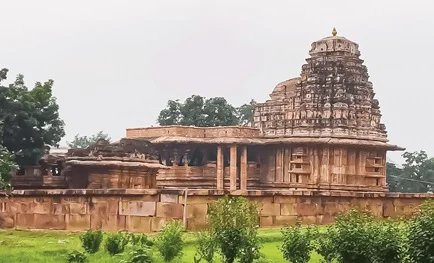
  • Ramappa Temple, also known as the Kakatiya Rudreshwara Temple, is an important Kakatiya-era temple located in Mulugu district, Telangana. 
  • It was constructed in 1213 CE during the reign of Kakatiya ruler Ganapati Deva by his general Recharla Rudra. 
  • The temple is named after its chief sculptor, Ramappa. It is considered one of the rare temples in India named after its architect or chief sculptor. 
  • In 2021, UNESCO inscribed the temple as a World Heritage Site under the name “Kakatiya Rudreshwara (Ramappa) Temple, Telangana.” 

Major Architectural Features of Ramappa Temple

  1. Star-Shaped Platform :-The temple stands on a nearly 6-foot-high star-shaped platform. Its walls, pillars and ceilings are decorated with intricate carvings.
  2. Distinctive Vimana :-The temple has a distinctive pyramidal Vimana, or stepped tower, made using relatively lightweight and porous bricks.
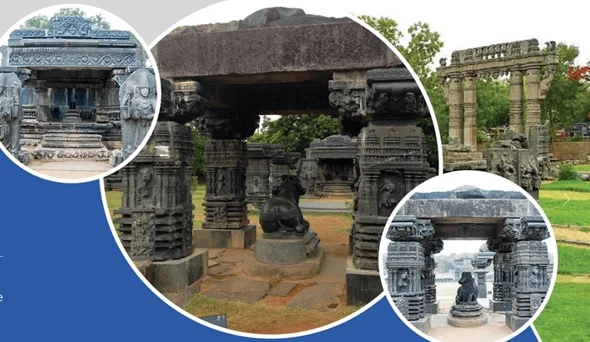
  3. Intricate Stone Carvings :-The temple features beautifully carved granite and dolerite beams and pillars, reflecting the advanced craftsmanship of the Kakatiya period.
  4. Use of Lightweight Bricks :-The upper portions of the temple use lightweight and porous bricks. These bricks are traditionally described as being made using materials such as clay, acacia wood, chaff and myrobalan fruit.

What is the Sandbox Technique?

  • One of the most important features of Ramappa Temple is its sandbox foundation technique. 
  • In this technique, the foundation pit was filled with a mixture of sand, lime, jaggery and black myrobalan fruit. 
  • This mixture acts as a cushion for the foundation and can help absorb vibrations during seismic activity. 
  • This technique is one of the reasons Ramappa Temple is regarded as an important example of earthquake-resilient architecture. 

UNESCO World Heritage Status

  • Ramappa Temple was inscribed on the UNESCO World Heritage List in 2021. 
  • Its official UNESCO name is Kakatiya Rudreshwara (Ramappa) Temple, Telangana. 
  • Heritage conservationists are concerned that geological changes, alterations in water flow and mining-related vibrations could affect the long-term stability of the temple and Ramappa Lake. 

Way Forward

  • Before undertaking major mining or infrastructure projects near a World Heritage Site, there should be a comprehensive Environmental Impact Assessment (EIA), Heritage Impact Assessment (HIA) and geological study. 
  • The project should be scientifically reviewed by considering the Ramappa Lake, temple foundation, groundwater system and local biodiversity. 
  • The priority should be to strike a balance between development needs and heritage conservation, while ensuring the long-term protection of Ramappa Temple and its surrounding ecosystem.

FAQs: Ramappa Temple and Proposed Coal Mine

Question 1. Where is Ramappa Temple located?

Answer: Ramappa Temple is located in Mulugu district of Telangana.

Question 2. When was Ramappa Temple constructed?

Answer: Ramappa Temple was constructed in 1213 CE during the reign of Kakatiya ruler Ganapati Deva.

Question 3. Who built Ramappa Temple?

Answer: The temple was built by Recharla Rudra, a general under Kakatiya ruler Ganapati Deva.

Question 4. Why is the temple called Ramappa Temple?

Answer: The temple is named after its chief sculptor Ramappa. It is considered one of the rare temples in India named after its chief sculptor.

Question 5. When was Ramappa Temple declared a UNESCO World Heritage Site?

Answer: In 2021, Ramappa Temple was inscribed on the UNESCO World Heritage List under the official name “Kakatiya Rudreshwara (Ramappa) Temple, Telangana.”

Have any Query?

Our support team will be happy to assist you!

OR