

Public Service Broadcasting Day: History, Mahatma Gandhi's Historic Radio Address and role of Public Broadcasting

Why in news?

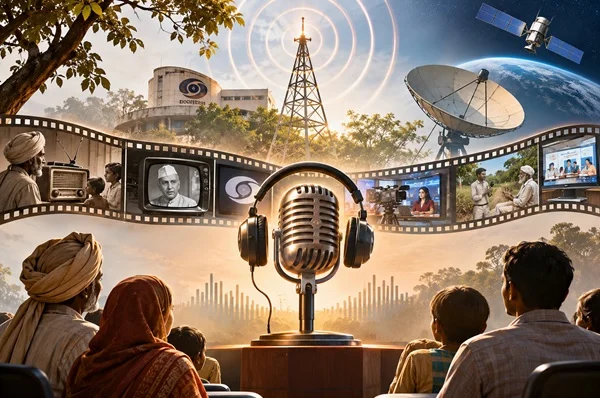
Public Service Broadcasting Day, also known as Jan Prasaran Diwas, is observed every year on 12 November in India to commemorate Mahatma Gandhi's first and only visit to the All India Radio (AIR) studio.
Key facts

Particular

Details

Occasion

Public Service Broadcasting Day

Also known as

Jan Prasaran Diwas

Date

12 November

First observed

2001

Historic event

Mahatma Gandhi's first and only visit to All India Radio's studio

Year of historic broadcast

1947

Location of broadcast

Broadcasting House, New Delhi

People addressed

Partition-displaced people staying in Kurukshetra, Haryana

Main objective

Promote the importance of public service broadcasting

Associated institutions

Akashvani and Doordarshan

Nodal ministry

Ministry of Information and Broadcasting

Historical Background

  • The history of Public Service Broadcasting Day is closely connected with the Partition of India in 1947.
  • Following the Partition, millions of people were displaced from their homes. Many refugees from the newly created Pakistan were temporarily accommodated in camps across India, including Kurukshetra in present-day Haryana.
  • On 12 November 1947, Mahatma Gandhi was unable to visit the refugees staying in Kurukshetra.

What is Public Service Broadcasting?

  • Public Service Broadcasting refers to broadcasting services that operate primarily to serve the public interest rather than merely commercial interests.
  • Its purpose is to inform, educate and entertain citizens while ensuring that information and cultural content reach different sections of society.
  • Unlike purely commercial broadcasting, public service broadcasting gives importance to educational programmes, public awareness, national integration, cultural preservation and balanced information.

Major Objectives of Public Service Broadcasting

Objective

Explanation

Information

Provide reliable and timely information to citizens

Education

Promote awareness, literacy and lifelong learning

Entertainment

Provide meaningful cultural and educational entertainment

National Integration

Promote unity, diversity and constitutional values

Cultural Preservation

Protect and promote regional languages, folk traditions and heritage

Social Awareness

Spread awareness about health, agriculture, environment and government programmes

Inclusive Communication

Reach rural, remote and marginalised communities

Public Service Broadcasting in India

  • Akashvani (All India Radio)
    • All India Radio (AIR), now popularly known as Akashvani, is India's national public radio broadcaster.
    • The Indian State Broadcasting Service was renamed All India Radio in 1936.
    • It broadcasts news, educational programmes, agricultural information, music and cultural programmes.
    • Its motto is "Bahujan Hitaya, Bahujan Sukhaya", meaning the welfare of the many and the happiness of the many.
    • According to Prasar Bharati, its home service has 470 broadcasting centres, covering nearly 92% of India's geographical area and 99.19% of its population.
  • Doordarshan
    • Doordarshan is India's public television broadcaster.
    • It was established on 15 September 1959 as an experimental television service in Delhi.
    • Initially, it functioned as part of All India Radio.
    • On 1 April 1976, Doordarshan became a separate department.
    • It plays an important role in educational broadcasting, public awareness, national integration and cultural preservation.
  • Prasar Bharati

Particular

Details

Governing legislation

Prasar Bharati Act, 1990

Came into existence

23 November 1997

Nature

Autonomous statutory body

Headquarters

New Delhi

Major constituents

Akashvani and Doordarshan

Administrative ministry

Ministry of Information and Broadcasting

Main objective

Inform, educate and entertain the public

Prasar Bharati Act, 1990: Important Provisions

Objective

Significance

National Integration

Uphold India's unity, integrity and constitutional values

Freedom of Information

Ensure fair, truthful and balanced information

Education

Promote education and literacy

Rural Development

Disseminate information related to agriculture and rural development

Cultural Diversity

Promote regional languages and diverse cultural traditions

Social Awareness

Provide information on health, environment and family welfare

Scientific Development

Promote science and technology through broadcasting

Importance of Public Service Broadcasting in a Democracy

  • Democratic Awareness: Informs citizens about government policies, elections and public issues.
  • Rural Development: Provides information on agriculture, weather and rural welfare.
  • Disaster Management: Disseminates emergency alerts and public safety information.
  • Cultural Preservation: Promotes regional languages, folk music and traditional art.
  • National Integration: Connects diverse communities through common platforms.

Major Challenges

  • Competition from Private Media: The growth of private television channels, FM radio and digital media has increased competition for audiences.
  • Digital Transformation: Public broadcasters need continuous technological modernisation to remain relevant in the age of smartphones, OTT platforms and social media.
  • Financial Sustainability: Maintaining extensive broadcasting infrastructure requires significant financial resources.
  • Misinformation and Fake News: The rapid spread of unverified information on digital platforms makes credible public communication increasingly important.

Prelims MCQ

Q. Prasar Bharati came into existence in which year?

A. 1990

B. 1992

C. 1995

D. 1997

Mains Practice Question

Q. Discuss the significance of the Prasar Bharati Act, 1990, in ensuring autonomy and accountability in India's public broadcasting system.

FAQs

When is Public Service Broadcasting Day celebrated in India?

12 November.

Why is Public Service Broadcasting Day celebrated?

It commemorates Mahatma Gandhi's first and only visit to the All India Radio studio in New Delhi on 12 November 1947.

Where did Mahatma Gandhi deliver his historic radio address?

He delivered it from the Broadcasting House of All India Radio in New Delhi.

What is Jan Prasaran Diwas?

Another name for Public Service Broadcasting Day.

What are the two major constituents of Prasar Bharati?

Akashvani and Doordarshan.




