|
Prelims
Raksha Framework, Defence Diplomacy, Defence Partnerships, Make in India, Defence Exports, Indian Ocean Region, Maritime Security.
Mains
GS Paper II: International Relations – Bilateral and multilateral defence partnerships, Indo-Pacific and strategic diplomacy.
GS Paper III: Defence Technology, Indigenous Defence Production, Defence Exports and Maritime Security.
Keywords
Raksha Framework, Defence Diplomacy, Defence Partnerships, Make in India, Defence Exports, Maritime Security, Indian Ocean Region (IOR), Strategic Autonomy.
|
Why in News?
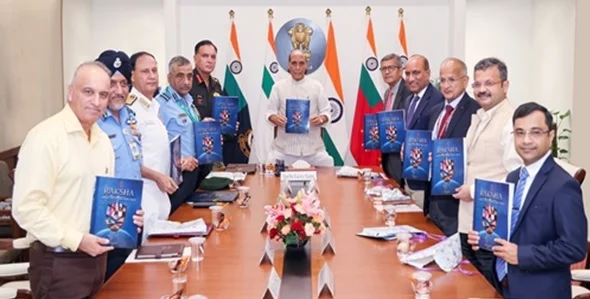
- Defence Minister Rajnath Singh released ‘Raksha’, a comprehensive strategic framework for India’s defence diplomacy on December 3, 2026.
Important Points
- Focus: Defence diplomacy and global defence partnerships
- Key initiative: Make in India and defence exports
- Major regional focus: Indian Ocean Region
- Key roles: Net Security Provider and First Responder
- Approach: Bilateral and multilateral defence cooperation
- Objective: Strengthen India’s strategic position and global defence partnerships
- The framework presents India’s vision and roadmap for the next 10 years to strengthen defence partnerships and expand strategic cooperation with friendly countries.
What is the ‘Raksha’ Framework?
- ‘Raksha’ is a strategic framework aimed at aligning India’s national security interests with proactive international defence cooperation.
- It focuses on strengthening relations with friendly countries while promoting India as a reliable security and defence partner.
Key Features of the ‘Raksha’ Framework
1. Strengthening Defence Partnerships
- The framework aims to deepen bilateral and multilateral defence partnerships with friendly countries.
- It also focuses on expanding:
- Joint military exercises
- Defence training programmes
- Capacity-building initiatives
- Strategic cooperation
2. Promoting Defence Exports
- A major focus is on increasing indigenous defence exports under the Make in India initiative.
- India aims to become a reliable global defence manufacturing partner by promoting cooperation in indigenously developed defence platforms and technologies.
3. Focus on Maritime Security
- The framework gives special importance to maritime security in the Indian Ocean Region (IOR).
- It seeks to strengthen India’s role as a Net Security Provider and First Responder in the region and contribute to peace, stability and security in the Indian Ocean.
4. Greater Global Strategic Engagement
- The framework provides a long-term roadmap for India’s engagement with the global security community.
- It aims to enhance India’s role in promoting:
- Peace and stability
- Strategic partnerships
- International cooperation
- A rules-based international order
Significance for India
1. Strengthens Strategic Partnerships
2. Boosts Defence Industry
3. Enhances Maritime Security
4. Increases India’s Global Role
5. Supports Strategic Autonomy
- Diversifying defence partnerships can help India reduce excessive dependence on any single country and strengthen its strategic autonomy.
Key Challenges
1. Balancing Multiple Partnerships
- India has defence and strategic relationships with different major powers. Maintaining these relationships while protecting national interests can be challenging.
2. Dependence on Foreign Technology
- Despite progress in indigenous production, India still depends on foreign sources for several critical defence technologies and systems.
3. Competition in Global Defence Markets
- India faces strong competition from established defence exporters such as the United States, Russia, France and Israel.
4. Technology Transfer
- Securing advanced technology and meaningful technology transfer from foreign partners remains a challenge.
5. Changing Geopolitical Environment
- Conflicts, tensions and shifting alliances in regions such as the Indo-Pacific, Europe and West Asia can complicate India’s defence diplomacy.
6. Balancing Exports and National Security
- While increasing defence exports is important, India must ensure that exports remain consistent with national security and strategic interests.
Way Forward
- India needs to focus on indigenous R&D, defence manufacturing, technology development and deeper international cooperation.
- A balanced approach combining strategic autonomy with strong global partnerships can help India emerge as a reliable defence and security partner.
Conclusion
The ‘Raksha’ Framework provides a long-term vision for India’s defence diplomacy. By strengthening defence partnerships, promoting indigenous defence exports and enhancing maritime security, it can help India play a greater role in maintaining regional stability and a rules-based international order.
Prelims Practice Question
Q. With reference to the ‘Raksha’ Framework, consider the following statements:
- It provides a 10-year roadmap for India’s defence diplomacy.
- It focuses on strengthening bilateral and multilateral defence partnerships.
- It seeks to promote indigenous defence exports under Make in India.
- It focuses only on land-based security and does not cover maritime security.
Which of the statements given above is/are correct?
A. 1, 2 and 3 only
B. 1 and 4 only
C. 2 and 3 only
D. 1, 2, 3 and 4
Mains Practice Question
Q. Discuss the significance of the ‘Raksha’ Framework in strengthening India’s defence diplomacy and global defence partnerships. What challenges could India face in implementing its vision?
|
FAQs
Q1. What is the ‘Raksha’ Framework?
It is a 10-year strategic framework for strengthening India’s defence diplomacy and global defence partnerships.
Q2. What are the major focus areas of the framework?
Defence partnerships, joint military exercises, training, capacity building, defence exports and maritime security.
Q3. How does it support Make in India?
It promotes indigenous defence production and aims to expand India’s defence exports and global manufacturing partnerships.
Q4. Why is the Indian Ocean Region important in the framework?
It seeks to strengthen India’s role as a Net Security Provider and First Responder in the Indian Ocean Region.
Q5. What is the significance of the framework?
It aims to strengthen India’s strategic partnerships, enhance defence capabilities and increase its role in maintaining regional and global security.
|






 Contact Us
  New Batch : 9555124124/ 7428085757
  Tech Support : 9555124124/ 7428085757