
- UPSC Exam
- State PCS
- One Day Exam
- Current Affairs
- PT Quiz
- Downlaods
- About Coaching
- Blog
- Videos

| Prelims: (Polity & Governance + CA) Mains: (GS 2 - Government Policies & Interventions, Welfare Schemes, Rural Development; GS 3 - Agriculture, Inclusive Growth) |
The proposed Viksit Bharat–Guarantee for Rozgar and Ajeevika Mission Gramin (VB-G RAM G) Bill seeks to replace the MGNREGS and introduces a 60-day suspension of rural employment works during peak sowing and harvesting seasons, to be notified in advance by States.
The move is justified on the grounds that MGNREGS allegedly creates shortages of agricultural labour during peak farm operations—a concern raised periodically by farmers and policymakers, including former Union Agriculture Ministers.
However, recent wage and labour market data challenge this narrative, raising important questions about rural employment, wage dynamics, and the real causes of farm labour shortages.
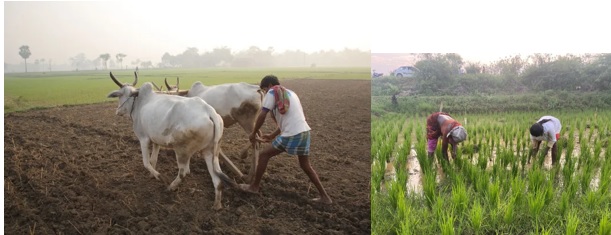
Since its launch in 2006, the Mahatma Gandhi National Rural Employment Guarantee Scheme (MGNREGS) has acted as a rights-based social security programme, guaranteeing 100 days of wage employment to rural households.
Its objectives include:
Over the years, critics have argued that MGNREGS diverts labour away from farms, especially during agricultural peak seasons. The VB-G RAM G Bill marks the first formal legislative attempt to structurally align rural employment guarantees with agricultural cycles.
MGNREGS is often credited with tightening rural labour markets and improving workers’ bargaining power. However, this has not translated into sustained real wage growth.
Key Findings from Labour Bureau Data
Key Insight
Even agricultural wages have largely stagnated in real terms, indicating that MGNREGS has not triggered an inflationary wage spiral.
1. Surge in Female Labour Force Participation
A critical but often overlooked factor is the sharp rise in women’s workforce participation.
LFPR measures the proportion of the population (15+ years) that is working or actively seeking work.
2. Role of Welfare Infrastructure
The Economic Survey 2023–24 attributes rising female participation to welfare schemes that reduced unpaid care burdens:
By freeing time previously spent on household chores, these schemes enabled women to enter paid work—expanding labour supply rather than shrinking it.
The data weakens the argument that MGNREGS is the primary driver of farm labour shortages:
Thus, imposing blanket employment suspensions during peak seasons may be policy overreach without granular evidence.
1. Low Farm Wages
2. Harsh Working Conditions
3. Rural–Urban Migration
4. Increased Bargaining Power
FAQsQ1. What is MGNREGS? It is a rights-based rural employment scheme guaranteeing 100 days of wage employment to rural households under the Mahatma Gandhi National Rural Employment Guarantee Act, 2005. Q2. What does the VB-G RAM G Bill propose? It proposes replacing MGNREGS and introducing a 60-day suspension of rural works during peak agricultural seasons to ensure farm labour availability. Q3. Has MGNREGS caused a rise in rural wages? Data shows rural wage growth has been modest and often below inflation, indicating no sustained wage surge due to MGNREGS. Q4. Why is female labour participation rising in rural India? Improved access to LPG, water, sanitation, and electricity has reduced unpaid care work, enabling women to join the workforce. Q5. What is the real cause of farm labour shortages? Low farm wages, harsh working conditions, migration, and rising worker bargaining power are more significant factors than MGNREGS. |



Our support team will be happy to assist you!

 Contact Us
  New Batch : 9555124124/ 7428085757
  Tech Support : 9555124124/ 7428085757