Prelims : Polity & Governance + CA
Mains : GS Paper 2 – Governance, Civil Services Reforms, Capacity Building |
Why in News ?
- The Sādhana Saptah 2026 initiative has been highlighted as a key step towards building a future-ready civil services system in India.
- It reflects the government’s broader push under Mission Karmayogi to enhance the competency, efficiency, and citizen-centric orientation of public servants.
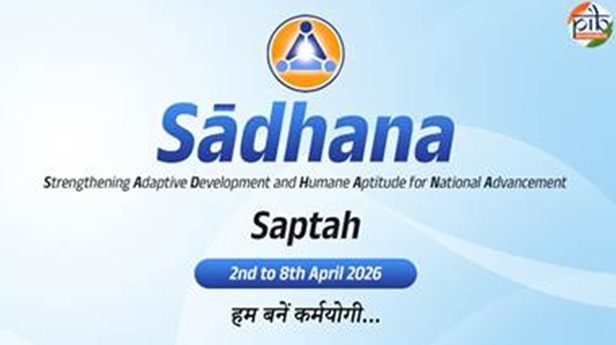
What is the Sādhana Saptah Initiative ?
- Sādhana Saptah is a structured capacity-building initiative under Mission Karmayogi (National Programme for Civil Services Capacity Building).
- The term SĀDHANA (Strengthening Adaptive Development and Humane Aptitude for National Advancement) reflects its focus on developing both technical competencies and ethical governance values.
- The initiative aims to create a responsive, adaptive, and citizen-focused bureaucracy capable of addressing complex governance challenges.
What is the Institutional Framework Behind the Initiative ?
- The initiative is jointly organised by :
- Department of Personnel and Training (DoPT)
- Capacity Building Commission (CBC)
- Karmayogi Bharat
- It brings together :
- Central Ministries
- State Governments
- Union Territories
- Training institutions
- This collaborative framework ensures a whole-of-government approach to capacity building.
Key Features of Sādhana Saptah
1. Three-Sutra Approach to Capacity Building
- The initiative is structured around three guiding principles :
- Technology : Promoting digital governance and data-driven decision-making
- Tradition : Integrating India’s administrative ethos and ethical values
- Tangible Outcomes : Ensuring measurable improvements in governance delivery
- This framework ensures a balanced approach combining modern tools with foundational values.
2. Integrated Learning Ecosystem
- The programme provides multiple learning opportunities through :
- Curated courses on the iGOT Karmayogi platform
- Samuhik Charcha (group discussions) for peer learning
- Thematic webinars and workshops
- These platforms enable continuous learning and knowledge sharing among civil servants.
3. Focus on Core Competencies
- The initiative emphasises development of critical skills such as :
- Leadership and decision-making
- Communication and stakeholder engagement
- Data analysis and evidence-based policymaking
- Project management and implementation efficiency
- Digital governance capabilities
- This competency-based approach aligns training with real-world administrative requirements.
How Does It Link with Mission Karmayogi ?
- Mission Karmayogi aims to shift civil services from a rule-based to a role-based human resource management system.
- Sādhana Saptah operationalises this vision by :
- Promoting continuous capacity building
- Encouraging self-driven learning
- Aligning skills with functional roles and responsibilities
Significance of the Initiative
1. Promoting Citizen-Centric Governance
- By focusing on behavioural and functional competencies, the initiative aims to make governance more responsive, transparent, and people-oriented.
2. Building Future-Ready Bureaucracy
- It prepares civil servants to deal with emerging challenges such as :
- Digital transformation
- Complex policy environments
- Data-driven governance
3. Supporting Vision of Viksit Bharat 2047
- The initiative aligns with the long-term goal of transforming India into a developed nation by 2047, by strengthening institutional capacity.
4. Encouraging Collaborative Governance
- By bringing multiple stakeholders onto a common platform, it fosters coordination across ministries and levels of government.
What are the Challenges?
1. Implementation Across Diverse Administrative Levels
- Ensuring uniform adoption across Central, State, and local levels remains a challenge due to variations in capacity and resources.
2. Resistance to Change
- Transitioning from traditional administrative practices to a competency-based system may face resistance within the bureaucracy.
3. Digital Divide and Accessibility
- Effective utilisation of platforms like iGOT requires digital infrastructure and literacy, which may not be uniformly available.
Way Forward
- Strengthen last-mile connectivity and digital infrastructure for wider participation
- Promote a culture of continuous learning and performance evaluation
- Ensure customised training modules based on roles and sectors
- Enhance monitoring and impact assessment of training outcomes
Practice Questions
Prelims :
Q. Mission Karmayogi is primarily aimed at :
(a) Electoral reforms
(b) Civil services capacity building
(c) Judicial reforms
(d) Agricultural modernization
Mains :
“Discuss the role of capacity-building initiatives like Sādhana Saptah in transforming governance and civil services in India.”
FAQs
Q1. What is Sādhana Saptah ?
It is a capacity-building initiative for civil servants under Mission Karmayogi.
Q2. What does SĀDHANA stand for ?
Strengthening Adaptive Development and Humane Aptitude for National Advancement.
Q3. Which institutions are involved ?
DoPT, Capacity Building Commission, and Karmayogi Bharat.
Q4. What platform is used for training ?
The iGOT Karmayogi digital platform.
Q5. What is its main objective ?
To build a competent, citizen-centric, and future-ready civil services system.
|






 Contact Us
  New Batch : 9555124124/ 7428085757
  Tech Support : 9555124124/ 7428085757