Why in News?
- Scientists at the Institute of Advanced Virology (IAV), Keralam have developed a Dengue Early Warning System (DEWS) that uses machine learning, epidemiological data and weather information to forecast dengue trends in advance.
- The system is designed to help public health authorities take preventive measures and plan resources before dengue cases increase significantly.
What is the Dengue Early Warning System?
- The Dengue Early Warning System (DEWS) is a machine-learning-based forecasting platform developed by scientists at IAV.
- It combines:
- Dengue case data
- Rainfall
- Temperature
- Humidity
- District-level geographical and environmental factors
- The system generates weekly forecasts of dengue trends and classifies the expected disease burden into four risk categories:
- Very High, High, Moderate and Low.
- The platform uses epidemiological data from the State Surveillance Unit (SSU) of the Directorate of Health Services and weather data from the India Meteorological Department (IMD).
How Does the System Work?
- The model has been trained using six years of epidemiological data from March 2020 to February 2026.
- It analyses climatic and disease-related patterns to identify conditions that may lead to an increase in dengue transmission.
- Each district is treated as an independent unit. This allows the model to consider district-specific factors such as:
- Geographical conditions
- Water bodies
- Drainage systems
- Local climatic conditions
- Historical dengue trends
The system then generates a district-wise forecast of the expected dengue burden.
Why is Weather Important for Dengue Transmission?
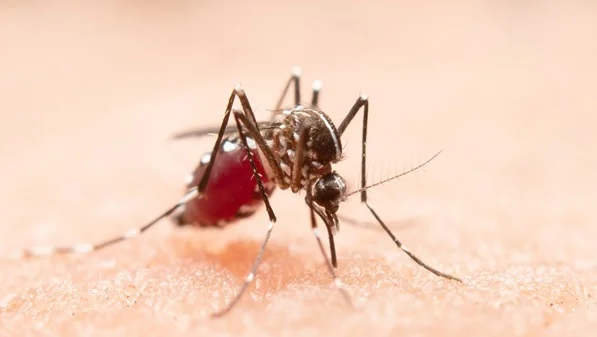
Dengue is mainly transmitted by Aedes mosquitoes, whose growth and survival are strongly influenced by environmental conditions.
Temperature
- Warm temperatures can accelerate mosquito development and shorten the time required for the dengue virus to become transmissible inside the mosquito.
Humidity
- Moderate to high humidity can increase mosquito survival, potentially supporting dengue transmission.
Rainfall
- Moderate rainfall can create water-filled containers and other breeding sites for mosquitoes.
- However, very heavy rainfall can sometimes wash away mosquito breeding sites, making its effect on dengue transmission more complex.
- Kerala's warm and humid climate provides favourable conditions for the growth and spread of Aedes mosquitoes, making dengue forecasting particularly important.
What Has the Model Found?
- According to IAV scientists, dengue trends predicted by DEWS have shown a positive correlation with actual dengue case data reported by the Health Department.
- Further evaluation using surveillance data from March to July 2026 has indicated the model's potential to forecast dengue trends at the district level.
- The system is available through the Dengue Early Warning System (DEWS) platform.
Why is Dengue Forecasting Important?
Dengue outbreaks can put significant pressure on public health systems. Early forecasting can help authorities prepare in advance instead of responding only after cases rise.
The system can potentially help in:
- Planning healthcare resources
- Strengthening disease surveillance
- Preparing hospitals and health facilities
- Increasing mosquito-control measures
- Conducting targeted awareness campaigns
- Identifying districts at higher risk
- Supporting timely public health interventions
Challenges in Predicting Dengue
Forecasting dengue is difficult because its transmission depends on several factors beyond weather.
- Urbanisation and Human Mobility: Rapid urbanisation and movement of people can influence how quickly dengue spreads between locations.
- Water Storage Practices: Improperly stored water can create breeding sites for Aedes mosquitoes.
- Population Immunity: Previous exposure to different dengue virus serotypes can affect transmission patterns and disease severity.
- Changes in Mosquito Behaviour: Changes in mosquito biology and behaviour can also influence dengue transmission.
Under-reporting
- Many dengue infections are asymptomatic or mild and may not be detected. Differences in testing and reporting practices can also create geographical variations in reported cases.
- Therefore, a model based largely on historical and climatic data may face difficulties when there are sudden changes in these factors.
Limitations of the Dengue Early Warning System
- The DEWS model is trained using historical data. Therefore, sudden changes in climatic conditions may affect its forecasting accuracy.
- Similarly, changes in the reporting of confirmed dengue cases can influence the data used by the model and consequently affect predictions.
- For this reason, the system requires regular updating and further refinement.
Future Scope
- According to IAV, the system will need annual updates and additional variables to evolve from a research model into a routinely used public health forecasting system.
- The technology could also potentially be extended to other Aedes-borne diseases, including:
- Chikungunya
- Zika virus disease
- This could strengthen disease surveillance and support more timely, data-driven public health interventions in Kerala.
Conclusion
The Dengue Early Warning System developed by IAV represents an effort to shift dengue management from a reactive approach to a preventive and predictive approach. By combining epidemiological information with weather and district-level environmental data, the system can provide early indications of dengue risk and help health authorities prepare for potential increases in cases.
Prelims Practice Question
1. The Dengue Early Warning System (DEWS), recently in the news, has been developed by which of the following?
(a) Indian Council of Medical Research (ICMR)
(b) Institute of Advanced Virology (IAV), Kerala
(c)National Centre for Disease Control (NCDC)
(d) National Institute of Virology (NIV), Pune
Mains Practice Question
Q. How can machine-learning-based disease forecasting systems strengthen India's preparedness against vector-borne diseases? Discuss the challenges associated with their use.
|
FAQs
1. What is the Dengue Early Warning System (DEWS)?
DEWS is a machine-learning-based system that uses epidemiological and climatic data to forecast dengue trends in advance.
2. Who developed DEWS?
It was developed by scientists at the Institute of Advanced Virology (IAV), Kerala.
3. What factors does DEWS analyse?
The system analyses temperature, rainfall, humidity and epidemiological data related to dengue.
4. What is the main vector of dengue?
Dengue is primarily transmitted by Aedes mosquitoes.
5. What is the main objective of DEWS?
Its main objective is to provide early forecasts of dengue trends, helping health authorities plan resources and preventive measures in advance.
|





 Contact Us
  New Batch : 9555124124/ 7428085757
  Tech Support : 9555124124/ 7428085757