Prelims: (Polity + CA)
For Mains: (GS 2 – Government Policies & Interventions; GS 3 – Energy Security, Climate Change, Infrastructure) |
Why in News?
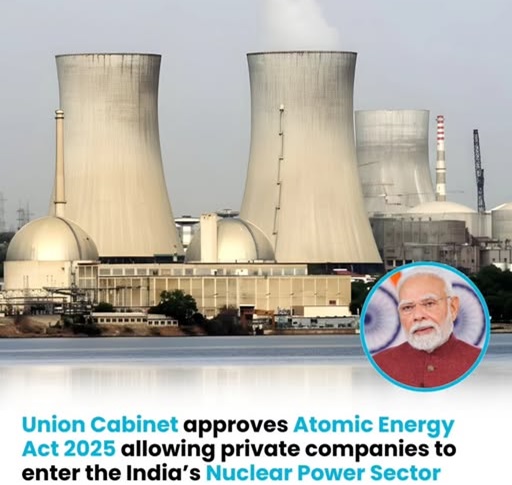
The Union Government has cleared the Atomic Energy Bill, 2025, rebadged as the Sustainable Harnessing and Advancement of Nuclear Energy for Transforming India (SHANTI) Bill. The Bill proposes sweeping amendments to the Atomic Energy Act, 1962, aiming to open India’s tightly controlled nuclear power sector to private and foreign participation in civil nuclear energy.
Background & Context
India’s nuclear power programme has historically followed a state-monopoly model, with the Department of Atomic Energy (DAE) and NPCIL exercising exclusive control. While this ensured strategic autonomy and safety, it also resulted in slow capacity addition due to high capital costs, long gestation periods, and limited public funding.
As India targets net-zero emissions by 2070, rapid renewable expansion has created grid stability challenges, while coal-based capacity faces environmental and political constraints. Against this backdrop, nuclear energy is being repositioned as a clean, reliable baseload source, essential for long-term energy security.
Reforming India’s Nuclear Sector
1. Energy Transition & Baseload Needs
- Renewables are intermittent and storage solutions remain expensive.
- Coal expansion is slowing due to climate commitments.
- Nuclear power offers low-carbon, round-the-clock electricity.
2. Capital Constraint, Not Technology Deficit
- India has strong indigenous nuclear capabilities (PHWRs).
- The primary bottleneck is financing, not know-how.
- Interest from foreign sovereign wealth funds, especially from West Asia, has been expressed.
3. Reviving the Indo–US Civil Nuclear Deal
- Nearly two decades after signing, its commercial potential remains underutilised.
- Nuclear reforms are being aligned with broader India–US trade and investment negotiations.
Key Provisions of the Atomic Energy Bill, 2025 (SHANTI Bill)
Opening the Sector
- Allows private companies up to 49% minority equity in nuclear power projects.
- Enables foreign participation through partnerships and sovereign investment funds.
Expanded Scope for Private Participation
Private entities may now participate in:
- Exploration of atomic minerals
- Fuel fabrication
- Equipment manufacturing
- Select aspects of plant operations
- Civil nuclear R&D, especially Small Modular Reactors (SMRs)
Scaling Up Nuclear Capacity: India’s Ambition
- Current capacity: ~8 GWe
- Target: 100 GWe by 2047
Global Comparison
- USA: ~100 GWe
- France: ~65 GWe
- China: ~58 GWe
Nuclear Energy Mission
- Outlay: ₹20,000 crore
- Focus: R&D and deployment of Small Modular Reactors
- Goal: At least 5 indigenous SMRs operational by 2033
SMRs: New Pillar of India’s Nuclear Strategy
Why SMRs?
- Smaller size, factory-built, modular deployment
- Faster construction and lower upfront costs
- Ideal for industrial decarbonisation, captive power for steel, cement, data centres
- Provide carbon-neutral baseload to complement renewables
Indian SMR Designs (BARC)
- Bharat Small Reactor (BSR – 220 MWe): PHWR-based
- Bharat Small Modular Reactor (BSMR – 200 MWe): LWR-based
- SMR-55 (55 MWe): LWR-based
Note: Designs are at an advanced stage; no initial foreign collaboration planned.
Private Sector Interest in SMRs
Interested Companies
- Reliance Industries
- Tata Power
- Adani Power
- Hindalco
- JSW Energy
- Jindal Steel & Power
Operational Model
- NPCIL retains ownership and operational control.
- Private players:
- Finance entire project lifecycle (including decommissioning)
- Receive assured long-term captive power supply
Potential Sites
- 16 locations across Gujarat, MP, Odisha, Andhra Pradesh, Jharkhand, Chhattisgarh
Nuclear Liability Law: The Key Bottleneck
Civil Liability for Nuclear Damage Act, 2010
- Includes a “right of recourse”, allowing operators to seek damages from suppliers.
- Foreign vendors (Westinghouse, EDF/Areva) see this as a major deterrent.
Proposed Solutions
- Cap supplier liability beyond a threshold
- Create a state-backed insurance pool
- Align with global nuclear liability conventions
- Ensure victim compensation without discouraging investment
Challenges and Way Forward
Key Challenges
- Public and political concerns over nuclear safety
- Private sector concerns on risk-sharing and cost recovery
- Scalability limits of PHWR-dominated reactor fleet
- Balancing sovereignty, safety, and openness
Way Forward
- Strengthen independent nuclear safety oversight
- Gradual transition toward globally dominant LWR technologies
- Clear, predictable liability and regulatory frameworks
- Integrate nuclear energy into India’s climate and energy-transition strategy
FAQs
Q1. What is the SHANTI Bill, 2025?
It is the proposed Atomic Energy Bill that seeks to amend the Atomic Energy Act, 1962 to allow private and foreign participation in civil nuclear power.
Q2. Why is India opening its nuclear sector now?
To address capital constraints, meet climate commitments, ensure baseload power, and scale nuclear capacity rapidly.
Q3. What are Small Modular Reactors (SMRs)?
Factory-built nuclear reactors under 300 MW that are quicker to deploy, safer, and suitable for industrial and captive power use.
Q4. Will private companies own nuclear plants?
No. NPCIL will retain ownership and operational control; private players will finance and receive power.
Q5. Why is nuclear liability controversial in India?
India’s liability law allows recourse against suppliers, unlike global norms, deterring foreign investment.
|






 Contact Us
  New Batch : 9555124124/ 7428085757
  Tech Support : 9555124124/ 7428085757