Prelims: Department of Telecommunications (DoT), Digital Intelligence Platform (DIP), SIM Card Limits, Customer Application Form (CAF), Telecom Cyber Security
Mains: GS Paper II: Government Policies and Interventions
GS Paper III: Cyber Security, Communication Networks, Internal Security, Digital Technology |
Why in News?
The Department of Telecommunications (DoT) has tightened the enforcement of rules governing the number of mobile connections that an individual can hold in India. From 24 August 2026, telecom service providers are required to identify subscribers who have already reached the prescribed limit of mobile connections and prevent them from obtaining additional connections beyond that limit.
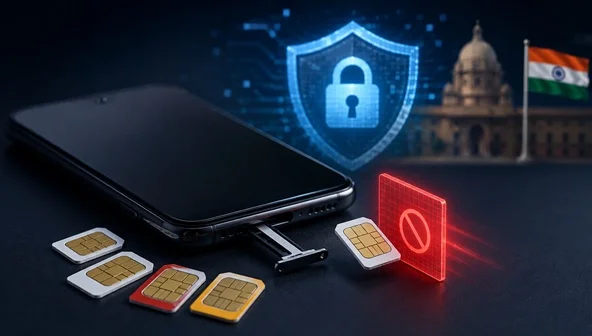
What is the SIM Card Limit in India?
- The maximum number of mobile connections that can be held by one individual is:
|
Region
|
Maximum Mobile Connections
|
|
Most parts of India
|
9
|
|
Jammu & Kashmir
|
6
|
|
Assam
|
6
|
|
North-East
|
6
|
- The limit applies to mobile connections registered in an individual's name across telecom operators and Licensed Service Areas.
What are the changes?
- Earlier: Verification across different operators and service areas was comparatively difficult because an individual could have connections from multiple telecom operators.
- Now: The government's Digital Intelligence Platform (DIP) will help telecom companies identify subscribers who have already reached the permitted limit.
Subscriber → Identity Check → DIP Verification → Existing Connections Checked → SIM Issued/Rejected
What is a SIM Card?
- SIM stands for Subscriber Identity Module. It is a small electronic module used in mobile devices to identify and authenticate a subscriber on a mobile network.
- A SIM contains information that enables a telecom network to recognise the subscriber and provide services such as voice calls, SMS and mobile data.
How Does a SIM Work?
- SIM inserted/activated → Mobile connects to network → Subscriber authenticated → Network services provided
What is an eSIM?
- An eSIM (Embedded SIM) performs the basic function of a conventional SIM without requiring the familiar removable plastic SIM card.
- It is embedded in the device and can be provisioned digitally with an operator profile.
Why Has the Government Tightened the Rules?
- Multiple mobile connections obtained through false or misused identities can facilitate cybercrime.
- Fraudsters may use such connections for phishing, impersonation, fraudulent calls and messages, financial scams, fake identities and organised cybercrime.
- Better coordination between telecom companies and government databases can make suspicious mobile connections easier to identify.
- The broader objective is therefore:
Verified Identity → Controlled SIM Issuance → Better Traceability → Reduced Telecom Fraud
Impact on Ordinary Mobile Users
- For the majority of consumers who have only one or a few SIM cards, the immediate impact is expected to be limited.
- The greatest impact will be on individuals holding many mobile connections, applicants already at the prescribed limit, cases involving multiple connections issued using the same identity and fraudulent or unauthorised connections.
- The reform therefore targets better subscriber verification rather than restricting ordinary mobile use.
Benefits of the New Enforcement System
- Stronger Cyber-Security: Better identity verification can make it more difficult to obtain large numbers of connections for fraudulent purposes.
- Better Subscriber Accountability: Mobile connections can be more effectively associated with verified subscribers.
- Cross-Operator Verification: DIP can help overcome information gaps where connections are spread across different telecom companies.
- Detection of Identity Misuse: Consumers may be better protected against unauthorised connections obtained using their identity.
- Real-Time Monitoring: The planned transition to real-time checks can prevent an impermissible connection at the enrolment stage rather than detecting it later.
What Should Consumers Do?
- Consumers should:
- Check how many mobile connections are registered in their name.
- Report connections they do not recognise.
- Keep subscriber/KYC details accurate.
- Provide correct information while applying for a new connection.
- Avoid allowing others to misuse connections issued in their name.
Prelims MCQ
Q. With reference to the rules governing mobile connections in India, consider the following statements:
- An individual can generally hold a maximum of nine mobile connections in most parts of India.
- The permitted limit is six in Jammu & Kashmir, Assam and the North-East.
- The Digital Intelligence Platform is being used to strengthen verification of subscribers who have reached the prescribed limit.
Which of the statements given above are correct?
A. 1 and 2 only
B. 2 and 3 only
C. 1 and 3 only
D. 1, 2 and 3
Mains Practice Questions
Q. “The regulation of mobile connections has increasingly become an issue of digital identity and cyber-security rather than merely telecom administration.” Discuss.
|
FAQs
What changed from August 24, 2026?
Telecom operators must strengthen checks to prevent subscribers from obtaining mobile connections beyond the prescribed limit.
How many SIM connections can a person have?
Generally, a person can have up to nine mobile connections in most parts of India.
Where is the limit six?
The limit is six connections in Jammu & Kashmir, Assam and the North-East
What is DIP?
The Digital Intelligence Platform supports information-sharing and verification to help detect misuse of telecom resources.
When will real-time verification be introduced?
Telecom operators have been directed to move towards the required real-time verification arrangements by 30 November 2026.
|






 Contact Us
  New Batch : 9555124124/ 7428085757
  Tech Support : 9555124124/ 7428085757