New
GS Foundation (P+M) - Delhi : 19th Jan. 2026, 11:30 AM Spring Sale UPTO 75% + 10% Off, Valid Till : 6th Feb., 2026 GS Foundation (P+M) - Prayagraj : 09th Jan. 2026, 11:00 AM Spring Sale UPTO 75% + 10% Off, Valid Till : 6th Feb., 2026 GS Foundation (P+M) - Delhi : 19th Jan. 2026, 11:30 AM GS Foundation (P+M) - Prayagraj : 09th Jan. 2026, 11:00 AM

Solid Waste Management Rules, 2026: Towards a Circular and Decentralised Urban Waste System

Prelims: (Environment + CA)
Mains: (GS 3 – Environment & Ecology, Urban Development, Sustainable Development)

Why in News ?

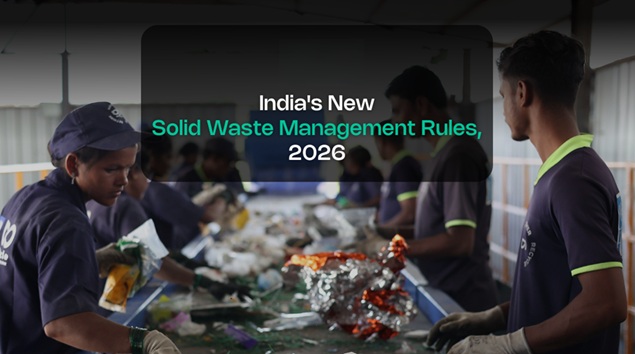
The Solid Waste Management (SWM) Rules, 2026, notified by the Union Ministry of Environment, Forest and Climate Change, will come into force on April 1, 2026, replacing the 2016 framework. The new rules comprehensively overhaul waste management by urban and rural local bodies, emphasising waste reduction, reuse, segregation, and at-source processing.

By discouraging dependence on large landfills and dumping yards, the rules seek to promote decentralised, sustainable, and circular approaches to managing India’s rapidly growing solid waste challenge.
Rationale Behind the Introduction of New Rules

According to the Central Pollution Control Board (CPCB) data for 2023–24, India faces a severe solid waste crisis:

  • Annual waste generation: Over 620 lakh tonnes
  • Daily waste generation: ~1.85 lakh tonnes
  • Daily waste collection: ~1.79 lakh tonnes
  • Daily waste processing/treatment: ~1.14 lakh tonnes
  • Daily landfilling: ~39,629 tonnes

Despite the Solid Waste Management Rules, 2016, large volumes of waste remain poorly segregated and end up in landfills, leading to environmental degradation and public health risks.

The SWM Rules, 2026 aim to:

  • Reduce dependence on landfills,
  • Improve segregation and accountability,
  • Shift towards a circular economy, where waste is treated as a resource,
  • Strengthen compliance through penalties and digital monitoring.

How Are the 2026 Rules Different from the 2016 Rules ?

While retaining core principles such as segregation, recycling, and scientific disposal, the 2026 Rules introduce stricter obligations, expanded segregation, and stronger enforcement mechanisms.

1. Introduction of a Waste Hierarchy

  • The new rules formally introduce a waste hierarchy:
    • Prevention → Reduction → Reuse → Recycling → Recovery → Disposal (last resort)
  • This signals a decisive shift away from landfill-centric waste management.

2. Four-Way Waste Segregation

The earlier wet–dry classification is expanded to a four-way segregation system:

  • Wet waste: Biodegradable household waste
  • Dry waste: Recyclables like paper, plastic, metal, and glass
  • Sanitary waste: Sanitary napkins, tampons, condoms
  • Special-care waste: Medicines, paint cans, bulbs, tube lights, and other hazardous or sensitive items

Urban local bodies (ULBs) must provide infrastructure support, including:

  • Green bins for wet waste,
  • Blue bins for dry waste, and
  • Red bins for sanitary waste, especially in public toilets.

3. Enhanced Responsibilities of Bulk Waste Generators

Who are Bulk Waste Generators ?

Entities meeting any one of the following:

  • Built-up area of 20,000 sq m or more, or
  • Water consumption of 40,000 litres/day or more, or
  • Waste generation of 100 kg/day or more.

This includes:

  • Housing societies and gated communities,
  • Malls, hotels, restaurants,
  • Colleges, universities, hostels,
  • Government departments and large townships.

New Obligations:

  • Mandatory segregation at source,
  • Handover of recyclable waste to authorised entities,
  • All gated communities, RWAs, hotels, restaurants, and institutions with over 5,000 sq m area must comply within one year.

This represents a significant tightening compared to the weaker enforcement under the 2016 Rules.

4. Polluter Pays Principle and Environmental Compensation

The rules introduce environmental compensation for:

  • Failure to register on the centralised portal,
  • False reporting or submission of forged documents,
  • Improper waste handling and segregation.

Additionally:

  • Higher landfill fees will be imposed on mixed or unsegregated waste,
  • Landfilling is made financially disincentivising.

The CPCB is tasked with framing detailed guidelines on compensation and penalties, marking a shift from advisory compliance to deterrence-based regulation.

5. Centralised Tracking and Digital Monitoring System

A centralised online portal will track:

  • Waste generation,
  • Collection,
  • Transportation,
  • Processing,
  • Disposal.

Mandatory registration is required for:

  • Bulk waste generators,
  • Urban and rural local bodies,
  • Waste transporters and processors,
  • Waste pickers,
  • Railways, airports, SEZs, and large authorities.

This addresses data gaps and weak monitoring mechanisms observed under the 2016 framework.

Impact on Bulk Generators Including Housing Societies

Under the new rules, bulk waste generators are placed under an extended responsibility regime, similar to the Extended Producer Responsibility (EPR) framework for electronic and plastic waste.

This framework will become operational once ULBs notify by-laws by March 2027.

1. Mandatory Registration and Certification-Based Compliance

Bulk generators must:

  • Register on the centralised portal,
  • Submit mandatory waste accounting data,
  • Follow certification-based compliance, replacing the earlier self-declaration system.

2. Segregation and On-Site Waste Processing Obligations

  • Mandatory four-way segregation,
  • Strong emphasis on at-source processing of wet waste, preferably through:
    • On-site composting, or
    • Other approved decentralised methods.

3. Alternative Compliance through Certification

Where on-site processing is not feasible, bulk generators may:

  • Procure compliance certificates from:
    • Urban local bodies, or
    • Authorised waste processing facilities.

These certificates will serve as proof of scientific waste processing.

4. Annual Reporting and Penalties

  • Annual returns to be filed by June 30 each year,
  • Returns must detail:
    • Quantity of waste generated,
    • Mode of processing,
    • Certificates procured,
  • Non-compliance will attract environmental compensation.

Implications of SWM Rules, 2026 for Landfills

The 2026 Rules aim to end India’s long-standing dependence on landfills.

  • Landfills are to be used only as a last resort, and exclusively for:
    • Non-usable,
    • Non-recyclable,
    • Non-energy-recoverable waste.

This marks a decisive shift away from dumping mixed waste, which has historically led to massive garbage mounds and environmental contamination.

Mapping and Remediation of Legacy Landfills

All ULBs must:

  • Map existing legacy landfills and dumpsites by October 31, 2026,
  • Prepare time-bound remediation action plans.

Remediation methods include:

  • Bioremediation: Using microbes to reduce waste volume and odour,
  • Biomining: Scientific excavation of old waste to recover usable materials and reduce landfill mass.

These measures aim to reclaim land, reduce pollution, and eliminate long-standing garbage mountains.

Energy Recovery from High-Calorific Waste

The rules mandate that waste with a calorific value of 1,500 kcal/kg or more must be diverted for energy recovery.

Methods include:

  • Refuse-Derived Fuel (RDF) production,
  • Co-processing in cement kilns and thermal power plants.

High-calorific waste includes plastic waste, agricultural residues, and kitchen waste.

Industries are assigned progressive substitution targets:

  • 6% initially,
  • Scaling up to 15% within six years.

This creates assured demand for waste-derived fuels and strengthens the waste-to-energy ecosystem.

FAQs

When will the Solid Waste Management Rules, 2026 come into force ?

They will come into force on April 1, 2026, replacing the 2016 Rules.

What is the new segregation system under the 2026 Rules ?

four-way segregation system: wet, dry, sanitary, and special-care waste.

Who qualifies as a bulk waste generator under the new rules ?

Entities generating 100 kg/day or more of waste, or having built-up area ≥ 20,000 sq m, or water use ≥ 40,000 litres/day.

How do the new rules affect landfills ?

Landfills are to be used only as a last resort, with mandatory remediation of legacy dumpsites and diversion of high-calorific waste for energy recovery.

What role does digital monitoring play in the new framework ?

A centralised online portal will track waste generation, collection, processing, and disposal, ensuring transparency and accountability.

Have any Query?

Our support team will be happy to assist you!

OR