
- UPSC Exam
- State PCS
- One Day Exam
- Current Affairs
- PT Quiz
- Downlaods
- About Coaching
- Blog
- Videos

| Prelims: Exoplanets | Transit Method | Radial Velocity | Gravitational Microlensing | Astrometry | Kepler | TESS | JWST | CHEOPS | Gaia | PLATO | Ariel | Nancy Grace Roman Space Telescope | Habitable Worlds Observatory Mains: GS Paper III – Science & Technology | Space Technology | Astronomy | Search for Extraterrestrial Life | International Space Cooperation Keywords: Exoplanets, Space Telescopes, Transit Photometry, Doppler Spectroscopy, Direct Imaging, Microlensing, Astrometry, Kepler, TESS, JWST, CHEOPS, Gaia, PLATO, Ariel, Roman Space Telescope, Habitable Zone, Biosignatures |
The study of exoplanets—planets orbiting stars outside our Solar System—has entered a new phase.
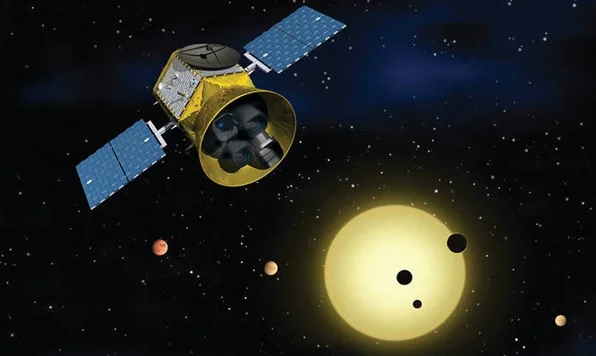
An exoplanet or extrasolar planet is a planet located outside our Solar System. Most known exoplanets orbit stars, although planetary-mass objects can also exist without being gravitationally bound to a star. Exoplanets vary enormously in size, temperature, composition and orbital characteristics. They include:
The ultimate scientific objective is not merely to count these worlds but to understand how planetary systems form, how common Earth-like environments are, and whether conditions suitable for life exist elsewhere.
Because stars are extremely bright and planets are comparatively small and faint, directly observing an exoplanet is difficult. Scientists therefore often detect planets indirectly through their effects on their parent stars.
1. Transit Photometry: When a planet passes between its parent star and a telescope, it blocks a tiny fraction of the star’s light.
2. Radial Velocity or Doppler Method: A planet and its star actually orbit their common centre of mass. Consequently, the planet’s gravity causes the star to make a small periodic wobble. Scientists observe changes in the star’s spectrum:
3. Direct Imaging: Instead of detecting a planet indirectly, scientists sometimes capture light coming from the planet itself. The major difficulty is the enormous brightness of the parent star.
Special instruments such as coronagraphs suppress the star’s light so that faint nearby planets can be studied. NASA’s Roman telescope will carry a Coronagraph Instrument as a technology demonstration, advancing techniques needed for future direct imaging of exoplanets.
4. Gravitational Microlensing: According to Einstein’s theory of general relativity, gravity can bend light.
5. Astrometry: Astrometry measures extremely small changes in the position of a star across the sky. An unseen planet can gravitationally pull its parent star, producing a tiny positional wobble. ESA’s Gaia mission, designed to map stellar positions and motions with extraordinary precision, has made astrometry an important tool for investigating planetary systems.
|
Kepler Space Telescope Agency: NASA |
Spitzer Space Telescope Agency: NASA |
CoRoT Agency: CNES with ESA participation Major Operational Exoplanet Observatories |
|
Hubble Space Telescope Agencies: NASA/ESA |
TESS Full Name: Transiting Exoplanet Survey Satellite |
James Webb Space Telescope Agencies: NASA/ESA/CSA |
|
Mission |
Agency |
Launch |
Main Role |
|
Kepler/K2 |
NASA |
2009 |
Transit-based exoplanet census |
|
TESS |
NASA |
2018 |
Planets around nearby bright stars |
|
CHEOPS |
ESA/Switzerland |
2019 |
Precise characterisation of known planets |
|
JWST |
NASA/ESA/CSA |
2021 |
Atmospheric spectroscopy |
|
Roman |
NASA |
2026 scheduled |
Microlensing + coronagraph demonstration |
|
PLATO |
ESA |
2027 planned |
Terrestrial planets around Sun-like stars |
|
Ariel |
ESA |
2029 planned |
Atmospheric chemical census |
|
HWO |
NASA |
Proposed |
Earth-like planets and potential biosignatures |
Therefore, discovering a planet is much easier than determining whether it actually supports life.
Prelims MCQsQ1. Which of the following space missions primarily uses the transit method to discover exoplanets around nearby bright stars? (a) Gaia Mains Practice Question“Space-based observatories have transformed exoplanet science from the discovery of distant planets to the characterisation of potentially habitable worlds.” Discuss with reference to major current and future space telescope missions. |
1. What is an exoplanet?An exoplanet is a planet located outside our Solar System, generally orbiting another star. 2. Which telescope discovered the most exoplanets historically?NASA’s Kepler/K2 mission revolutionised the field and discovered thousands of exoplanets, with more than 2,600 confirmed discoveries credited to the mission. 3. What is the difference between TESS and JWST?TESS primarily discovers transiting planets around bright nearby stars, whereas JWST is especially powerful for detailed characterisation, including atmospheric spectroscopy. 4. Which upcoming mission will search for Earth-like planets around Sun-like stars?ESA’s PLATO is specifically designed to study terrestrial planets extending into the habitable zones of Sun-like stars. Its current planned launch is March 2027. 5. Have scientists discovered life on an exoplanet?No confirmed extraterrestrial life has been discovered. Scientists can detect atmospheric molecules and investigate potential biosignatures, but such observations require extensive confirmation before they can be interpreted as evidence of life |



Our support team will be happy to assist you!

 Contact Us
  New Batch : 9555124124/ 7428085757
  Tech Support : 9555124124/ 7428085757