Special Intensive Revision

(Prelims: Indian Polity and Governance - Constitution, Political System)
(Mains, General Studies Paper 2: Indian Constitution - Historical Underpinnings, Evolution, Features, Amendments, Significant Provisions and Basic Structure, Separation of Powers among Various Components, Dispute Redressal Mechanisms and Institutions)

Context

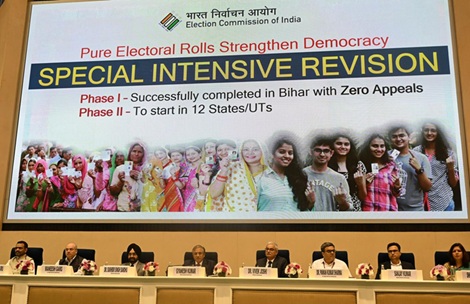
  • The Election Commission of India (ECI) has launched a Special Intensive Revision (SIR) of electoral rolls covering 51 crore voters in 12 states and union territories to ensure the accuracy and correctness of electoral rolls.
  • This is the first nationwide SIR since 2002-2005, aimed at eliminating duplicate, migrated, or ineligible entries (voters) and verifying voter eligibility.

Background and Significance

Evolution of SIR

  • The ECI The ECI order (June 2025) makes it mandatory for all registered voters to fill out new enumeration forms, while voters added after the last thorough revision (2002-2005) will have to submit eligibility and citizenship documents.
  • The first phase began in Bihar, where assembly elections are being held. It served as a pilot model for future nationwide implementation.

Constitutional and Legal Basis

  • The ECI cited Article 326 of the Constitution to justify the confirmation of eligibility (not the cancellation of citizenship).
  • The process is governed by the Representation of the People Act, 1950. It ensures free and fair elections, one of the fundamental features of the Constitution.

SIR The Need for

  • Political parties have repeatedly complained about "inaccuracies" in the voter list:
  • Migration and multiple registrations
  • Non-removal of dead voters
  • Incorrect inclusion of non-citizens
  • The SIR has been conducted eight times since 1951, and the last thorough revision was between 2002-2005, after  which only summary revisions have been conducted.

Current SIR Coverage and Implementation

  • States and Union Territories Covered: The SIR will be conducted in Andaman and Nicobar Islands, Chhattisgarh, Goa, Gujarat, Kerala, Lakshadweep, Madhya Pradesh, Puducherry, Rajasthan, Tamil Nadu, Uttar Pradesh, and West Bengal.
  • Key Dates:
    • Enumeration Period: Beginning November 4, 2025
    • Draft Roll Publication: December 9, 2025
    • Final Roll Publication: February 7, 2026
  • Excluded States: Assam has been excluded due to the ongoing NRC process and separate provisions of the Citizenship Act.

Operational Details

Enumeration Process

  • 5.33 lakh Booth Level Officers (BLOs) will conduct door-to-door verification.
  • All voters must submit enumeration forms by December 4 to remain on the draft roll.
  •  Eligibility proof is required for those whose names are not included in the SIR roll for the years 2002-2005.

Accepted Documents

  • 13 types of documents are accepted, including Aadhaar and extracts from the SIR roll of Bihar.
  • Aadhaar will be used only for identity verification, not for citizenship proof.
  • Voters born after July 1, 1987, will be required to provide proof of parental eligibility.

Special Cases and Administrative Coordination

Bihar Experience

  • Bihar's SIR ended on September 30, 2025, with the number of voters declining by 6% to 74.2 million.
  • No appeals were filed against the decisions of the Electoral Registration Officer (ERO).
  • This model will guide the second phase of the SIR.

State-Specific Considerations

  • Migration to urban areas like Delhi and Chandigarh has led to lower engagement with the older population.
  • Weather conditions and local body elections also influenced state selection and timelines.

Challenges and Related Controversies

  • Legal Challenge: The Supreme Court is hearing petitions questioning:
    • The ECI's authority to verify the citizenship of registered voters
    • The process followed in Bihar's SIR
  • Political Opposition:
    • The Chief Minister of West Bengal has called it a "backdoor NRC."
    • However, the ECI maintains that constitutional bodies will perform their respective roles independently.
  • Administrative: Strict deadlines and document verification could burden BLOs and EROs.
  • Social: Citizens risk being disenfranchised if they lack documentary proof.

Way Forward

  • Transparency and Technology: Using voter portals to help citizens locate outdated voter list entries
  • Electoral Inclusiveness: Clean voter lists can reduce fraudulent voting and increase public confidence.
  • Awareness Campaigns: Ensuring public participation and timely documentation
  • Data Synchronization: Integrating digital databases to prevent duplication
  • Periodic SIRs: Institutionalizing regular in-depth revisions to maintain credibility
  • Stakeholder Engagement: Institutionalizing consultations with political parties, civil society, and local administrations before implementation
    • Legal Clarity: Seeking guidance from the Supreme Court to define the ECI's powers under Article 326 and the Representation of the People Act, 1950.
    • Facilitating Document Access: Simplifying and digitizing the process of submitting eligibility proof, especially in rural and migrant-heavy areas.
  • Phased implementation: Instead of implementing it across the country at one go, it will be implemented gradually state-by-state.

Conclusion

  • SIR of voter lists is a major administrative reform to restore public confidence in the electoral process.
  • By verifying eligibility and updating voter lists, the Election Commission aims to strengthen democratic legitimacy.
  • However, political concerns and legal scrutiny highlight the delicate balance between ensuring voter integrity and protecting voter rights.

Download Free Study Material

Enter your details to download the PDF.

Verify once. Download for 7 days. Your details are used for download access and verification.