Prelims: Environment, Environmental Impact Assessment (EIA), Environment (Protection) Act, 1986, Supreme Court Judgments
Mains: GS Paper III – Environment, Environmental Governance, Sustainable Development, Judicial Activism
Keywords: Ex-Post Facto Environmental Clearance, Supreme Court, EIA Notification 2006, Environment Protection Act 1986, Public Interest Test, Office Memorandum, Vanashakti Case, Environmental Jurisprudence |
Why in News?
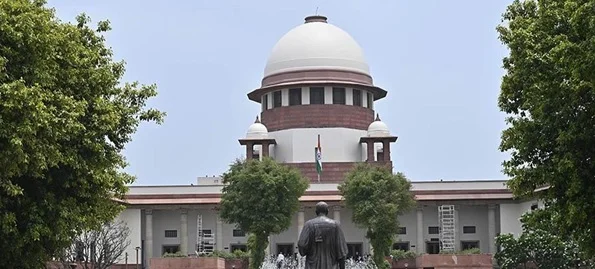
The Supreme Court has quashed the Environment Ministry's July 2021 Office Memorandum (OM) that allowed ex-post facto (retrospective) Environmental Clearances (ECs) for projects that had begun without prior approval.
Important Points
- The Court held that an Office Memorandum (OM) cannot create a legal mechanism for granting ex-post facto Environmental Clearances.
- A statutory notification issued under the Environment (Protection) Act, 1986 may allow a one-time, narrowly tailored amnesty only in exceptional circumstances.
- Any future regularisation must satisfy the Supreme Court's "Public Interest Test" and cannot become a permanent mechanism.
- The judgment strengthens the Precautionary Principle and reinforces that prior Environmental Clearance remains the legal requirement under the EIA Notification, 2006.
What is Ex-Post Facto Environmental Clearance?
- An Ex-Post Facto Environmental Clearance (EC) is an approval granted after a project has already commenced construction or operations, instead of obtaining permission before starting work.
- Under India's Environmental Impact Assessment (EIA) Notification, 2006, prior environmental clearance is mandatory for specified projects before any construction or expansion begins.
What Did the Supreme Court Hold?
The Court adopted a balanced approach by distinguishing between executive instructions and statutory powers.
Key Observations
- The 2021 Office Memorandum (OM) has been declared invalid.
- An Office Memorandum cannot create a legal mechanism for regularising environmental violations.
- The Centre cannot provide a permanent or continuous amnesty for projects violating environmental laws.
- However, Parliament has delegated powers under the Environment (Protection) Act, 1986, allowing the government to issue statutory notifications in exceptional situations.
- Therefore, a narrowly tailored one-time amnesty may be permissible only if justified by overriding public interest.
- Every future scheme must satisfy the Supreme Court's "Public Interest Test."
Difference between Office Memorandum and Statutory Notification
|
Office Memorandum (OM)
|
Statutory Notification
|
|
Administrative instruction
|
Issued under statutory authority
|
|
Does not have force of law
|
Has legal force
|
|
Cannot create new legal rights
|
Can create legally enforceable mechanisms
|
|
Easily modified by ministry
|
Governed by delegated legislation
|
Background of the Case
March 2017 Notification
- Environment Ministry issued a one-time six-month amnesty.
- Allowed projects that had violated environmental norms to disclose violations.
- Required environmental assessment and legal action where necessary.
July 2021 Office Memorandum
- Introduced a Standard Operating Procedure (SOP) for granting ex-post facto ECs on a continuing basis.
- Effectively created a permanent regularisation mechanism for violation cases.
The Supreme Court has now ruled that this continuing mechanism is unconstitutional.
Evolution of Supreme Court's Stand
Common Cause v. Union of India (2017)
- Mining projects cannot begin without prior environmental clearance.
- Environmental assessment must occur before environmental damage takes place.
Alembic Pharmaceuticals v. Rohit Prajapati (2020)
- Ex-post facto EC violates the Precautionary Principle.
- Environmental protection cannot become an afterthought.
Pahwa Plastics v. Dastak (2022)
- Closure is not always the best solution.
- In some cases, regulation and environmental restoration may better serve public interest.
Vanashakti Case (2025–2026)
- Initial 2025 judgment completely prohibited ex-post facto EC.
- Review petition led to reconsideration.
- Final judgment now allows only a limited statutory amnesty in exceptional public-interest situations while rejecting blanket regularisation.
Public Interest Test Introduced by the Supreme Court
The Court held that any future amnesty scheme must satisfy the following conditions:
- It should be exceptional, not routine.
- It should be one-time and narrowly tailored.
- It must be based on public interest, not convenience of project developers.
- It must be introduced through a statutory notification, not an Office Memorandum.
- Environmental assessment and accountability cannot be bypassed.
Why is the Judgment Important?
- Reinforces the Precautionary Principle in environmental governance.
- Prevents misuse of retrospective approvals.
- Protects forests, biodiversity, rivers and local communities.
- Clarifies limits of executive power.
- Balances environmental protection with genuine developmental needs.
Constitutional & Legal Provisions
- Article 21 – Right to Life (includes Right to a Healthy Environment)
- Article 48A – Protection and Improvement of Environment
- Article 51A(g) – Fundamental Duty to Protect Environment
- Environment (Protection) Act, 1986
- Environmental Impact Assessment (EIA) Notification, 2006
UPSC Prelims MCQ
Q. With reference to Ex-Post Facto Environmental Clearance in India, consider the following statements:
- It allows environmental clearance after a project has already commenced.
- The Supreme Court has held that an Office Memorandum can permanently regularise environmental violations.
- The Environment (Protection) Act, 1986 empowers the government to issue statutory notifications.
Which of the statements given above is/are correct?
A. 1 and 3 only
B. 2 and 3 only
C. 1 and 2 only
D. 1, 2 and 3
Mains Practice Question
"Environmental governance requires balancing ecological protection with developmental needs." In light of the Supreme Court's judgment on Ex-Post Facto Environmental Clearances, examine the evolving environmental jurisprudence in India.
|
FAQs
Q1. What is Ex-Post Facto Environmental Clearance?
It is an environmental approval granted after a project has already started construction or operations.
Q2. Why did the Supreme Court strike down the 2021 Office Memorandum?
Because an administrative Office Memorandum cannot legally create a permanent mechanism for regularising environmental violations.
Q3. Has the Supreme Court completely banned Ex-Post Facto Environmental Clearances?
No. It has allowed the possibility of a limited statutory amnesty only in exceptional cases involving genuine public interest.
Q4. What is the Public Interest Test?
Any future amnesty must be narrowly tailored, exceptional, legally authorised through a statutory notification, and genuinely serve public interest rather than private commercial interests.
Q5. Which law governs Environmental Clearances in India?
The Environment (Protection) Act, 1986 and the Environmental Impact Assessment (EIA) Notification, 2006 govern the environmental clearance process.
|






 Contact Us
  New Batch : 9555124124/ 7428085757
  Tech Support : 9555124124/ 7428085757